Senate Environment and Public Works ranking member Sheldon Whitehouse, D-R.I., said Thursday that the process of papering, selling and voting on a potential deal to take up legislation overhauling the federal permitting system will likely push consideration to the lame-duck session in November.
Speaking at a news conference, Whitehouse said that negotiators are “over the hump on the deal-break issues” and that text of a deal “should be finalized within a matter of days, maybe even hours.” Once text is released, Whitehouse added, senators will need a chance to take a look at the legislation and seek feedback from “major stakeholders.”

“This was a pretty close hold, even within EPW, and luckily, the hold worked. But it does mean that colleagues looking at this for the first time need the assurance, like in any bill, that there is going to be some process through which their views can be considered,” Whitehouse said. “So that process is going to continue. It is completely ordinary Senate procedure.”
This would include providing feedback that could be incorporated into a manager’s amendment, Whitehouse said, and if their feedback is rejected a chance to make their case on the Senate floor.
Whitehouse’s comments come a day after Energy and Natural Resources ranking member Martin Heinrich, D-N.M. — another member of the team working out the deal — said he was looking for a “by-the-book, regular order kind of process.”
The permitting overhaul debate has been a bipartisan endeavor — with Senate Environment and Public Works Chairman Shelley Moore Capito, R-W.Va., and Energy and Natural Resources Chairman Mike Lee, R-Utah, leading the charge for their caucus.
‘Caught the car’
Senate Majority Leader John Thune, R-S.D., criticized Democrats on Thursday, arguing that the extended debate over a permitting overhaul is “the most visible and recent manifestation of the fact that you can give them everything they want and just drag it out.”
In a floor speech, Thune said Republicans and the White House had “closed the deal” on legislation that “incorporated essentially all” of the Democrats’ asks.
“But when it began to look like we could consider the bill this work period, Democrats changed their tune. Because while they may acknowledge the need for permitting reform, what they really care about is denying Republicans another legislative win,” Thune said. “Democrats can’t take yes for an answer. It’s like they caught the car, Mr. President, and they don’t know what to do.”
Thune said the Senate will likely be in next week as scheduled, where it may consider a bill that would require states to consider adopting standards to address data center costs for electricity ratepayers.
Efforts to overhaul the federal permitting system have been ongoing for decades, but gained new salience in the last few years, with the most current talks on the issue running back to 2022.
The eventual bill is expected to make major updates to the process by which energy infrastructure projects — ranging from oil refineries to wind and solar farms — are evaluated under laws like the National Environmental Policy Act. Lawmakers have spent years working through issues including judicial review periods and agency deadlines related to those evaluations.
Some environmental groups have urged Democrats to go slow on a possible permitting bill, in part because they may make big electoral gains in November. And they don’t trust the Trump White House to treat fossil fuel and renewable energy projects evenly.
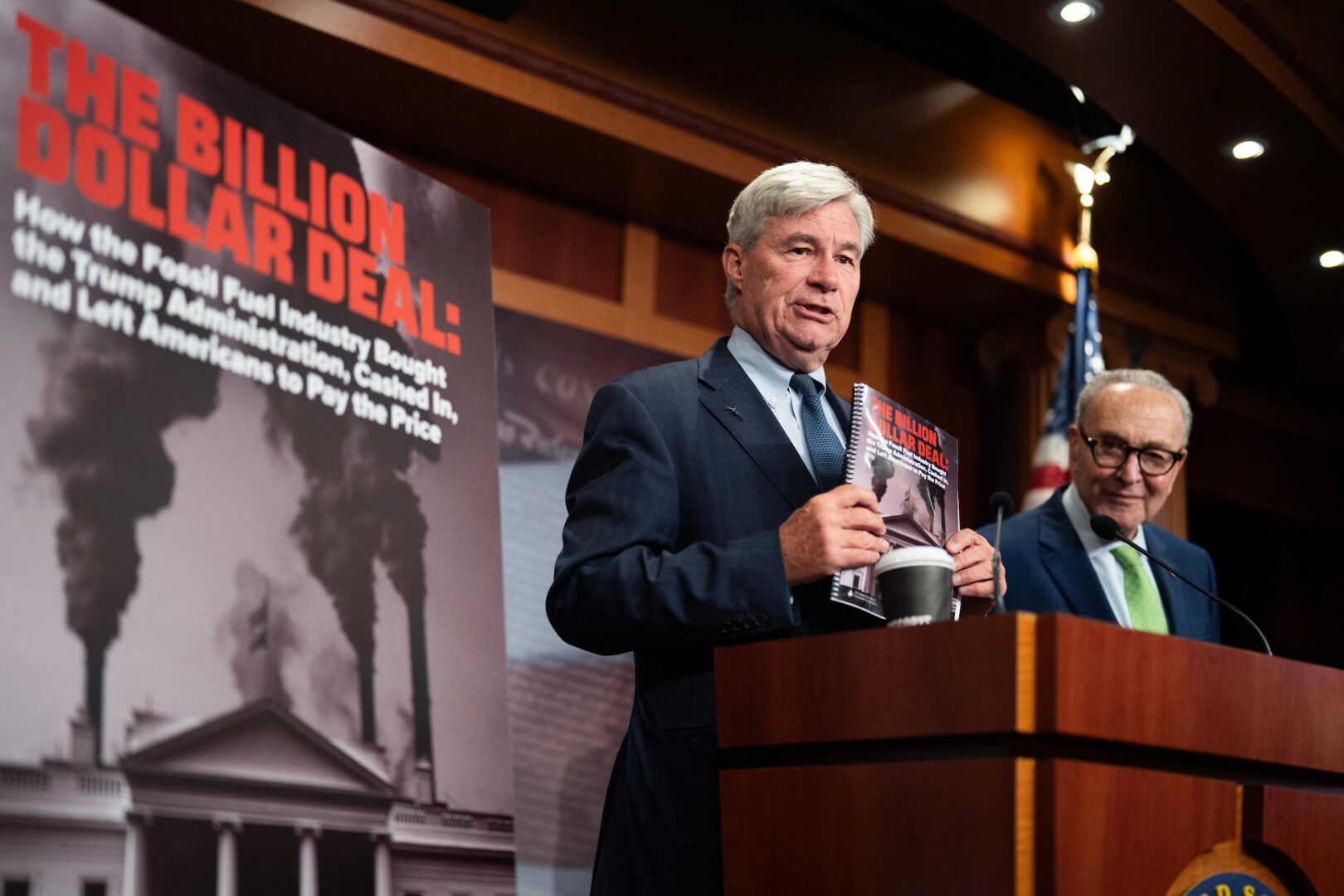
Whitehouse appeared at a news conference Thursday with Senate Minority Leader Charles E. Schumer, D-N.Y., to tout a new 79-page staff report detailing the relationship between fossil fuel companies, Trump and Republicans in the lead-up to the 2024 elections and the legislative benefits that followed in this Congress.
“By Election Day, oil and gas executives, their corporate PACs, and the dark-money organizations they fund had contributed an estimated $201 million to support Donald Trump and allied Republican lawmakers through direct donations and ad spending,” the report said, plus $19 million for inauguration support.
Earlier Thursday, Whitehouse told reporters that some elements of the text are still being worked out.
A major point of disagreement between Democrats and the Trump administration has been whether the latter will allow wind and solar energy projects to move forward.
“We’re waiting for a clearer explanation from the administration of what a return to regular order for wind and solar permitting looks like,” Whitehouse said.
A White House spokesperson wasn’t immediately available for comment.
He said the administration has made “some specific proposals” on those terms, but, “some are still so general that we don’t know what we’re getting.” Whitehouse added he would need to explain those details to the Democratic caucus.
Still, he said the absence of the House, and understanding that the chamber is unlikely to return before the election, has hampered prospects and made a post-election vote a better scenario.
Meanwhile, Whitehouse said the Senate is out of time needed for a regular-order debate and vote, and is contending with “the desire for Republican senators to get the hell out of here ASAP.”
Savannah Berhmann contributed to this report.