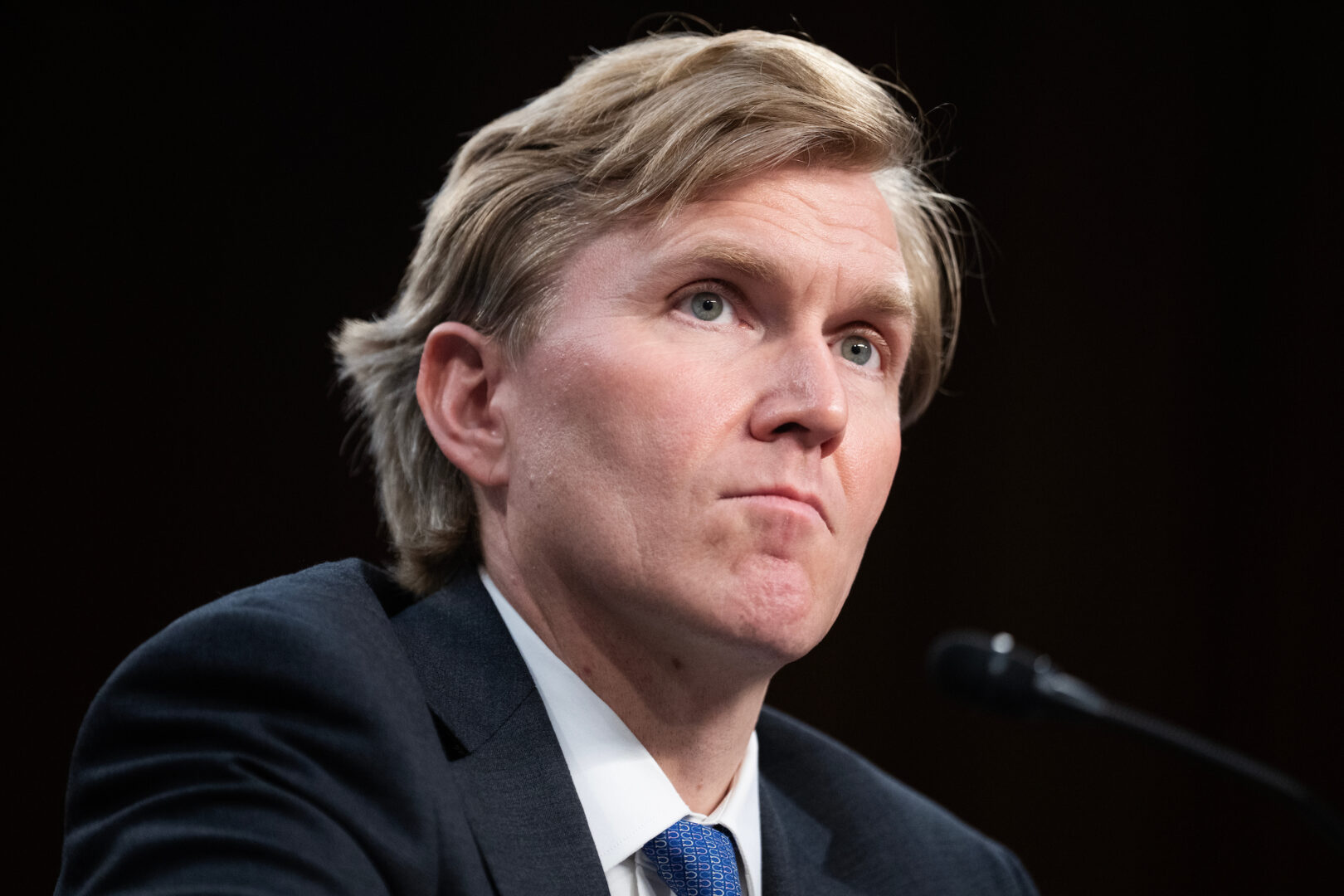
Senators from both parties emerged from a classified briefing with the Pentagon’s policy chief on Thursday morning expressing outrage at what they described as the official’s stonewalling.
The stated purpose of the briefing by Elbridge Colby, the undersecretary of Defense for policy, was to update the Senate Armed Services Committee on implementation of the National Defense Strategy, which was released in January.

But Colby did not have an opening statement on the strategy or much of anything else to say on the topic, Sen. Kevin Cramer said after the meeting.
“The most telling thing I can tell you is that he didn’t have an opening statement, and he’s there to give us an update,” Cramer, R-N.D., said. “That seemed weird. You’re the policy undersecretary and you come before the Armed Services Committee and you don’t have an opening statement? That seemed contemptuous.”
Colby also did not answer questions he clearly was able to answer about critical topics, said Sen. Tim Kaine, D-Va.
“There were some pretty important questions that Secretary Colby is capable of answering with a yes or a no and was unwilling to do so,” Kaine said. “When you ask somebody a question of, ‘Have you been involved in discussions about X’ [the answer was], ‘I’ll have to get back to you in writing.’ And some of the Xs that were asked about were very consequential.”
Although discussion of the defense strategy was the official purpose of the meeting, the Iran war was a major focus, senators said.
The Trump administration’s plan for what comes next in that conflict was one of the unanswered questions irking senators, Sen. Mark Kelly, D-Ariz., suggested.
“When you don’t have a strategic goal, it’s very difficult to come up with a plan, and when you don’t have a plan, you can’t figure out what the target set is,” Kelly said.
He suggested that is why the Pentagon struck 14,000 to 16,000 targets in Iran, including some civilian ones.
“That’s why we’ve got a munitions problem,” Kelly said.
Sen. Eric Schmitt, R-Mo., faulted Democrats for how they treated Colby in the briefing.
“I would say that the level of disrespect shown to the secretary by my Democratic colleagues was 10 out of 10,” Schmitt said.
But other senators from both parties said Colby deserved the pointed responses.
“I think the dissatisfaction expressed on both sides of the aisle for his seemingly evasive answers was far from disrespect,” said Sen. Richard Blumenthal, D-Conn. “It was simply a demand for truthful, forthcoming answers.”
The contentious meeting came as the Trump administration’s $1.5 trillion fiscal 2027 defense budget proposal and its $67.1 billion supplemental request, which is mostly but not entirely slated for paying war bills, are stuck in legislative limbo until mid November at the earliest.
Long-running tensions
Colby has a troubled history with the defense oversight panels.
Last November, frustrations with Colby erupted into the open at a Senate Armed Services Committee hearing.
“You know who the hardest guy to get a hold of in the Trump administration is? The undersecretary of Defense for policy,” said Sen. Dan Sullivan, R-Alaska, at that hearing. “It’s frustrating when on the DOD stuff, especially on the policy stuff, on big decisions, we’re not getting anything. And we’re not. We’re not. Trust me, I’ve been trying.”
A similar scene played out at a House Armed Services Committee hearing in March, when Rep. Mike D. Rogers, R-Ala., the panel’s chairman, accused Colby of misleading Congress and neglecting to consult lawmakers on major military moves.
Ironically, the official subject of the March House hearing was the same as Thursday’s briefing: the National Defense Strategy.
The bipartisan senatorial anger shown after Colby’s latest appearance before them suggests the relationship may not have improved in the last several months.
Since the March hearing, the Iran war has waxed and waned in intensity, and its resolution still appears far off.
The unresolved questions that Kelly cited about the path forward in that conflict may have added tensions to the relationship between Colby and senators that was already strained back in March.
“Right now, I don’t think any of us are happy with the amount of information being shared by the administration,” said Sen. Mike Rounds, R-S.D., said after Thursday’s briefing with Colby.
‘Basic information’
Also on Thursday, nearly every Senate Democrat pressed Defense Secretary Pete Hegseth to provide lawmakers with “basic information” about the Pentagon’s Iran war costs.
“Despite your stated needs, you have repeatedly refused to share basic information that previous administrations, Republican and Democratic, provided to the American public and Congress during times of war,” the Democrats wrote in a letter to Hegseth on Thursday.
“Congress must have access to this information to carry out our oversight responsibilities. It is the bare minimum that any American would expect in balancing their own household budget,” they added.
The letter was organized by Sen. Elissa Slotkin, D-Mich, a Senate Armed Services Committee member and former Defense Department civilian, and co-signed by every Senate Democrat except Sen. John Fetterman, D-Pa.
Lawmakers have knocked the administration’s supplemental funding request for a lack of details. And none of the cost estimates account for repairs to the damaged facilities as officials weigh the future of the U.S. military footprint in the region.
Additionally, the Pentagon has yet to spend billions of dollars from the reconciliation law that Congress passed last year.
The letter sent Thursday asks Hegseth to unpack the budget tangle for them by Sept. 30.
Specifically, the letter requests a “detailed breakdown” of war costs, including damage to military installations, cost to refurbish deployed ships and expected benefits for veterans.
It also asks for a detailed accounting of what parts of the supplemental request are intended to cover costs already incurred, what would fund expected future operations and what parts are unrelated to military operations against Iran.
Finally, the letter asks for a full breakdown of how the $34 billion remaining from last year’s reconciliation bill will be spent, including whether anything will be used to support the war.
Rebecca Kheel contributed to this report.