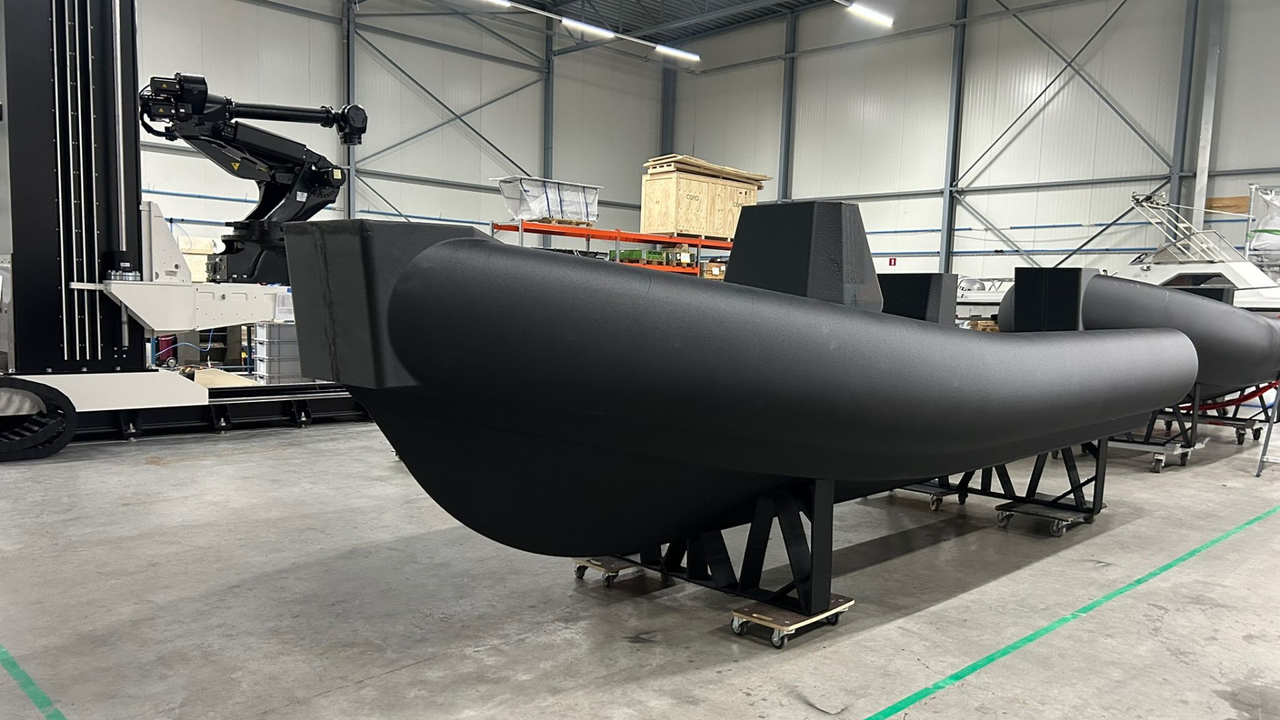
A Hawaii-based startup has just submitted a six-meter 3D-printed boat for consideration by the Pentagon. According to 3D Printing Industry, Voltage Vessels used a CEAD large-format additive manufacturing system to build the rigid hull inflatable boat (RHIB), which makes it easier to manufacture at forward locations. So, instead of relying on a 6,545-mile logistics supply chain (the distance between Naha Airport in Okinawa and San Diego International Airport), naval forces can just 3D print these boats from digital files as needed.
Voltage is also using another novel breakthrough in the material for its 3D-printed boats. Instead of relying on traditional fiberglass and plastic construction, these boats are printed using recycled PETG plastic combined with chopped basalt fiber. This material has significantly higher tensile strength compared to the HDPro material currently used by CEAD 3D printers for maritime use. More importantly, the basaltic material, which the company calls Eclipse X9, has no electrical conductivity. Although its transparency for specific radio frequencies is still being evaluated, it theoretically has the advantage of reducing its radar cross section (RCS), as well as avoiding interference with the various signals that autonomous naval systems rely on.