Get all your news in one place.
100's of premium titles.
One app.
Start reading
The Independent UK
The Independent UK
Lisa Mascaro and Ben Finley

Pentagon admits talks over sending National Guard to polling stations

Friction is mounting between Congress and the Pentagon over the flow of information regarding American military priorities, with lawmakers across party lines accusing a senior defense official of opacity.

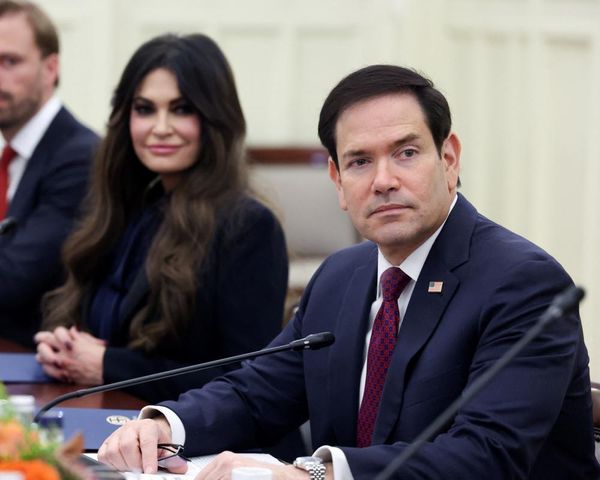
Members of the Senate expressed deep concern on Thursday after the Pentagon's top policy adviser, Defense Undersecretary Elbridge Colby, failed to deliver an expected status update on the Trump administration's National Defense Strategy during a classified session.

Legislators also reported being unsatisfied with Colby's responses to questions concerning the ongoing Iran war and potential plans to place troops at voting stations during November’s midterm congressional elections. Colby acknowledged that conversations about deploying the National Guard had occurred.

Sen. Jacky Rosen, a Nevada Democrat on the Senate Armed Services Committee, stated that Colby "was not forthcoming" and "did not really address our concerns or issues."

North Dakota Republican Sen. Kevin Cramer, who also sits on the committee, described the confidential session as "just sort of dodge and punt."

"It’s very peculiar to have somebody come in for a congressionally mandated update and not have a statement," Cramer said.

Colby was scheduled to present a mandatory briefing on the National Defense Strategy, a major document that establishes military direction.

President Donald Trump said he is weighing whether to 'annihilate' Iran in comments earlier this week (Getty Images)

Published in January, the framework aligns with President Donald Trump’s "America First" doctrine, which emphasizes overseas nonintervention while questioning long-standing security arrangements with European partners.

Under the statutory terms of the annual National Defense Authorization Act passed by Congress, the Defense Department must present the Senate Armed Services Committee with a classified update on the strategy's implementation no later than Sept. 15.

"It was not what we had expected," said South Dakota Republican Sen. Mike Rounds.

"Let’s just put it that way," Rounds added. "They owe us a report, and we did not get the report."

Democratic Sen. Mark Kelly of Arizona noted that he raised questions about the strategy in Iran and the decision-making that led to what he described as a "munitions deficit."

Democratic Sen. Mark Kelly of Arizona noted that he raised questions about the strategy in Iran and the decision-making that led to what he described as a

Industry specialists estimate defense contractors will require roughly three years to replenish depleted stocks of specific advanced hardware, such as defensive missile interceptors.

"You walk out with more questions than when you went in, and for me, that was the case today," Kelly said.

During the briefing, Colby was asked directly whether he had participated in conversations about deploying National Guard troops for voter security on Election Day. Colby told senators he was aware of such discussions, though he was not leading the effort.

"Never once said ‘yes’ or ‘no,’" Cramer said.

The prospect of troop deployments at polls has drawn heightened scrutiny ahead of the midterms. Sen. Elissa Slotkin, D-Mich., recently sought explicit assurances from Defense Secretary Pete Hegseth and Gen. Dan Caine, chairman of the Joint Chiefs of Staff, that forces would not be sent to polling sites.

In a written response to Slotkin last month, Caine stated there are "no plans to send Federal military personnel or Federalized members of the National Guard to polling places during the 2026 elections."

Thursday's session did not draw uniform criticism from all attendees.

Sen. Jim Banks, R-Ind., described the briefing as "constructive, substantive" and said it "answered all my questions."

When asked whether he was satisfied with the presentation, Mississippi Republican Sen. Roger Wicker, chairman of the Senate Armed Services Committee, declined to detail the classified proceedings.

"You understand," Wicker said.

Sign up to read this article
Read news from 100's of titles, curated specifically for you.
Already a member? Sign in here
Related Stories
Top stories on inkl right now
One subscription that gives you access to news from hundreds of sites
Already a member? Sign in here
Our Picks
Fourteen days free
Download the app
One app. One membership.
100+ trusted global sources.