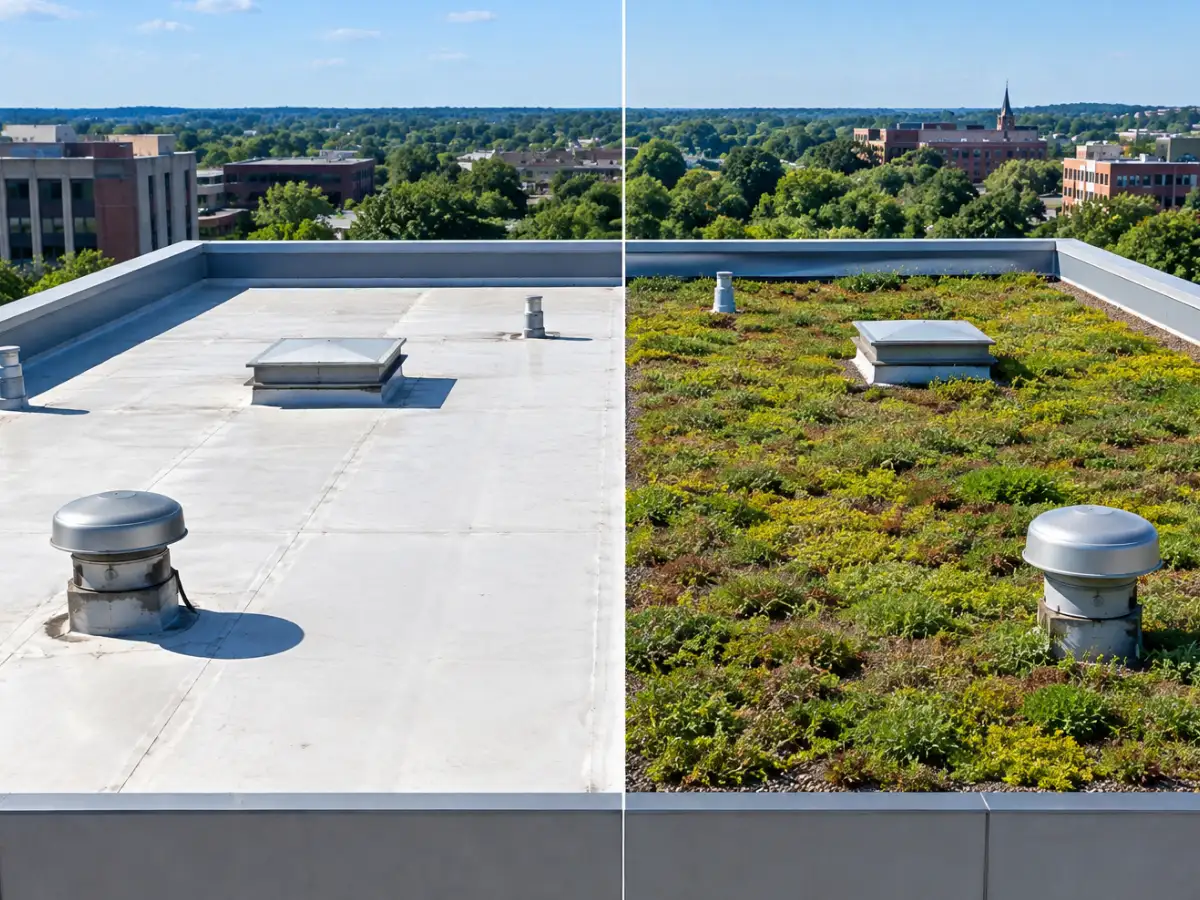
A week in June 2002 produced a stark comparison for two test roofs at Penn State. Researchers at the Penn State Center for Green Roof Research monitored two identical roofs, one covered with a plain waterproofing membrane and the other covered with plants. One bare roof reached almost 70 degrees Celsius in the summer sun. At the same time, the membrane beneath the plants stayed near 30 degrees Celsius, a few degrees below the surrounding air temperature, according to the center's monitoring data.
A bare roof turns into a heat trap without shade or moisture
A typical roof absorbs a lot of heat when the sun comes out. Dark membranes and shingles absorb solar radiation, and the only way to escape the heat is to warm the building below and the air above. The Penn State team found the same pattern in another test on a hot day. With the air at about 32 degrees Celsius, an exposed black plastic surface reached about 63 degrees Celsius, while sedum plants on a green roof stayed near 28 degrees Celsius.
A green roof breaks that pattern through evapotranspiration. The US Environmental Protection Agency has observed the same effect nationwide. Their findings suggest that green roofs provide shade, cool the air, and lower temperatures in both the roof surface and the surrounding air. In contrast, conventional rooftop surfaces may exceed the air temperature.
The heat gap reaches the room below, not just the roof
Roof temperature does not stay on the roof. It moves into the ceiling and the rooms below. In the same June 2002 test, the average interior temperatures of buildings with bare roofs soared past 40 degrees Celsius, while the green-roofed buildings kept interior temperatures close to the outside air for most of the period.