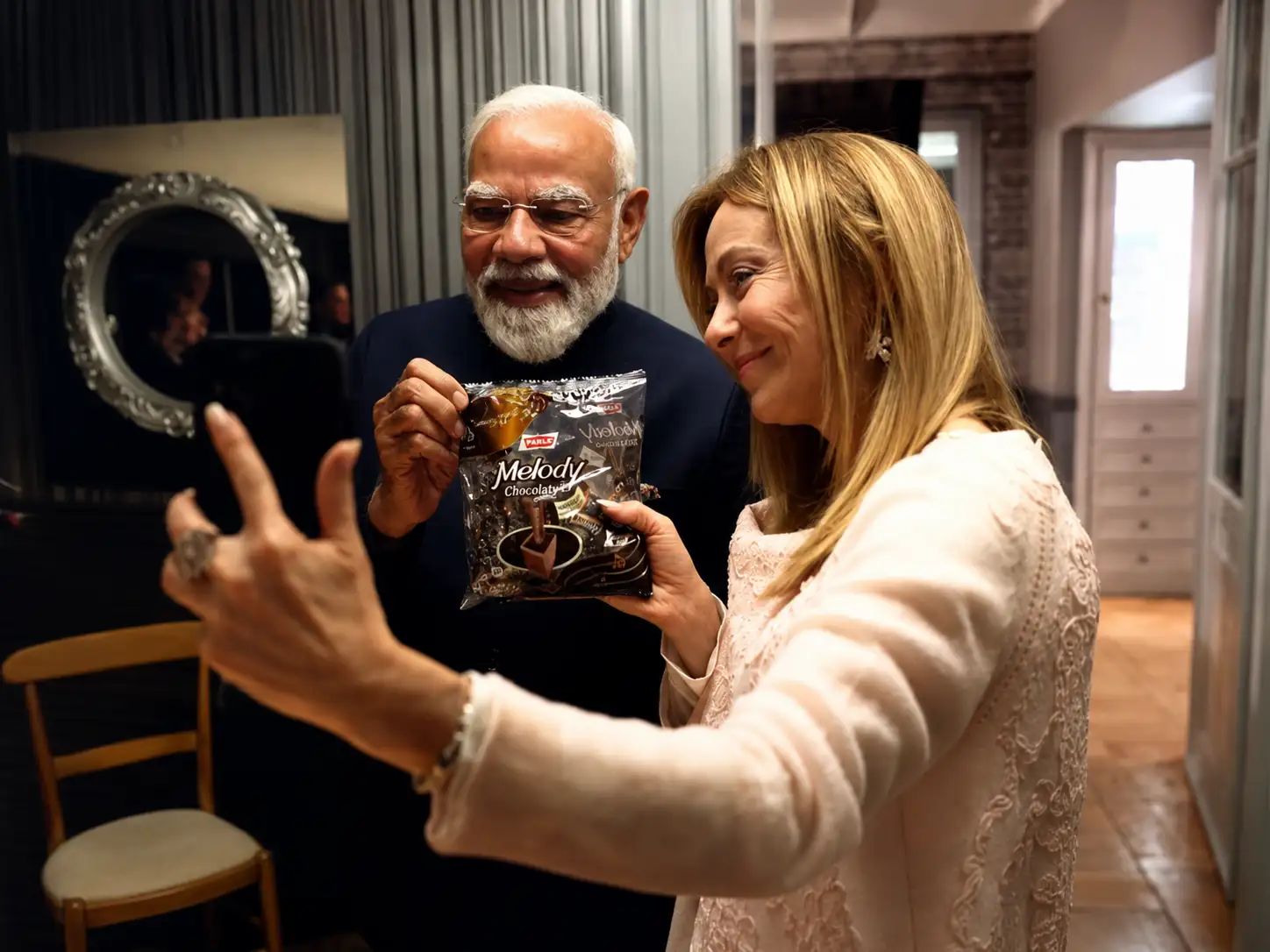
When Narendra Modi handed a packet of Parle’s Melody toffee to Italian Prime Minister Giorgia Meloni in Rome on May 20, the moment looked like a playful internet joke that had suddenly broken the boundaries of social media and entered diplomacy. Why is Parle Melody so chocolaty? That’s a question the brand had positioned and is a popular tag for the toffee. However, Melody has become an answer to questions about India’s rising export and production story in a symbolic manner.
The “Melodi” meme, born from a combination of the two leaders’ surnames, has been amplified online since the G20 summit in 2023. Meloni laughed on camera and called it a “very, very good toffee” as the clip spread rapidly across platforms.

But beneath lies a larger business and economic story of India, even as India’s opposition party leader Rahul Gandhi called it a gimmick and not leadership.
Also Read: PM Modi’s Melody gift to Meloni boosts Parle buzz
Countries once exchanged luxury watches, rare artefacts and expensive wines to project national identity. India’s prime minister instead chose a caramel toffee sold in neighbourhood shops for ₹1, a product recognised by generations of Indians across cities, villages and citizens from all income groups. For many Indians, Melody is not merely confectionery, but it’s a memory wrapped in golden packaging. That says something about modern India’s confidence in its own mass-market culture.
From Mumbai factory floors to India’s memory bank
Parle Products, maker of Melody, is one of India’s oldest and most recognisable consumer goods companies. Founded in 1929, the Mumbai-based group built its empire not through premium branding but through affordability and scale.
Parle also gave India its most loved biscuit, Parle-G. A swadeshi biscuit of independent India, It has accompanied the nation on its journey since then.
Its products travelled through India long before organised retail chains arrived or quick-commerce players delivered to you in 10 minutes. Melody, Parle-G, Poppins and Mango Bite adorn the kirana stores, railway stations and school canteens.
Indians across generations immediately understood the cultural reference when Modi gave Meloni a Melody toffee, even as Indian consumers are also tasting imported chocolates such as Ferrero Rocher. Perhaps, that is the larger shift underway. India is beginning to project not only its elite heritage to the world, but also its everyday consumer identity while the Make in India and make for the world ambitions gain more strength.
The Melody moment was such that shares of Parle Industries, an unrelated small-cap company with no connection to Parle Products, hit the upper circuit on the BSE following the viral episode. It was not clear what drove the move.
Also Read: Parle Industries shares hit 5% upper circuit after PM Modi's 'Melody' gift to Meloni
The moment also spilled into corporate branding campaigns, with Air India posting on X: “Some places don’t need introductions, just the right melody,” underscoring how the Modi-Meloni Melody exchange quickly evolved from a diplomatic gesture into a marketing moment for Indian brands.
The rise of India’s ₹1 soft-power economy
For decades, countries exported influence through luxury or premium products. France had luxury fashion and champagne. Switzerland built symbolic power through watches. Japan turned electronics, anime and convenience-store culture into global industries. South Korea transformed K-pop and beauty products into economic weapons.
India’s soft power traditionally travelled through yoga, spirituality, classical arts and later Bollywood.
Now the symbols are changing.