
Paris-Roubaix is nearly upon us, and for bike tech nerds, it’s arguably the biggest race of the year, surpassing the Tour de France in terms of innovations of interest, and perhaps is only rivalled by the Critérium du Dauphiné (or the Tour Auvergne-Rhône-Alpes, to give it its new name) in terms of cool things to see.
This year will be my third in a row covering the Hell of the North, and the previous two years have definitely seen some well-established trends. Aero bikes are now the norm, and while the days of dedicated Roubaix bikes are behind us, thanks to the advent of disc brakes allowing wider tyre clearances, advances in our understanding of rolling resistance have seen some teams buck this trend and opt for endurance or even gravel bikes.

Based on a combination of previous experience and the rumour mill, the predictions I think are a mix of safe bets and a few outlandish ones at the bottom, primarily so that if they come to pass, I look like some sort of cobble-oracle.
Wider tyres everywhere

This is hardly breaking news, but tyres have been getting wider every season over the past several years, both in normal road races and on the cobbles. Plenty of riders are running 30mm tyres as standard now, and on the cobbles, the most common size last year was 32mm, which happened to be the largest size that Continental offered in the GP5000 S TR, and Vittoria offered in the Corsa Pro, the most common race tyres in the bunch. Fred Wright was spotted in 2024 using 35mm GP5000 AS TR tyres, but he was in the minority.
Since then, Continental has launched a 35mm variant of the GP5000 S TR, which was the fastest non-time trial tyre we tested in a recent lab test, and so I expect anyone who can cram it into their frames will be doing so.
Vittoria now offers the Corsa Pro Control, a slightly slower and slightly more durable offering than the standard Corsa Pro in sizes up to a UCI-illegal 42mm, but I don’t expect Visma - Lease a Bike et al to be running these, despite my Visma-related predictions at the end of this article.
You'll have to read our separate story to find out what the widest tyre we expect to see is.
1x everywhere, except for Alpecin

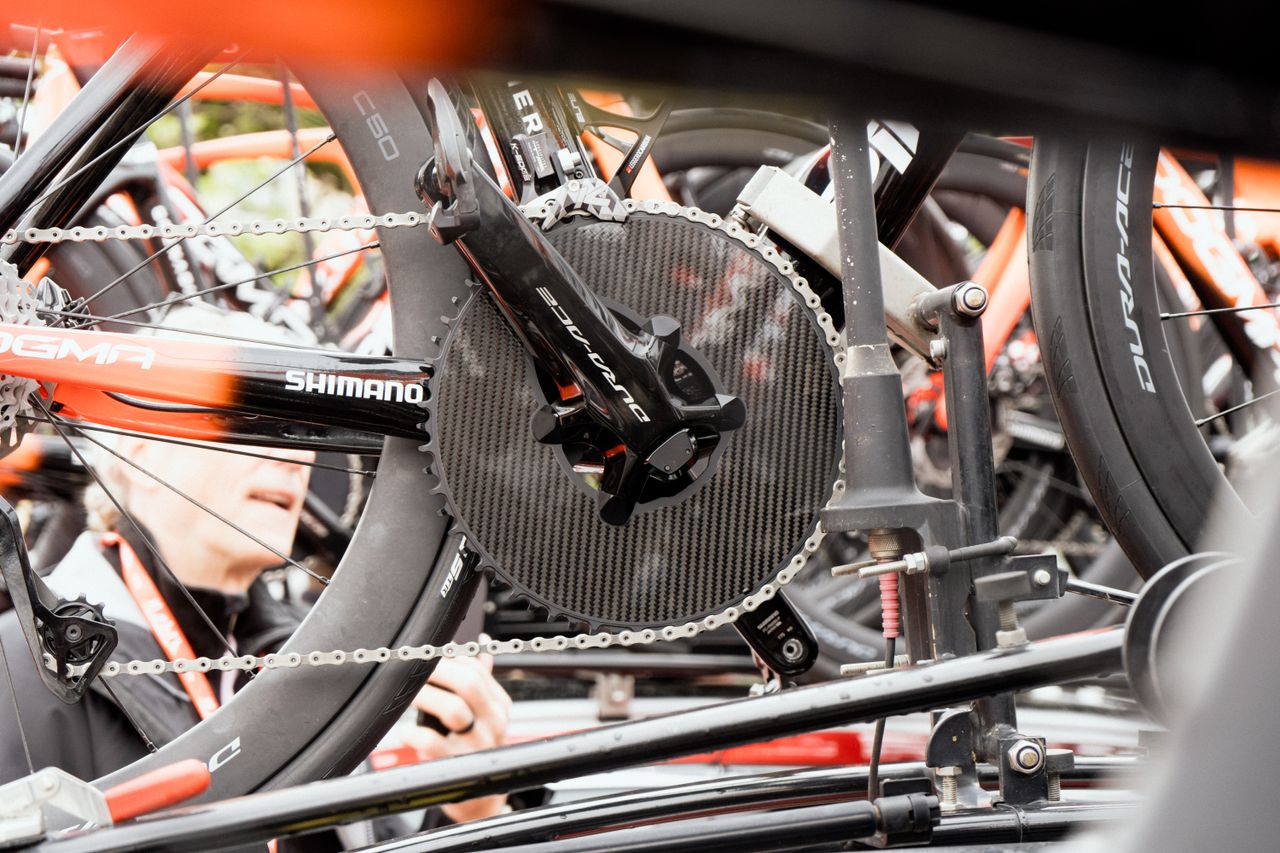
Last year, a great many teams, Shimano-sponsored or SRAM, ran 1x systems. A single front chainring is more aerodynamic, lighter, and given the flat course, the additional range of a smaller inner ring is essentially surplus to requirement. More than that, though, the front derailleur is often more of a rate limiter in terms of tyre capacity than the rear triangle of the frame, and so ditching it altogether allows teams to bolster their tyres up to 35mm and possibly beyond.
I’d be absolutely shocked if any SRAM teams run 2x, especially as last year Lidl-Trek modded their 13sp gravel groupsets to make them 12sp to reduce the gear range even further. Shimano teams technically don’t have a native 1x system available, but they often get around this by using bigger chainrings than Shimano produces, freeing them from sponsor obligations. Tellingly, we saw Tadej Pogačar run a 1x setup for the first time when he took the victory at Milan-San Remo a few weeks ago. This can only be a dry run for Roubaix.
Oddly, I suspect the other big team in terms of contention for the overall victory, Alpecin-Premier Tech, will stick to a 2x setup. The vibe of the team is a lot more old school, and more than that, we’ve seen Mathieu van der Poel doggedly refusing to fit narrower bars and adopt modern trends to get more aero. He won the last two editions of the race on a 2x setup, as well as all of his other professional victories, so why change now, eh?
Mathieu van der Poel will use his old bike

On the subject of being change-averse, I suspect the Flying Dutchman will opt to use his normal Canyon Aeroad, despite having access to the new Canyon Endurace, which appears to have been designed at great expense to be almost exactly the same as the Aeroad, but with capacity for slightly wider tyres; in other words, a Paris-Roubaix bike.
His aforementioned traditionalism, coupled with the fact that he won the last three editions on the Aeroad and just escaped the chase at E3 before being caught at the death at Ghent-Wevelgem, means he will probably stick with what he knows best.
Perhaps most tellingly, having trialled the new Endurace at a few minor races, he was back aboard the Aeroad for Flanders, so I think it’ll only be the strong arm of a sponsor that’ll get him back on the new machine on Sunday.
More glued on tyres

No, I don’t mean we’re going back to tubs, don’t panic. Last year, I spotted the Visma mechanics had been glueing their tubeless tyres onto the rims of the mini-hooked Reserve wheels as an extra safety measure in the event of a sudden blowout.
Wheels failing at Roubaix is not new, and while there have been some very high-profile disasters (including Visma’s own Wout van Aert suffering a rim folding in half in 2022 on hooked Shimano wheels), but it does seem that even with tyre inserts installed there’s little that can be done to stop tyre and rim parting company in the event of a sudden, catastrophic blowout.
Maybe it’s overkill, but I wouldn’t be at all surprised to see other teams picking up this hack, especially those using hookless rims.
More hacked SRAM derailleurs

The big tech story of last year’s race was the Lidl-Trek mechanics adding an additional limit screw to the team’s SRAM Red XPLR gravel derailleurs to allow the riders to run the tightly grouped 12sp Red road cassettes. On the face of it, it looked somewhat agricultural, but as the saying goes, if it looks stupid but it works, then it ain’t stupid. The hack was, from what I can gather, also sanctioned by SRAM itself rather than a rogue bodge, and as such, I suspect there will be other SRAM teams clamouring to be let loose with the drill and tap combo from the little-used corner of the mechanic’s truck.
More aero hacks

The rough cobbles take almost all of the column inches, but this belies the fact that the race is almost entirely flat, often windy, and extremely fast, making it a prime place to eke out aero advantages.
Using aero bikes has become de rigueur, and no longer offers the surprise advantage it did years ago when Matt Hayman took his famous victory aboard an aero bike. Now we’re seeing the most marginal of gains being utilised. Remco Evenepoel, though not in attendance on Sunday, used aero arm warmers at Flanders, while Wout van Aert, who very much will be, uses lace-up shoes and even went to the trouble of adding a rubberised lace cover to make his feet even more slippery.
Looking at Pogačar, however, who seems to have totally overhauled his Roubaix setup in testing from the V5Rs to the Y1Rs, has been opting for a less aero, more sturdy computer mount. On the whole, the setup looks drastically more aerodynamic than the previous year.
Visma men will use gravel bikes, but not the women

Ok, this is my head above the parapet, but I think Visma’s male riders will be the first to use a gravel bike and still be in contention for the overall, or at the very least have some riders still at the pointy end of the race, rather than Israel-Premier Tech’s use of the Factor Ostro Gravel in 2024 that felt more like a publicity stunt as they still used pretty skinny tyres thanks to the front derailleur.
Here’s my reasoning: Last year, the Visma women did their recon on the aero S5 and raced aboard the Aero S5. That I don’t think will change. The men, however, did recon on the S5 and then opted to race on the Soloist, despite ‘only’ using 32mm tyres, which would have fit inside the S5. This means it’s not the tyre capacity of the soloist they’re after, but the geometry, compliance of the frame, fork and cockpit, or a combination of both.
Since last year’s race, Cervélo has come out with the new Aspero-5, nominally a gravel bike, but it looks very much like a cobble-munching S5 to my eyes. From a visual aerodynamic assessment, it looks more aero than the Soloist, and as I assume whatever stopped the men racing aboard the S5 last year will also stop them this year (probably because it’d be a brutal bike to ride over the cobbles), then I think the team will opt for the more aero but gravel option of the Aspero-5. Despite this, I think they’ll still run 32c tyres, rather than the larger but slower Corsa Pro Control models.







