
I hear you. It’s easy to get sucked into the marketing narrative when brands launch new products, but Parcours has never been one to overhype things. The British wheel brand has always aimed to keep things relatively simple, and was among the very first to embrace the virtues of wider rims. Having tested much of the range over the past six years, starting with the original Parcours Strade in 2020 and then the Alta and FKT gravel wheelsets, I’ve always been impressed by how Parcours has managed to stay abreast of trends and sometimes even beat more internationally established brands to market with new ideas that work well.
What makes its newest offering to enter the best road bike wheels space, the Strade GT, all the more impressive is that the company has sought to enhance the riding experience by utilising recycled carbon fibre in a clever, functional way, thanks to a partnership with composites experts, Lineat.

With performance gains in weight reduction and aerodynamics becoming increasingly marginal, Parcours considers material exploration as the next meaningful step in cycling performance.
“Rather than chasing increasingly marginal gains in weight or aerodynamics, we wanted to take a broader step forward in product design,” said Dov Tate, founder of Parcours. “Materials felt like the next frontier – we were initially drawn to Aligned Formable Fibre Technology (AFFT) from a sustainability perspective, but only if it could deliver without compromise. With Lineat’s process, we retain a high proportion of the core mechanical properties, and when combined with the vibration-damping benefits, it results in a clear net performance gain for the rider.”
High-performance wheels are not without some trade-offs, and attributes such as ride quality and comfort come at the detriment of the average rider. According to Tate, "the Strade GT takes a different approach by combining race-level speed with the kind of composure and ride quality the everyday rider is looking for."
The secret recipe of the Strade GT wheelset comes from what Parcours calls VibraCore, a structural integration of recycled carbon material within the wheel itself, designed to minimise vibration at the source (the spoke bed) before it is transmitted to the bike and rider.

The carbon-fibre reclamation process
While sustainability was not the core focus of the Strade GT project, the use of VibraCore enabled the use of reclaimed carbon fibre in a performance‑driven application.
Carbon fibres are reclaimed from composite waste material or offcuts from the aerospace industry using processes such as pyrolysis and solvolysis, which remove plastics, resin and solvents to obtain short carbon fibres. In pyrolysis, the resins are essentially burned off. The remaining fibres retain many of the physical and tensile properties of virgin carbon fibre and help eliminate landfill waste by bringing otherwise wasted carbon fibre back into the manufacturing cycle. Currently, around 90% of all carbon fibre ends up in landfill.
The short carbon fibres are then re-aligned by Lineat and combined with resin to form a new composite material in sheets. Compared to conventional continuous carbon fibre, AFFT retains a proportion of the original material properties while introducing a different structural behaviour. This allows it to be used selectively within a performance-critical component without compromising overall structural integrity.
In a VibraCore rim, AFFT is incorporated as a layer within the spoke bed region of the layup and accounts for approximately 12–15% of the rim's total material, with the balance of the wheel manufactured from conventional continuous carbon fibre to ensure structural integrity is still maintained.
Asked if all Parcours wheels will be manufactured from recycled carbon fibre in the future, Tate was confident of the company’s long-term outlook.
“The Strade GT is the first in our new GT Series of wheels. Given our strong background in triathlon and gravel, we’re already exploring how VibraCore can be applied across those categories. It won’t be a simple rollout as each application needs to be engineered for its specific use case, but there’s a clear pipeline ahead.”

Premium look, refined design
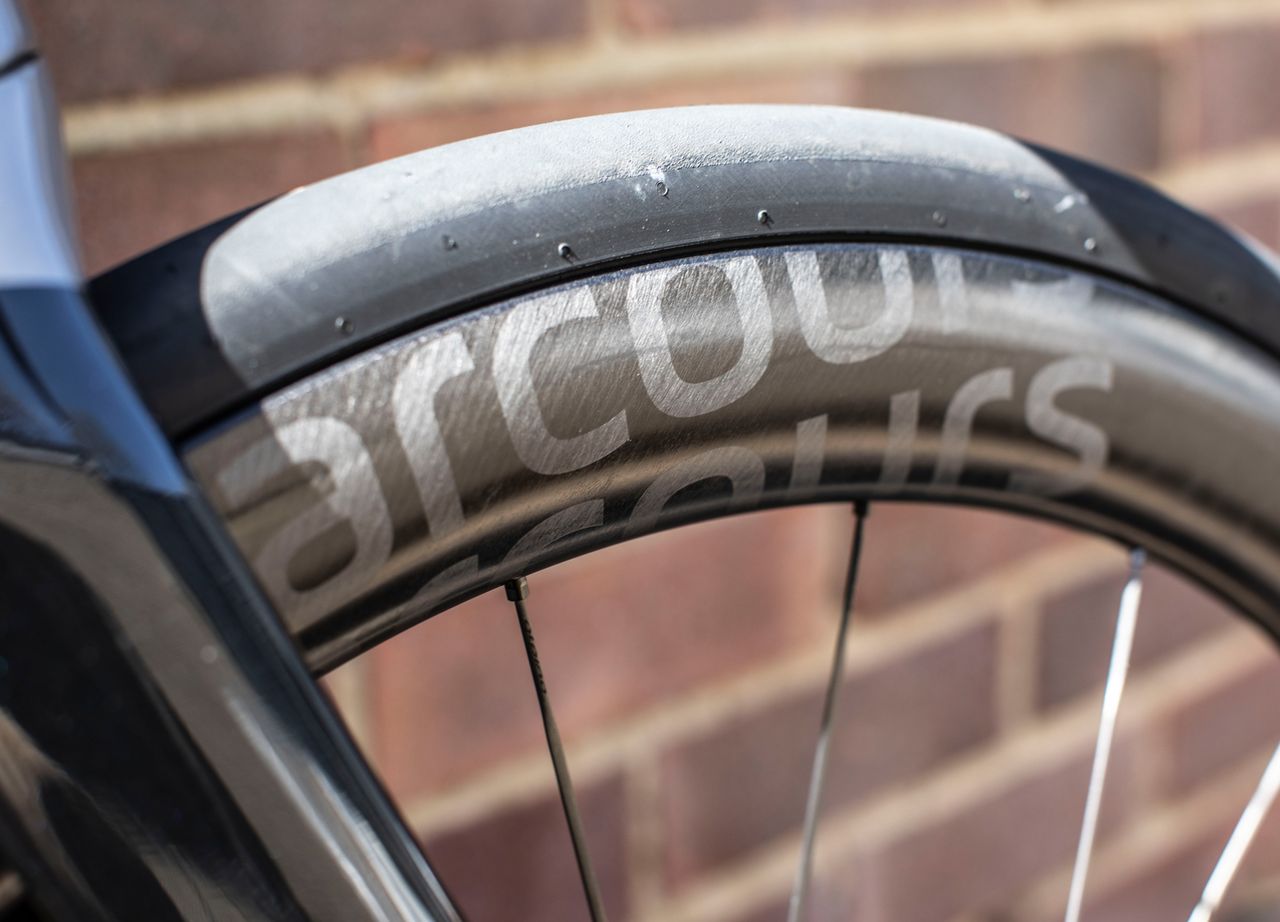
As seen on the FKT gravel wheels, the Strade GT utilises the company’s new graphic design language. It all looks very premium – and the new GT nomenclature, Lineat, and AFFT logos further bolster the visuals. The front and rear hubs are branded with the new GT logo, too.
If you look closely, you’ll also notice the unique carbon-fibre pattern on the rim, which can be attributed to the AFFT. Unlike traditional unidirectional fibres, these fibres exhibit an almost diagonal cross-hatch pattern. Parcours chose this particular look over a standard unidirectional carbon layer for its cosmetic qualities.
The initial pair of Strade GR wheels I tested was a prototype set with an aesthetic quality I quite liked. Unlike the current Parcours range, the prototypes used a keyline holographic, rainbow treatment on the Parcours decals. While this provided a contrast to the carbon fibre backdrop of the wheels, it was at odds with the design language of the broader range. Still, I hope Parcours can mix things up with something like that for a future model or perhaps a special-edition rim.

Technical details and specifications
The Strade GT’s rim profile represents an evolution of the existing Strade wheelset’s 49/54mm front/rear configuration, but is optimised for a 30mm tyre to improve handling and aerodynamics. Unlike the 22.5mm figure of the Strade, it uses an updated 23.5mm internal rim width and a hooked-bead interface for improved tyre security. Looking at the numbers, the Strade GT is 3.2W faster than the current Strade at 48km/h and 15% more stable in the handling stakes, not to mention some 390g lighter.
The hubs use a captive-spoke design that will find favour with riders seeking security and reliability. The drive mechanism uses a four-pawl freehub and 60T ratchet, chosen for its notably quick engagement and light system weight. The spoke count is 21/24 front/rear and is laced in a two-cross radial pattern at the front and a one-cross (NDS)/three-cross (DS) configuration at the rear.

The big talking point here is the VibraCore technology, which integrates Lineat’s AFFT (Aligned Formable Fibre Technology) reclaimed carbon material into the spoke bed, which is the thickest area of the wheel. By placing the reclaimed carbon fibre sheets in this area, VibraCore influences how vibrational energy is transmitted through the rim at the earliest possible stage, rather than acting as an external damping system.
VibraCore has also enabled the introduction of carbon-fibre spokes to mitigate the harsh vibrations often associated with the material – in this case, Alpina Carbolite spokes have been chosen for their narrow-bladed design.
To quantify the VibraCore tech, Parcours conducted real-world testing with Nottingham Trent University, using riders of various heights and weights across varied surfaces equipped with vibration sensors. The test data was analysed using power spectral density (PSD) to quantify performance differences between a non-VibraCore and VibraCore rim.
The results were interesting, showing that VibraCore reduced vibration energy by 19-23%, which is comparable to a 10-15psi reduction in tyre pressure without negatively impacting associated rolling efficiency or speed.

Parcours Strade GT – riding impressions
A few hundred metres on a choppy road surface is all you need to feel the vibration-damping qualities of the VibraCore tech of Strade GT wheels. It’s hard to quantify or put into words, but it unquestionably smooths out road buzz and delivers a softer, quieter ride with no discernible effect on speed and wheel stiffness. Where usually I’d avoid rough road sections and rumble strips like the plague, during my initial testing, I found myself ploughing across the worst road surfaces I could find to properly test and assess how VibraCore works in the real world.
Despite my efforts to purposely unsettle things, the wheels maintained speed while remaining comfortable at all times. I’m not sure how they would cope over cobblestones and the like, but paired with larger-volume tyres and lower pressures, I suspect comfort and overall control would supersede that of a deeper-section wheel with racier intentions.
While Parcours recommends pairing the Strade GT wheels with 30mm rubber, I shod them with 28mm Pirelli PZero TLR SL-R tyres to get a better feel for the wheels' ride quality and to experience the claimed reduction in road vibration at my usual 55/60psi front/rear pressures. I spent time testing both a prototype version of the Strade GT and the production-ready model, and aside from a 30T ratchet and prototype graphics, there wasn’t much difference between the two wheelsets in behaviour and overall performance. The production-ready Strade GT wheels use a four-pawl 60T ratchet, which engages instantly.
In terms of straight-line performance, the wheels accelerate quite rapidly thanks to their relatively low system weight of 1,140g (495/645g front/rear), as measured on our scale. Naturally, they climb very well, too, thanks to notably dropping the total system weight of my Cannondale SystemSix by 475g. The 49/54mm front/rear rim profiling, while not overly deep, rolls well and doesn’t suffer much in crosswind scenarios – if anything, they feel more controlled and stable than the original Strade wheels, especially when descending.
While I’m still testing the Parcours Strade GT, initial impressions are very positive. The difference between them and my stock Shimano Dura-Ace C60 wheel setup is stark, and they feel far superior in ride feel and comfort.
Not only do they feel fast on all surfaces and in all scenarios, but my body also feels less fatigued when I return from a ride

Pricing and availability
The Parcours Strade GT wheels are priced at £2,499 / US$3,299 / €3,199 (steel bearings) and £2,719 / US$3,589 / €3,489 (ceramic bearings) and are available through the Parcours website from today, although stock will be limited owing to disruptions in global shipping routes.
Parcours Strade GT wheelset specs
- Price: £2,499 / US$3,299 / €3,199
- Weight: 1,140g (495/645g front/rear)
- Disc layout: Centrelock
- Spoke count: 21/24 front/rear
- Rim depth: 49/54mm front/rear
- Internal rim width: 23.5mm
- Rim type: Hooked
- Freehub options: Shimano HG11/12, SRAM XDR