
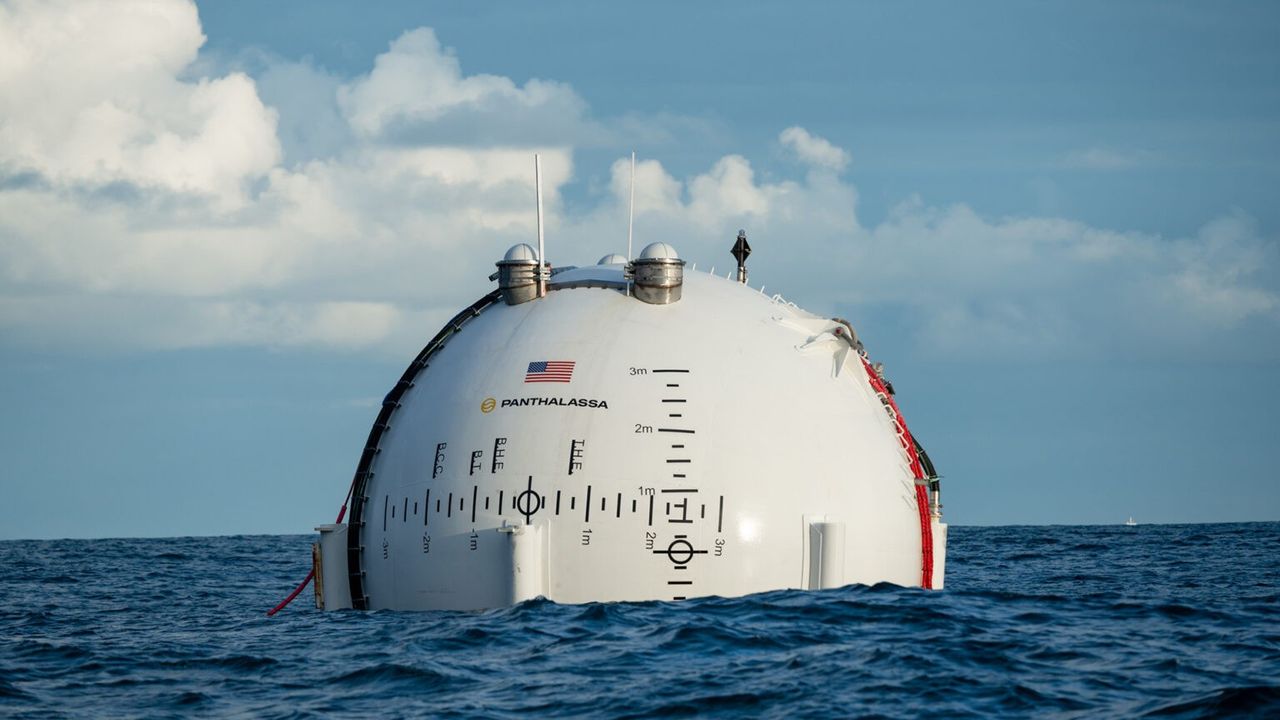
An official press release yesterday confirmed a $140 million investment to power AI data centers at sea. The funding goes to Pathanlassa — a renewable energy and ocean technology company — and was raised in a Series B financing led by avid investor and former PayPal CEO and Palantir co-founder Peter Thiel, alongside several other investors.
The Portland-based start-up said it would use the funding to complete its pilot manufacturing facility in Oregon for its Ocean-3 series nodes — an autonomous platform that will house and power data centers for AI inference computing at sea, using electricity generated from ocean waves.
“There are three sources of energy on the planet with tens of terawatts of new capacity potential: solar, nuclear, and the open ocean,” said Garth Sheldon-Coulson, Co-Founder and CEO of Panthalassa. “We’ve built a technology platform that operates in the planet’s most energy-dense wave regions, far from shore, and turns that resource into reliable, clean power. We’re now ready to build factories, deploy fleets, and provide a sustainable new source of energy for humanity.”
Panthalassa’s solution is an autonomous, fully integrated system called a node that houses both AI infrastructure and power-generating hardware in a single offshore unit. Each lollipop-shaped node consists of a buoyant spherical head connected to a long, submerged vertical tube and structural frame.
As ocean waves pass, the node bobs up and down, but, crucially, the surrounding water moves only in small orbital paths. This relative motion between the structure and the water column induces oscillations within the tube, effectively driving seawater up and down through the system.
That oscillating flow is channeled into the spherical chamber through a high-pressure jet, where it is converted into usable mechanical energy. The water then passes through internal turbines, generating electricity before recirculating back into the tube to repeat the cycle. The system is designed as a closed hydraulic loop that continuously extracts energy from wave-induced motion.
As the ocean never stops moving, the system generates power around the clock. That power runs the onboard payloads. For truly autonomous operation, the system transmits data back to shore via satellite, eliminating the need for tethering. Another noteworthy benefit of the system is that the surrounding ocean provides free supercooling, solving one of the biggest engineering challenges in land-based data centers.
Each node also incorporates propulsion and station-keeping systems, allowing it to maintain optimal positioning or operate as part of a distributed offshore network, effectively coupling renewable energy generation directly with modular AI compute at sea.
After decades of research and development, and several preceding versions, Panthalassa says it plans to “deploy its Ocean-3 pilot node series in the northern Pacific Ocean, demonstrating AI inference capabilities and refining its manufacturing process in preparation for commercial deployments in 2027.”
AI’s electricity demand is rising much faster than conventional power infrastructure can keep up with. In many regions, grid operators are already struggling to keep up, while communities are increasingly pushing back against new builds over concerns about land use, noise, and energy diversion. In response, companies are scrambling for alternatives, and the solutions are becoming increasingly unconventional. “The future demands more compute than we can imagine,” said Peter Thiel. “Extra-terrestrial solutions are no longer science fiction. Panthalassa has opened the ocean frontier.”
Panthalassa’s wave-powered offshore compute nodes are the latest in a growing line of radical bets on how to power AI sustainably. Last month, we reported that Meta had signed a partnership with an energy start-up to beam solar energy from space to enable continuous, 24/7 power. Other startups are exploring the idea of moving data centers entirely off-planet. These are just a few of the many other initiatives to meet AI’s seemingly impossible electricity demands.