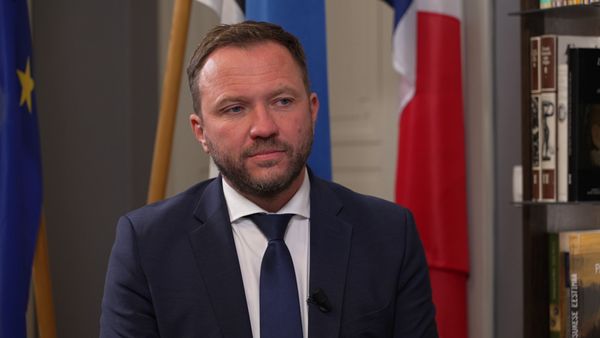
France’s caretaker prime minister, Sébastien Lecornu, has said a majority of MPs “rejects the idea” of snap elections and that “a path still exists” that should allow Emmanuel Macron to appoint a new premier within 48 hours.
“Several groups are willing to seek agreement on a budget” for 2026, Lecornu told France 2 public television on Wednesday, and were making clear their “conditions”. Talks would be difficult, he said, but “the prospect of a dissolution [of parliament] is fading”.

Lecornu, who resigned on Monday after 27 days in office but was given 48 hours by the French president to try to rally support for a new government, presented his conclusions to Macron at the Élysée Palace earlier on Wednesday.
Macron was re-elected for a five-year term in 2022, but since snap parliamentary elections last summer, a hung parliament has ousted two successive prime ministers who failed to find a majority for austerity budget plans, plunging France into one of its deepest political crises since the foundation of the Fifth Republic in 1958.
Lecornu became the third to go when he tendered his government’s resignation just 14 hours after his new cabinet had been announced, saying opposition to the lineup from allies and opponents alike would make it impossible for him to do the job.
He said earlier on Wednesday that reducing France’s ballooning budget deficit – projected to exceed 5.5% of GDP this year, almost twice the EU’s permitted limit – was “vital, including for France’s image abroad and for our capacity to borrow”.
Lecornu said he was “quite optimistic” progress could be made. “We’re only missing the final metre,” he said, calling on the parties to show a “capacity for compromise” and suggesting that a non-political technocratic government could be a way forward.
The former defence minister, who met leftwing parties including the Socialist party (PS), Greens and Communists on Wednesday, told France 2 that every political group he had talked to except the far right and radical left had “told me that it would be too dangerous not to have a budget by the end of this year”.
Lecornu said he was “not running after the job” of prime minister and it would be “up to the president” to decide whether his successor should come from the moderate left, which has repeatedly said any government headed by a Macron ally would be doomed to fall.
He had appeared to offer a possible olive branch to the PS and moderate left on Tuesday by suggesting Macron’s unpopular pension changes, pushed through in 2023, may be “suspended”, partly meeting the left’s demands that they be scrapped.
However, the leader of the PS, Olivier Faure, said after meeting Lecornu on Wednesday he had “not received any guarantees” that the reform, which raised France’s retirement age from 62 to 64, would indeed be suspended.
Lecornu told France 2 that the question was “a real blocking point” and “one of the most difficult” to resolve. It would be “up to the president” to make the final decision, he said.
If the PS and moderate left can be won over, a left-led cabinet backed by Macron’s centrist allies and centre-right MPs could be an option, but it would be fragile – and is not guaranteed the support of the centre-right, for whom changing the pension system is sacrosanct.
The Greens leader, Marine Tondelier, whose party is allied with the PS, said after meeting Lecornu that France had “never been closer” to getting a new leftwing prime minister, adding that another appointee from Macron’s camp “wouldn’t last a minute”.
Both the far-right National Rally (RN) and radical left France Unbowed (LFI) have promised to back a vote of no confidence in the new government. “I will block anything that comes from this government,” the RN’s leader, Marine Le Pen, said on Wednesday. “The joke has gone on long enough.”
LFI’s parliamentary group leader, Mathilde Panot, reiterated that its MPs would vote against “any government that persists with Macron’s policies”.
Lecornu’s shock resignation was the latest twist in the political crisis that has gripped France since the snap 2024 election, which produced a parliament divided into three more-or-less equal blocs: the left, far right and Macron’s own centre-right alliance.
Macron has faced repeated opposition requests in recent days to hold snap elections or resign to end the crisis, with the far-right RN demanding a legislative ballot and radical left LFI calling for the president’s departure.
On Tuesday, even the beleaguered president’s former allies, including two former prime ministers, Edouard Philippe and Gabriel Attal, distanced themselves from Macron, with Philippe going so far as to join demands for his early resignation.
Macron has long said he is reluctant to hold fresh legislative elections, which polls suggest would probably return another divided parliament or usher in a far-right government.
He has repeatedly said he will not resign before the end of his mandate in 2027, when presidential elections are due that are seen as a watershed moment in French politics, with the far-right RN sensing its best chance of seizing power.