
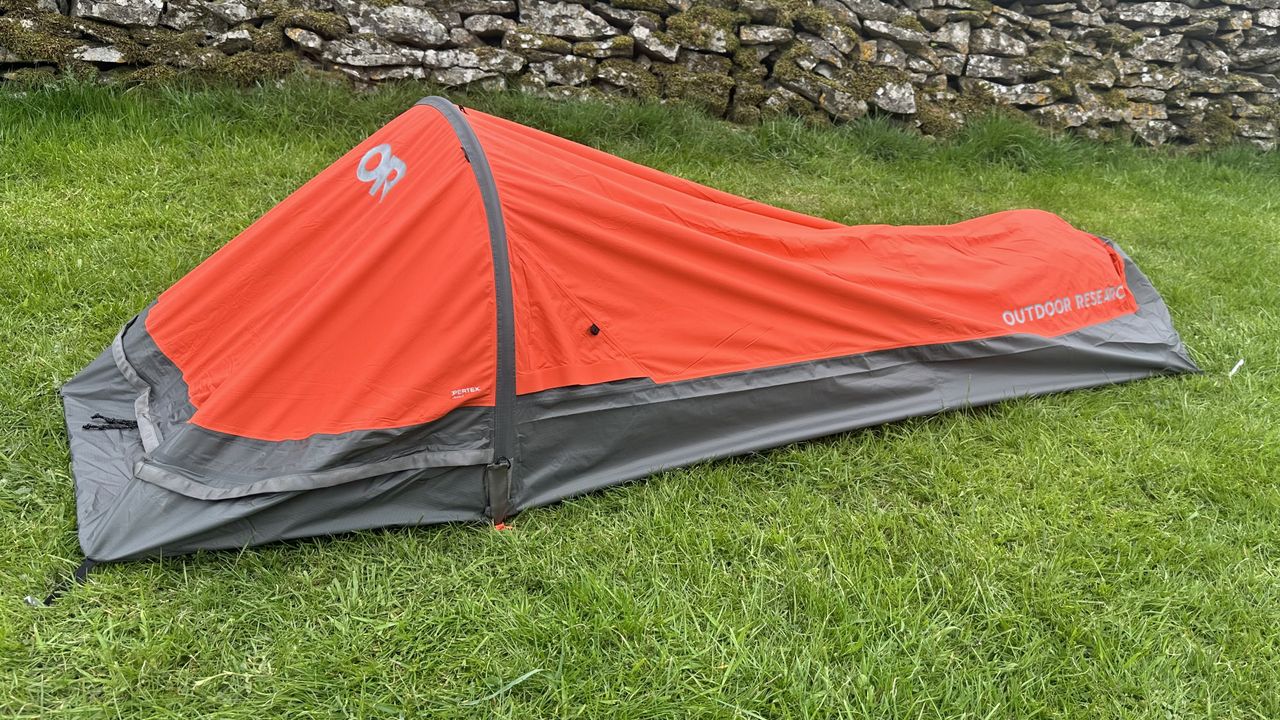
Based in Seattle, USA, adventure apparel and gear specialists Outdoor Research (commonly just called OR) have been manufacturing excellent outdoor equipment since 1981, and I’ve always been impressed with their gear.
Most recently, I tested the Helium UL, a super-light waterproof jacket from the brand, which boxes well above its extremely svelte weight, keeping you dry and protecting you from the wind while weighing virtually nothing and taking up very little room in your backpack or running pack.

As you can probably deduce from the name, the Helium UL Bivy is part of the same range, and it’s not much of an exaggeration to say that it’s a long waterproof jacket that you can climb into and go to sleep in by the side of the trail.
Outdoor Research Helium UL Bivy review
Price and availability
The Outdoor Research Helium Bivy is available now from various outdoor shops and websites. It comes in a range of colours, from discreet natural hues (perfect for wild camping) to brighter options, which can be good in remote areas and extreme conditions, just in case everything goes south and the emergency services have to come looking for you.
In Britain, the recommended retail price is £257.95, while in the United States you can expect to pay around $300; across the European Union, it will cost in the region of €275 and in Australia the price tag will be pushing AU$400.
Specifications
- Guide price: £257.95 (UK) / $300 (US)
- Style: Ultra-lightweight shelter
- Pack size (L x H x W): 37 x 12 x 12cm
- Pitched dimensions (L x W x H):
- Weight: 510.9g / 18.02oz
- Seasons: 3
- Capacity: 1 person
- Vestibules: 0 (awning is extra)
- Hydrostatic Head rating: HH 20,000
- Fabric: Pertex with Diamond Fuse technology (100% polyamide)
- Pole: 1 x aluminium pole
- Pegs: 4
- Pitch time: 2 minutes
- Colour: Light pewter / Spice
Design, materials and ease of pitching
This minimalist shelter is essentially a large bag constructed from OR’s ‘Helium’ fabric, made with Pertex Shield with Diamond Fuse technology.
This membrane-based material is extremely thin and lightweight (even more so than Gore-Tex), and it’s also waterproof (with a hydrostatic head rating of 20,000), windproof and breathable (20,000g/m²/24hr). Of course, the effectiveness of all of these ratings is dependent on various factors (see below).
The bivy utalises one aluminium pole, which threads through a sheath at the head end and is secured in place by a couple of Velcro flaps, creating a hoop that’s large enough to keep the outer fabric from falling on your face and upper torso. It features a ‘clamshell’ opening, which you climb through to enter the shelter. There’s also an insect mesh layer, which you can use on dry nights to vastly improve the airflow.
And that’s pretty much it. The shelter is freestanding, but there are four pegs to stop the bivy from blowing away when you’re not in it, and a pole repair sheath, but there’s no secondary pole at the bottom that you could use with a guy line and a peg to create a little bit of volume at the foot end.
An awning is also available as an optional extra (£100/$110; 155g/5.46oz), if you want some more protection and space at the head end, or somewhere to stash your walking shoes, trail runners, or hiking boots, plus your pack – but you do need a trekking pole to make this work.
Performance on the trail
I love a good bivvying escapade. There is something extra adventurous about travelling light and fast across wild terrain, and then setting up a super-minimalist shelter for nights out right next to the trail.
Sleeping out under the stars with nothing at all between you and the star-spangled sky is the stellar option, waking every now and then to see how the earth has turned and the constellations have changed position, but if the elements don’t allow for this, then a tarp or bivy (or bivvy, as some prefer) is next best.
I have been using the OR Helium UL bivy in the Peak District and in Devon, during various overnight escapades, and overall I’ve been impressed. It does what it designed to do and provides high-level protection during overnight outings, but as mentioned, people need to be very aware of its limitations.
Without weighing you down with any appreciable bulk (the UL in the OR Helium Bivy’s name stands for ultralight, and the kit tips the scales at just over 500g, or about the same as a pair of hiking trousers), a good bivy like this shelters you from wind, cold and rain (to a point).
Obviously, Pertex, like any breathable membrane, has its limits, and if you pitch the Helium Bivy in a puddle, or camp out in the full blast of a rainstorm, you’re going to get damp – as I did during one night of torrential rain.
Likewise, the breathability of such membrane-based materials (Gore-Tex included) is dependent on the conditions, and they only work optimally in dry environments (like the Alps or the Rockies), rather than in the humidity and moistness of the UK.
Also, do not take ‘breathable’ to mean you can zip the whole thing fully shut while inside – ventilation isn’t brilliant in this bivy, which is essentially a large plastic bag (albeit a very technical one), and you will quickly feel like you’re suffocating (and, indeed, you might be).
Space is tight in hoop bivies, and while I’m not claustrophobic, I always like to keep a breathing hole and an escape route nice and close to my face when I’m sleeping in one. If it’s not raining, I recommend rolling up the outer layer around the entrance and using the insect mesh, which will also allow you to gaze up at the stars.
The clamshell opening on the Helium bivy is pretty nifty, folding back so you can insert your lightweight camping mat and sleeping bag, and then get your legs in and assume a sitting position before wriggling fully into the shelter. However, I still found it a little tricky to get into the bivy (especially in wet conditions), compared to having a side zip to enable access.
The bucket floor is reasonably good for keeping moisture out, but in the absence of a small pole at the feet end of the shelter (which would, arguably, make it more of a backpacking tent and less of a bivy) you are always going to be in contact with the fabric, and no matter how waterproof and breathable the fabric claims to be, condensation will accumulate and you do get damp.
Verdict
If you’re really into lightweight gear and you regularly embark on fastpacking and bikepacking escapades where keeping carry weight and bulk to an absolute minimum is the biggest priority, then the OR Helium UL Bivy is a good investment. It’s well designed and made with premium fabrics that are reasonably robust and offer category-leading technical protection.
But, as any bivy user already knows, this is an outdoor shelter in its most minimalist form – it’s basically a highly technical survival bag with some small features that make life a tiny bit more comfortable (and less cold and damp) when you’re adventuring on the edge and sleeping in very close proximity to the wilderness.
Also consider
For a more comprehensive shelter that weighs a few grams less than the OR Helium UL bivy and provides full overnight cover for you and your backpack, boots, and so on, check out the Vango F10 Neon UL1 – a superlight one-person tent.
The Lifesystems Solo Peak tent is another minimalist shelter worth considering – this model has good internal space and an awning for storage, although it tips the scales at 1kg, so is twice as heavy as the OR Helium bivy and the Vango F10 Neon UL1.







