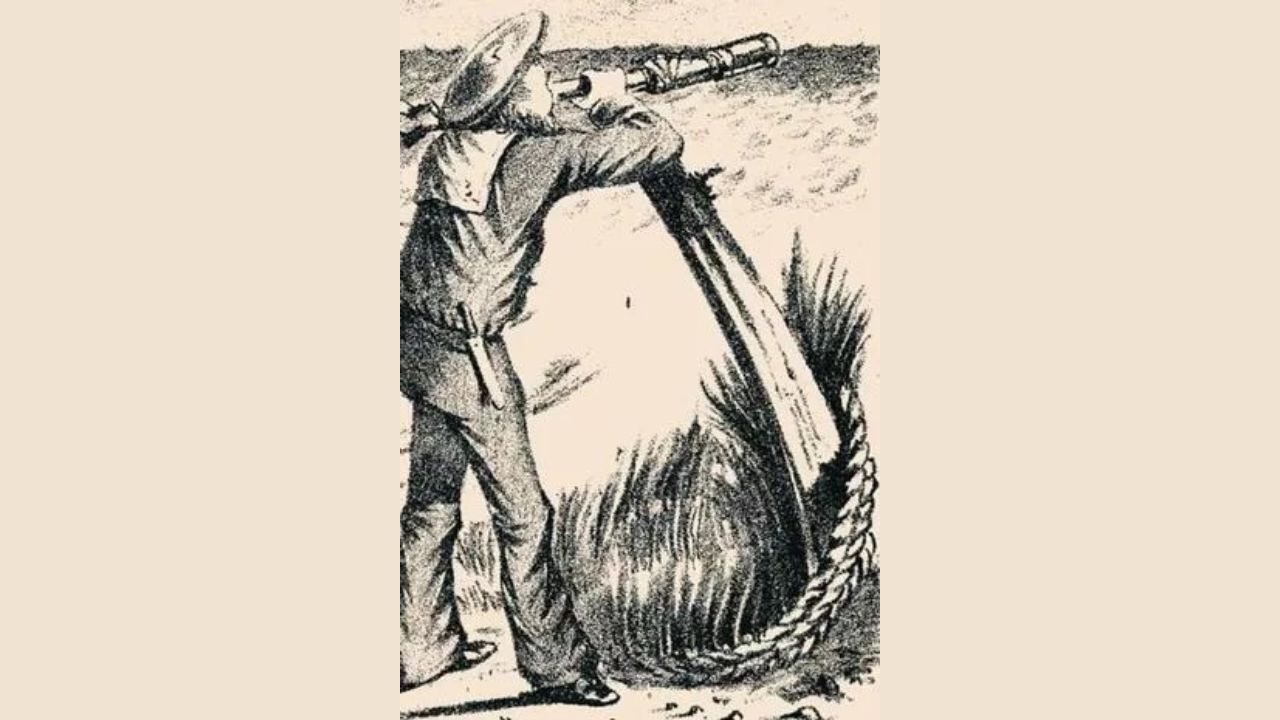
A new challenge is here for you. In this image you see a man, probably a sailor, is gazing into something relevant. All you can see is the sailor, a telescope and sparse vegetation around. But would you believe if we say that his wife is also there in the image?
Optical illusions are intriguing visual phenomena that deceive the brain into interpreting images in ways that vary from reality. These illusions challenge our perceptions by making us see things that aren’t actually present or by altering our understanding of what we are observing. They provide a captivating insight into the intricacies of visual perception and cognitive processing.

The principle behind optical illusion rests on the complex mechanisms that come into play when the brain tries to process what they see. This means that the brain takes support from past experiences, contextual clues, and immediate sensory input while trying to make some sense of what it is looking at when viewed with an image. However, in the case of an optical illusion, this gets disrupted because the presentation of visual stimuli tricks the brain into seeing something not aligned with actual reality.
Consider, for example, a classic optical illusion in which a supposedly regular photograph hides an element. Take the picture that is said to have within its background a hidden image of a sailor's wife cleverly hidden.
The problem, in such cases with an optical illusion, is that it is really subtle. It camouflages with the background or the other elements in the picture and obscure the figure, and hence becomes very difficult to trace. This fine degree of difficulty underlines how our visual perception can so easily be manipulated and how sophisticated this art of creating illusions can be.
The picture appears to be that of a normal sailor. On closer inspection, one will notice there is indeed an outline of a woman-what is claimed to be the sailor's wife-hidden somewhere in the picture.
But optical illusions serve not just to entertain; they are important means for finding out how our brains process visual information. They show the discrepancies between our perception and reality, demonstrating how our cognitive processes can be influenced by context, expectations, and visual cues. It helps one sharpen their attention to detail and develop their cognitive flexibility.