Get all your news in one place.
100’s of premium titles.
One app.
Start reading
The Times of India
The Times of India
Lifestyle
etimes.in

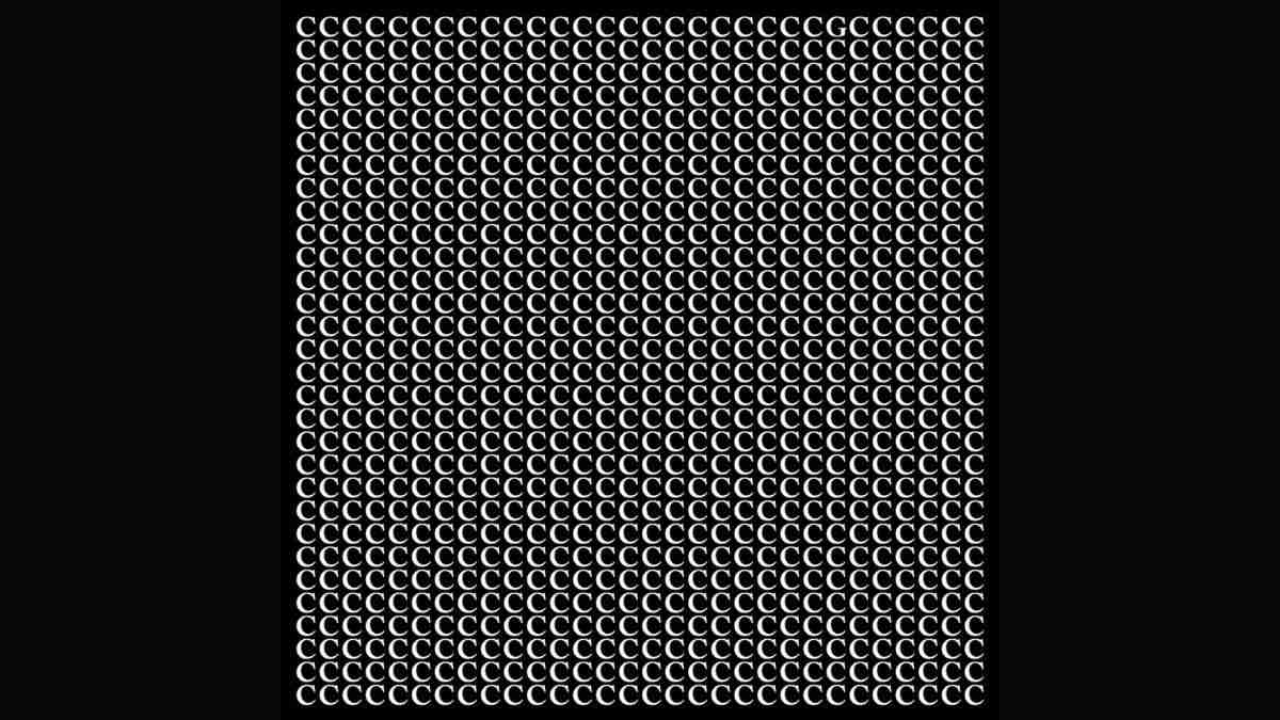
Optical Illusion eye test: Only those with a perfect vision can spot the odd letter in this image

Optical illusions challenge the brain by presenting images that appear differently from reality, requiring the brain to interpret and make sense of conflicting visual information. This mental exercise stimulates the brain, enhancing cognitive flexibility, attention, and problem-solving skills.

Somewhere in this grid, there's an odd letter among the "C"s that differs from the rest. Let’s solve the puzzle by focusing on how to identify the odd letter effectively.

Here’s a step-by-step guide for solving puzzles like this:

Understand the puzzle layout

This type of puzzle is common and generally presents a grid with a single odd letter placed randomly. The odd letter may be slightly different in shape, orientation, or simply a different letter that looks similar to "C," such as "O" or "Q."

Look for common differences

The odd letter is often one that closely resembles "C" to make it challenging to spot. Letters like “G” "O" and "Q" are the usual suspects.

O: Has a completely closed loop, while "C" is open on one side.

Q: Similar to "O" but has a small tail, making it distinct.

G: Has similarity in appearance

Examine each row and column carefully

Start from the top left and scan each row from left to right, then move down row by row. Look for a letter that doesn’t have the open space typical of "C." Try not to rush, as the difference is subtle.

Focus on the center first

Sometimes, the odd letter is placed near the center or slightly off-center since these areas are less likely to be noticed on a quick scan. After checking the center, gradually move outward.

Optical illusions do strengthen neural connections and slow down cognitive decline. They also enhance visual perception and concentration by making the brain pay attention to fine details and thoughts beyond initial impressions. Regular interaction with optical illusions could be a fun way to keep the brain active and promote long-term mental agility and health.

Sign up to read this article
Read news from 100’s of titles, curated specifically for you.
Already a member? Sign in here
Related Stories
Top stories on inkl right now
One subscription that gives you access to news from hundreds of sites
Already a member? Sign in here
Our Picks
Fourteen days free
Download the app
One app. One membership.
100+ trusted global sources.