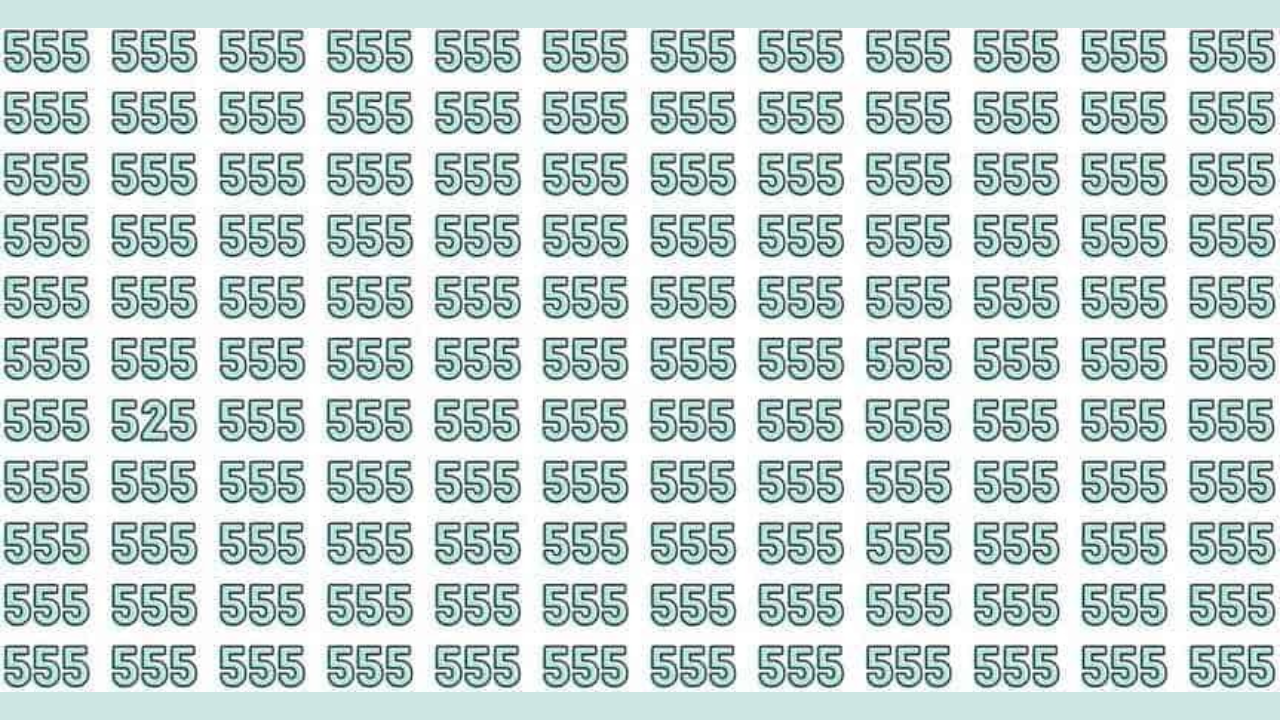
Here's a new challenge for you. In this image, there are 555 in every row and column, however somewhere in this image there is 525 hidden. The challenge is to find the hidden 525 among the 555.
A lot of patience and close attention to detail are required in solving optical illusions. Just look at the illusion without rushing and see if it changes from different perspectives, distances, or aspects such as color and shape to patterns. Some of them depend on cognitive biases, therefore put your first interpretation to question and open up alternative possibilities. Sometimes, a person needs to unsee, or rather, relax the eyes, or even squint to notice whatever is hidden. Looking from all sides of the illusion, one can figure out the trick to solve it.

5 benefits in solving optical illusions
Optical illusions teach your brain to detect those minute visual cues and patterns, which one misses in regular observation. Thus, these sharpen the observation skills of a human and work well to pay more attention to visual details.
Many optical illusions are such challenging tasks for the brain as they literally ask to think beyond the usual set of patterns and assumptions. Solving such puzzles necessitates creative and analytical thinking while increasing problem-solving skills in everyday life.
To solve an illusion, the brain needs to pay attention consistently. Exposure to them develops the attention span and concentration ability that can be applied to work or study that require mental endurance.
Optical illusions make you change your perception and look at things from another person's angle. Cognitive flexibility improves so that your brain adapts quickly to new situations and perceives things more dynamically.
Solving illusions is a break in the daily routine while solving an illusion. It distracts you from your stress and anxiety and inadvertently becomes a fun method of unwinding-all the while exercising your brain.
The answer to the challenge is here: