Get all your news in one place.
100’s of premium titles.
One app.
Start reading
The Times of India
The Times of India
Lifestyle
TOI Lifestyle Desk | TIMESOFINDIA.COM

Only a true dog lover can find the real dog in this picture; here's your chance to prove yourself

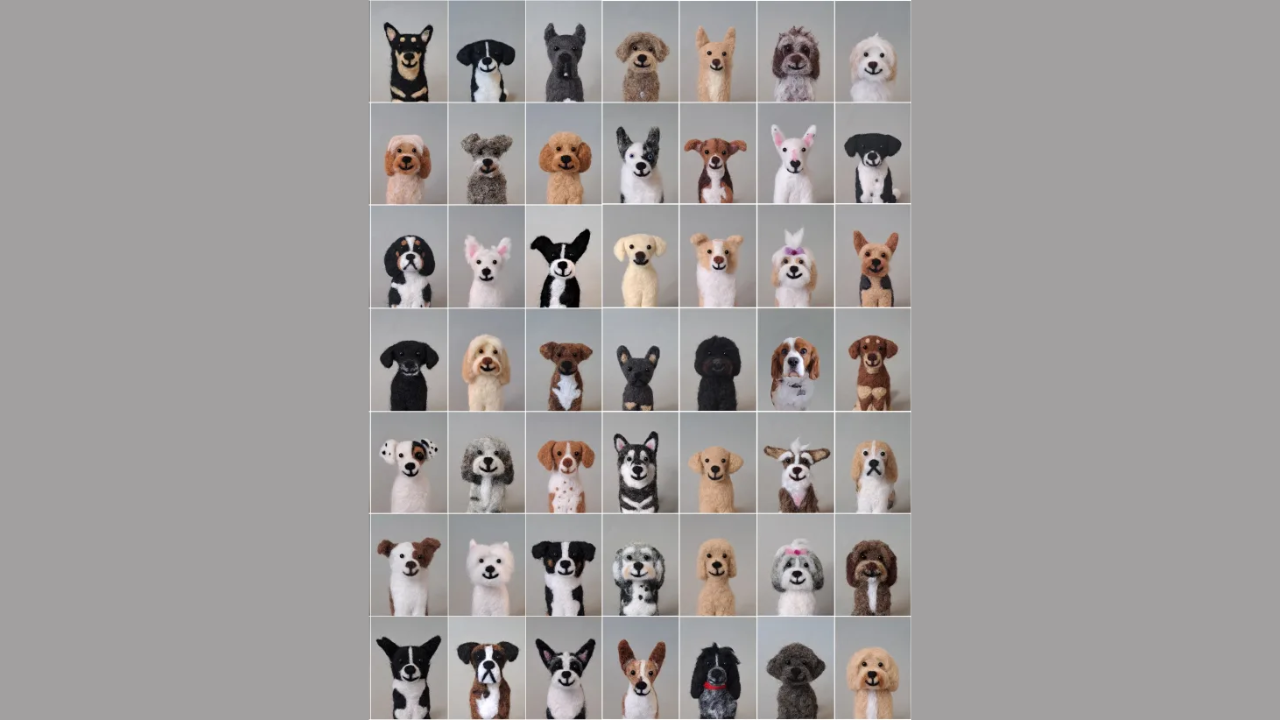
Here's another challenge for you. The task is to find the real dog among these wool dog models. The image contains 48 cute woolen dog models made by Lauren Mann, a 26 year old from Llandudno, North Wales.

Identifying hidden objects in optical illusions is challenging due to the brain's intricate processing of visual information. Optical illusions exploit the brain's reliance on assumptions, patterns, and expectations to create misleading images. The brain naturally seeks to interpret visual stimuli based on prior experiences and learned patterns. When presented with ambiguous or contradictory information in illusions, it can struggle to reconcile conflicting signals.

In this picture, it is hard to find the difference between a real dog and a dog model. Illusions often exploit the brain's processes related to depth perception, contrast, and perspective. These visual tricks may cause the brain to misinterpret the size, shape, or position of objects within the image. Additionally, the brain tends to fill in missing information based on assumptions, leading to perceptual errors.

Moreover, the complexity of the visual system makes it susceptible to cognitive biases and contextual influences. Factors such as color, shading, and surrounding elements contribute to the illusion's effectiveness. Cognitive processes like selective attention and the brain's natural inclination to simplify complex stimuli further complicate the identification of hidden objects.

What you see first will reveal whether you are a practical or an emotional individual

In essence, optical illusions challenge the brain's ability to accurately interpret visual cues, exploiting its reliance on shortcuts and heuristics. Recognizing hidden objects requires individuals to consciously override these automatic processes and engage in focused observation, highlighting the intricate interplay between perception, cognition, and visual processing.

How to solve this optical illusion?

In this picture, you can find the real dog, only if you check the traits of a real dog. The physical traits of a real dog varies from that of a model one. A striking feature of a real dog are its ears. The ears, one of the most responsive body parts, have distinguishable movements. They are not always straight as a scale. Notice, the real dog's ears are dropped in a very casual manner. The answer is here:

Sign up to read this article
Read news from 100’s of titles, curated specifically for you.
Already a member? Sign in here
Related Stories
Top stories on inkl right now
One subscription that gives you access to news from hundreds of sites
Already a member? Sign in here
Our Picks
Fourteen days free
Download the app
One app. One membership.
100+ trusted global sources.