A health insurance policy may carry disease-specific sub-limits that restrict how much an insurer will pay for a particular treatment.
Sub-limits are expressed as a fixed value for a particular disease/treatment or room rent or as a percentage of the total sum insured.

But what happens when an insurer relies on a sub-limit from an earlier policy after the policy has been renewed and the sum insured has been increased?
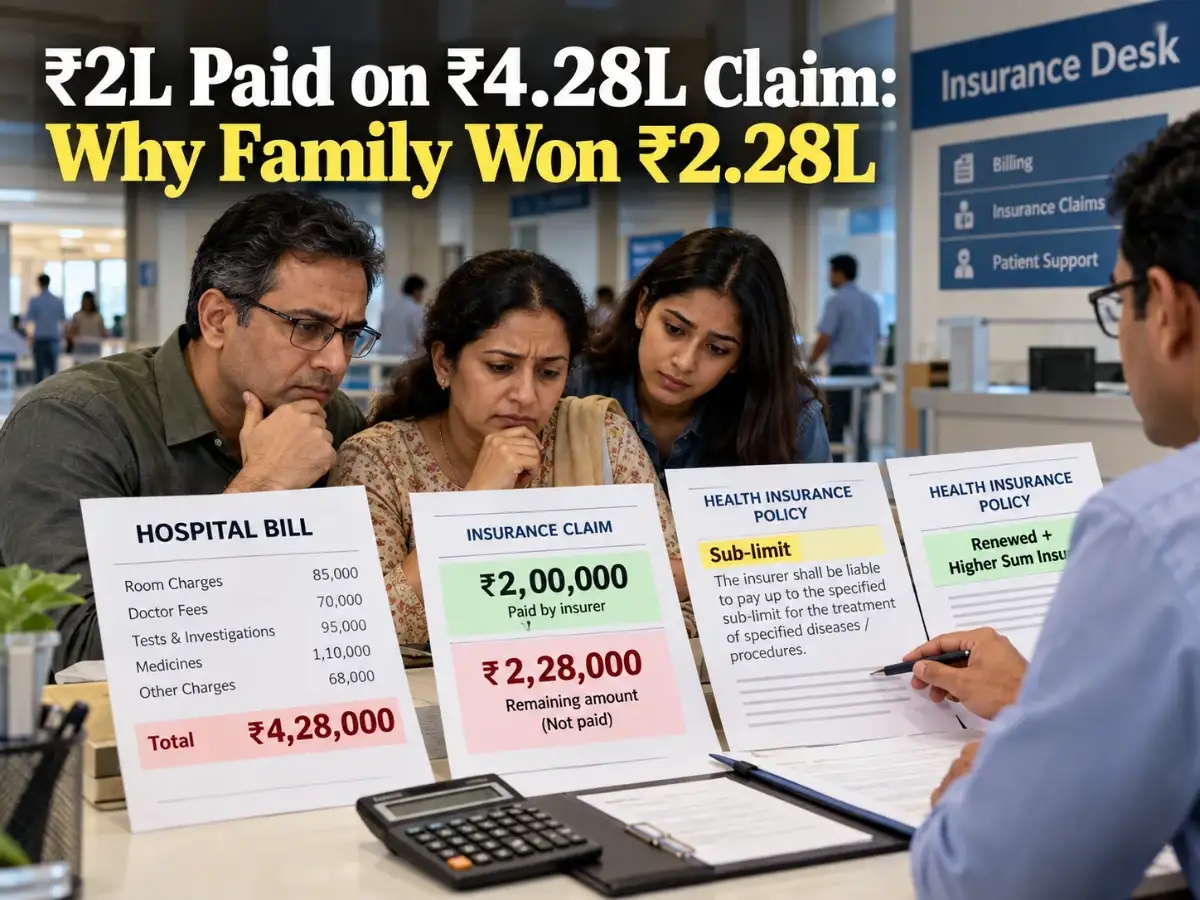
That was the issue before the Additional District Consumer Disputes Redressal Commission, Belagavi, in a case involving Star Health and Allied Insurance Company Ltd. The commission found a deficiency in service after the insurer restricted a claim for cerebrovascular accident treatment to Rs 2 lakh, while the family had incurred medical expenses of Rs 4.28 lakh.
How did the Star Health claim dispute arise?
The insured was covered under Star Health's STARS Senior Citizen Policy. The policy was originally issued in 2019 with a sum insured of Rs 3 lakh.
The policy was subsequently renewed. For the policy period from November 24, 2022 to November 30, 2025, the sum insured was enhanced to Rs 5 lakh, with the premium also increasing from Rs 15,222 to Rs 21,240, according to the case record.
The dispute arose when the insured suffered a cerebrovascular accident (CVA) and was admitted to Venugram Hospital, Belagavi, on March 10, 2025.
“During the renewed policy period, the insured was hospitalised from 10 March 2025 to 30 March 2025 for a cerebrovascular accident,” says Vivek Kumar, Advocate, Delhi High Court.
The family initially sought cashless treatment. However, the cashless claim was deferred, with the insurer stating that the expenses could be reimbursed after the bills were submitted. After discharge, the family submitted medical bills totalling Rs 4,28,308 for reimbursement.
Why did Star Health pay only Rs 2 lakh?
Star Health settled only Rs 2 lakh and declined to pay the remaining amount. The insurer's defence was that the policy contained a disease-specific sub-limit for cerebrovascular accident treatment, under which the maximum amount payable was Rs 2 lakh per policy period.
The insurer contended that ₹2 lakh represented the maximum admissible amount for such treatment under the policy and that this limit had already been exhausted through the cashless settlement, says Kumar.
Why did the consumer commission reject Star Health's sub-limit argument?
The Commission did not accept this defence because the insurer was unable to demonstrate from the policy documents placed before the Commission that the alleged Rs 2 lakh sub-limit formed part of the operative insurance contract applicable after the renewal.
The Commission noted that the relevant document relied upon by the insurer did not contain the stipulated sub-limit and that the insurer had not established that the insured had been provided with that document when the policy was issued, explains Kumar.
The Commission also took into account the fact that the original sum insured of ₹3 lakh had subsequently been enhanced to ₹5 lakh on renewal, with an increased premium.
It found that the insurer had not clarified how the restrictions contained in the earlier 2019 policy continued to operate under the renewed policy or whether they had been incorporated into the renewed contractual terms, he adds.
In other words, the issue was not whether a health insurance policy can contain a disease-specific sub-limit. The key question was whether Star Health could establish that the particular ₹2 lakh CVA sub-limit was part of the policy governing the claim.
The Commission held that the insurer could not rely on the restriction to limit the reimbursement to ₹2 lakh and consequently found deficiency in service.
ET Wealth has reached out to Star Health Insurance for its response. However, at the time of publishing, the insurer had not responded.
How much did Star Health have to pay?
The Additional District Consumer Disputes Redressal Commission, Belagavi, partly allowed the complaint and directed Star Health to pay the balance Rs 2,28,308.
The insurer was also directed to pay:
- 12% annual interest on Rs 2,28,308 from March 30, 2025, the date of discharge, until realisation;
- Rs 10,000 as compensation for mental agony and inconvenience; and
- Rs 5,000 towards litigation costs.
The commission directed the insurer to make the payment within 60 days of the order. If it failed to do so, the amount would carry an additional 6% interest per annum from the date of the order until realisation.
What does the case mean for health insurance policyholders?
The case highlights an important point for policyholders: the sum insured shown on the policy is not necessarily the amount payable for every disease or treatment. Disease-specific sub-limits and other restrictions can affect the final claim amount.
At the same time, when a policy is renewed and the sum insured is increased, policyholders should carefully check whether there are any changes or continuing sub-limits in the renewed policy.
“Policyholders should examine the complete policy documents, particularly disease-specific sub-limits, co-payments, room-rent restrictions, exclusions and waiting periods. Renewal should be treated as an opportunity to compare the old and renewed policy wordings and schedules, especially where the sum insured is increased,” says Amitraj Kaushal, Advocate at the Supreme Court of India.
In this case, the Commission’s decision turned significantly on the insurer’s failure to establish that the particular CVA sub-limit it relied upon was part of the renewed contract.
That does not mean that every sub-limit becomes unenforceable after renewal. A clearly incorporated and properly disclosed contractual sub-limit may still govern a claim, he adds.