
Get all your news in one place.
100's of premium titles.
One app.
Start reading
What Hi-Fi?
What Hi-Fi?
Technology
Andy Madden

Onkyo Icon A-50

Onkyo Icon A-50 streaming amplifier.

It’s been a tricky few years for Onkyo.

Historically better known for its AV receivers, the Japanese company filed for bankruptcy back in 2022, but not before offloading its core home AV and hi-fi division to a joint venture between Premium Audio Company (the parent company of Klipsch, Integra, Magnat and others) and Sharp.

It teased a return at the end of 2024 before finally launching new hi-fi electronics and an affordable line of powered speakers at CES 2025.

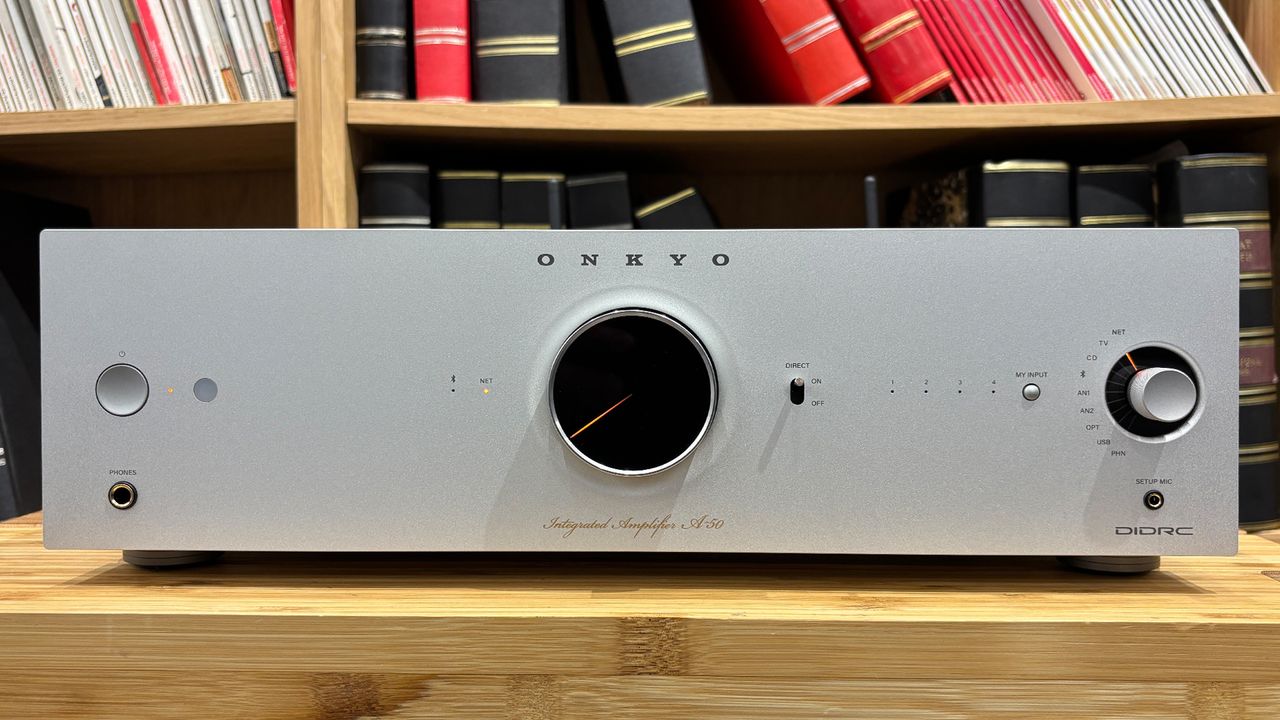
That range of electronics was called ‘Icon’, and it’s the Onkyo Icon A-50 streaming amplifier that you see before you here.

It’s a strong choice of name – but can the level of performance on offer match it?

Price

(Image credit: What Hi-Fi?)

Priced at £1199 / £1599 / AU$3299, the Onkyo lives in a space where there isn’t too much in the way of major rivals.

The one potential stumbling block to its success is a big one, though. It comes in the shape of the Ruark Audio R610 (£1199 / $1599 / AU$2299), a What Hi-Fi? Awards 2025 winner, no less.

This neat box of tricks offers similar functionality to the Onkyo and has a price tag which is comparable in both the UK and the US.

There is a bit of a gap in pricing when you look at the Australian market, but we think it’s the product most people are likely to compare it to.

Design & build

(Image credit: What Hi-Fi?)

Once unboxed, first impressions are mixed. Onkyo has gone down the traditional full-width separates route for the Icon A-50 as opposed to the slightly more stylish and more modern design of the Ruark.

Onkyo Icon A-50 tech specs

(Image credit: Onkyo)

Power 110W per channel

Streaming features Bluetooth (SBC, aptX HD), AirPlay 2, Google Chromecast, DNLA, UPnP, Qobuz Connect, Tidal Connect, Spotify Connect, Amazon Music, internet radio

Network Wi-fi, ethernet

Inputs HDMI ARC, Optical, Coaxial, RCA line level, Phono MM/MC, USB-A

Outputs RCA line level

Headphone output? Yes (6.3mm)

Max file resolution 32-bit/768kHz PCM

Dimensions (hwd) 13.5 x 43.5 x 35.5 cm

Weight 13kg

There’s certainly nothing wrong with 'traditional', and from a distance everything appears perfectly well-appointed – all the various controls, buttons and switches seem to be proportionate and in the right place.

Once it’s powered up, that sliver of orange LED on the volume control sharpens up the amp’s appearance nicely. It contrasts neatly with its black surround and matches the ladder of LEDs that arcs around the input selector. Each rung glows orange as you cycle through the various options until you arrive at your desired input.

However, your contact points feel a little, dare we say, cheap. The top of the chassis, despite having an attractive pattern of vents, doesn’t feel the most robust.

The power button, depending on how it’s pressed, can make a quite off-putting springy noise, while the volume control makes quite a substantial clicking noise around halfway up its travel.

We weren’t quite sure why the amp was doing this, so we reached out to Onkyo, who told us “to prevent the product temperature from becoming high, the power supply for the amplifier is designed to switch between two levels, low and high, depending on factors such as the volume value, internal temperature sensor, and speaker output level".

It’s a strange quirk and something that we haven’t come across on a product like this before. It’s also something that we did find distracting during testing.

The textured finish to the input selector feels nice to the touch, but the control’s actual movement is a little soft and not quite as precise as we’d like.

Add all the design and build elements together, and we’re left with a feeling that we’re not quite getting our money’s worth.

The supplied remote is a relatively ordinary plastic wand which contains all the basic buttons for changing input, volume and accessing the tone controls.

It does the job without too many complaints, although a couple of times, when controlling the volume, the dial seemed to briefly resist and even go in the opposite direction before rotating the desired way.

Features

(Image credit: What Hi-Fi?)

Speaking of controls, you are encouraged to download Onkyo’s Controller app before you begin set-up.

Companion apps for anything streaming-related can be hit and miss in our experience, and the Onkyo’s isn’t without issue. There’s plenty of functionality built in, for sure, but it struggles to gloss over what is all too often a frustrating and buggy experience.

What should be a simple set-up process is hampered by an over-complicated and overly fussy menu system and an app that is generally slow and sluggish to respond.

Tidal Connect worked smoothly as you’d expect, but the Amazon Music implementation is sluggish and buggy. On one occasion, we are streaming music using the service through the Controller app and the icons for skipping tracks disappear from the screen on our iPhone 15 Plus.

Through the app, you can access the Onkyo’s basic Dirac Live room correction or the built-in Fidelity IQ calibration. Both of these can use the microphone, which comes with the amplifier and plugs into the corresponding socket on the front panel.

Depending on your room layout and characteristics, you might want to stick with how they calibrate the sound, but we preferred them both turned off. In our acoustically treated rooms, Dirac Live sounded a little lightweight, while the Fidelity IQ option seemed to change the balance and boost certain frequencies at the expense of others, resulting in an unbalanced sound.

Instead, we would suggest actually flicking the switch on the front of the A-50 to turn on Direct mode. With this mode engaged, your music won’t pass through the amp’s tone control circuit and instead travel on a slightly shorter signal path.

In our opinion, it makes a subtle, yet audible difference to the sound quality. Music sounds slightly cleaner and more transparent.

During testing, there were a couple of bugs that cropped up when experimenting with Dirac Live, Fidelity IQ, and Direct mode. On a couple of occasions, the amplifier went rogue and turned the bass up in the tone controls when switching between them. The Onkyo would also occasionally mute the sound when switching between Dirac Live and Fidelity IQ.

(Image credit: What Hi-Fi?)

We actually found the best part of the control app to be the volume control. Tapping the button on your screen launches a pop-up volume dial, which you slide your thumb around. The dial’s action is nice and smooth, and the amp is quick to respond.

On the front of the amp is a 6.3mm headphone socket, and four LED indicators next to a ‘my input’ button, which you can use to assign a particular source and sound settings to a single preset.

Around the back are three analogue inputs, two optical digital inputs, one coaxial digital input, a USB-A input for an external storage device, an HDMI ARC socket and a phono input for the moving magnet/moving coil phono stage.

Bluetooth connectivity is also included, which allows you to not only beam music to the Onkyo from a smartphone or tablet, but also transmit Bluetooth audio to a pair of Bluetooth headphones for, say, some late-night, wireless listening. The amp is compatible with SBC, aptX and aptX HD codecs.

The networked A-50 can cater for virtually all your streaming needs with support for Spotify Connect, Tidal Connect, Qobuz Connect, Amazon Music and TuneIn internet radio. It also supports AirPlay, Chromecast and is Roon Ready.

Sound

(Image credit: What Hi-Fi?)

The Icon A-50 is claimed to deliver 110W per channel (into 8 ohms) using Class A/B amplification. During testing, we have it hooked up to our reference bookshelf speakers, the Epos ES-7N, and the amplifier seems perfectly at home driving them.

We start with a track or two from our Naim Uniti Core server accessed through the controller app, and we like what we hear.

Playing Lady Gaga’s Starstruck, the A-50 puts its best foot forward. The track sounds punchy, weighty and piques our interest with a lively and spacious sound.

There’s plenty of scale and size to the soundstage, too – the Onkyo sounds bold and forthcoming, but doesn’t sound overpowering. It’s nicely measured in its approach.

Bass notes hit with weight and authority, but it’s not just about the amount of bass. There’s decent detail and texture there too, and the difference in intensity between each low-frequency blow is easy enough to distinguish.

We wheel out the five-star Ruark R610 for comparison, and although it sounds smaller scale and less open, you do get a much greater sense of focus and precision compared to the Onkyo.

The current What Hi-Fi? Award-winner sounds more sure of itself, displaying greater composure and also has the edge when communicating the rhythmic flow and dynamic shifts of the track.

We slow things down with George Michael’s Careless Whisper and the Onkyo’s large, expansive delivery comes to the fore once again. It’s nice to listen to and does a fine job of separating the various elements of the track.

However, the vocal isn’t delivered with quite as much conviction or precision, nor does the saxophone sound as solid or dynamically dexterous as it is when heard through the Ruark.

Having said that, the A-50 still sounds balanced. There’s no sign of any brightness or hardness at the top end, and you certainly couldn’t accuse the Onkyo of delivering unruly and overly keen bass frequencies, either.

(Image credit: What Hi-Fi?)

We play the same two tunes over Tidal Connect and Bluetooth, and the amplifier remains in character. Yes, the compressed Bluetooth versions sound just that, but the Onkyo maintains its broad, expansive personality.

Unfortunately, we can’t say the same for the phono stage. Connecting a Rega Planar 3 RS Edition and playing Lukas Graham’s Happy Home, and we are left feeling disappointed by the slightly flat and compressed sound that greets us.

Tonally, there’s nothing too off-putting, and it’s balanced and easy-going enough, but there’s a distinct lack of drive to the synthy bassline, and his normally expressive vocal sounds stunted.

The headphone output, by contrast, sounds tonally grey compared to what we hear from the amp’s speaker outputs. There’s a lack of natural warmth, and detail levels take a hit too.

Verdict

(Image credit: Onkyo)

As you’ll have probably guessed by now, we aren’t as enamoured with the Onkyo Icon A-50 as we had hoped to be.

The large-scale, powerful sound it produces shows potential, and there are likeable elements to its sound quality, but it never really comes close to troubling the composure and dynamic finesse of the class-leader at this level.

Combine the questions over build with the buggy app, and the Onkyo feels like one of those products where it’s a good concept on paper, but, ultimately, the execution is lacking.

Review published: 9th June 2026

SCORES

  • Sound 3
  • Features 3
  • Build 3

MORE:

Also consider the Ruark Audio R610

Best music streamers: top network audio players tested by our experts

Sign up to read this article
Read news from 100's of titles, curated specifically for you.
Already a member? Sign in here
Related Stories
Top stories on inkl right now
One subscription that gives you access to news from hundreds of sites
Already a member? Sign in here
Our Picks
Fourteen days free
Download the app
One app. One membership.
100+ trusted global sources.