
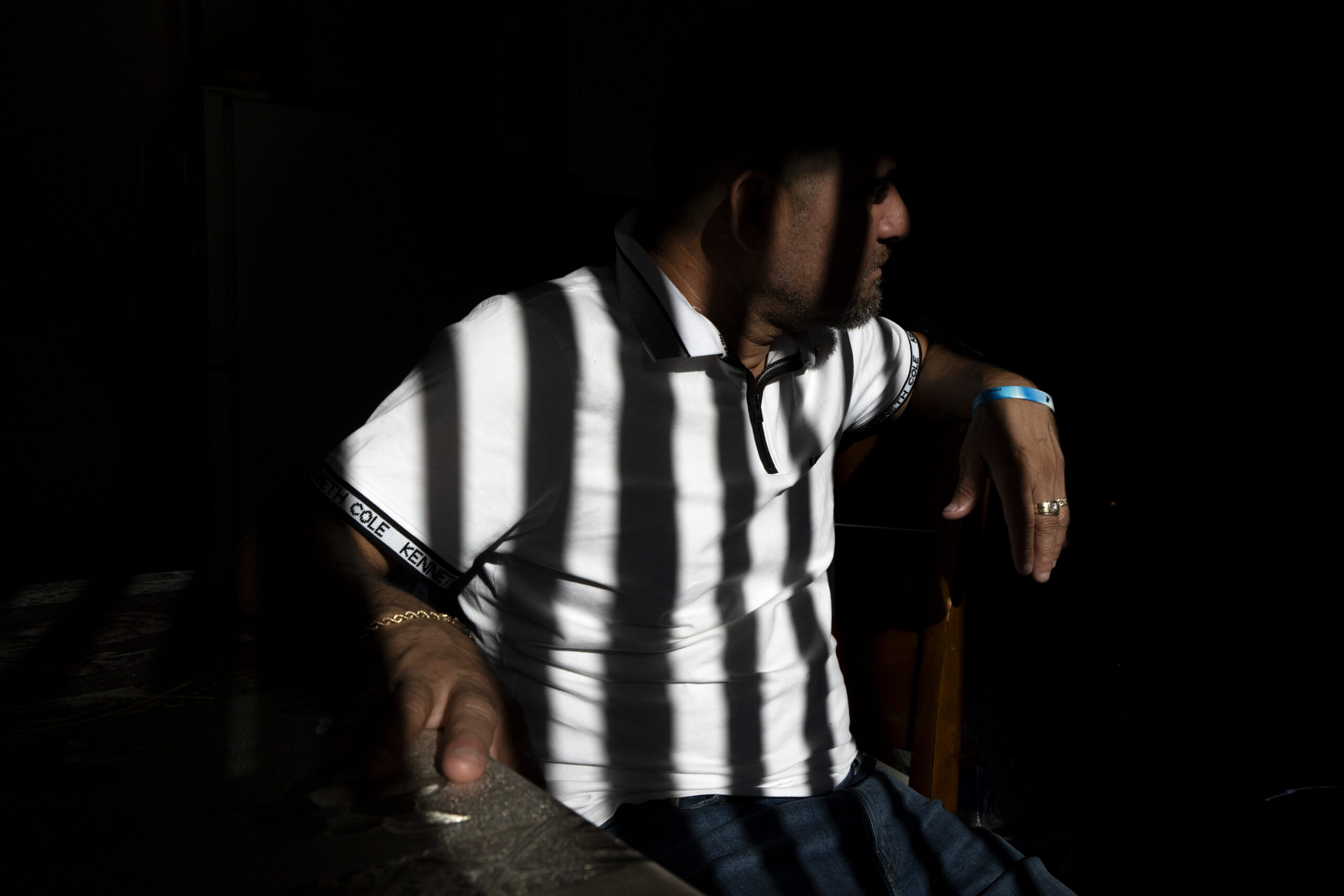
When immigration agents arrived at the Los Angeles car wash where he worked, Giovanni didn’t see them until one was standing beside him. Giovanni’s thoughts turned to his family: How would they get by without him? Would he have to uproot his school-age children from the only home they had ever known?
Giovanni had worked at the car wash in the San Fernando Valley for years, vacuuming interiors and scrubbing cars. Then, on that day in October, he was taken away by federal immigration agents along with three other workers.

Within 24 hours his compatriots had been deported to Mexico, and Giovanni, now 48, was on his way to the Adelanto ICE Processing Center in San Bernardino County, where he would remain for six months. Unlike his co-workers, Giovanni refused to sign documents that would have allowed the federal government to deport him to his native El Salvador.
At home in the San Fernando Valley, his family was distraught. Someone sent Giovanni’s wife, Maria, a video of the raid at the car wash. She watched as her husband, in his bright blue shirt and sun hat, was escorted into a vehicle that then sped off.
The couple and other immigrants who shared their experiences with Capital & Main are being identified only by their first names for safety reasons.
Giovanni is one of thousands of people detained in Southern California by U.S. Immigration and Customs Enforcement, Customs and Border Protection and other federal law enforcement agencies in an often-violent campaign against undocumented immigrants that began one year ago.
For advocates who had prepared for expanded immigration enforcement under a second Trump administration, the scale and speed of the raids that began in June 2025 still came as a jolt.
“I think it has taken our breath away in the velocity, the cruelty, the unbridled violence that we have seen,” said Lindsay Toczylowski, co-founder, president and CEO of Immigrant Defenders Law Center.
Federal immigration agencies cast a wide net during the Trump administration’s summer 2025 surge in Southern California, shifting resources from border enforcement to neighborhoods. Arrests increased by a factor of seven compared to the same period the previous year and swept up more immigrants without criminal convictions in their communities, workplaces and homes, according to a Capital & Main analysis of data ICE collected for the seven-county region under the jurisdiction of its Los Angeles field office.
A year later, the public spectacle of masked men pulling people out of vehicles and pointing guns at bystanders, of multiple vehicles surrounding businesses and agents tackling workers, has largely faded from view. Massive public protests that ended in clashes with police have subsided. The National Guard members and Marines that President Donald Trump ordered deployed to Los Angeles left after two months. Viral videos of arrests no longer dominate social media feeds.
But for many immigrant families, the consequences of the crackdown have persisted. Thousands of people detained during the height of the raids remain in immigration custody or have already been deported. Partners have been left to raise traumatized children alone, families have lost primary breadwinners and face losing their housing too, and communities that once watched arrests unfold in broad daylight are now navigating a quieter, more entrenched threat.
What began in June 2025 as a highly visible show of immigration enforcement under the Trump administration evolved over the past year into something less public but still deeply felt. Community advocates say enforcement tactics have shifted from large-scale visible operations to smaller, quicker raids, even as arrests and removals continue at an elevated rate across Los Angeles and other cities nationwide.
For many, especially immigrant and Latino residents who describe a lingering sense of uncertainty, the summer 2025 raids have reshaped how safe it feels to move through the city — especially after a September Supreme Court decision allowed agents to profile people based on the language they speak, their race or ethnicity, their jobs or where they are located.
In the U.S., where 82% of Latino adults are native-born citizens, naturalized citizens, or otherwise lawfully present, Latinos are increasingly worried about being asked about their citizenship or legal status, according to the Pew Research Center. In the same survey, conducted in October, Pew reported that about 11% of Latinos said they had begun carrying passports or other identifying documents with them for safety.
Data now offers a clear picture of the scale of the crackdown in the L.A. ICE field office’s “area of responsibility,” which spans Los Angeles, Orange, San Bernardino, Riverside, Ventura, Santa Barbara and San Luis Obispo counties. During the six-week summer surge from early June to mid-July last year, arrests in the region increased nearly sevenfold compared to the same period in 2024, rising from roughly 500 to more than 3,500, according to data provided by ICE in response to a Freedom of Information Act request from the Deportation Data Project and analyzed by Capital & Main.
Arrests remained two to four times higher in the months that followed compared to the same period a year prior, the analysis found. The latest Deportation Data Project records release covers ICE activity through early March. The figures cover only interior enforcement operations — people arrested by ICE in Southern California. They do not include border apprehensions.
When Donald Trump returned to office in 2025, his administration placed immigration enforcement at the center of its political agenda, promising to target people accused or convicted of violent crimes.
However, data from the counties policed by the L.A. ICE field office shows the raids increasingly swept up people without criminal convictions.
In 2024, about a third of those arrested in the region had no criminal conviction or pending criminal charge. By 2025 the share had grown to more than half. During the six-week peak summer period, 69% of those arrested had no prior convictions, including Giovanni.
A DHS spokesperson, who declined to provide a name for this story, said in an email that the information gathered by the Deportation Data Project had been “cherry picked” to “peddle a false narrative.”
“DHS nor ICE have verified the accuracy, methodology or the analysis of the project and its results,” the spokesperson wrote. “The bottom line is that the Deportation Data Project is not accurate.”
A Capital & Main reporter asked the agency to provide correct data, but DHS did not respond.
In response to a separate query, a DHS spokesperson, who also declined to provide a name for this story, defended its enforcement methods, saying that the agency is focused on enforcing laws and that officers are trained to “use the minimum amount of force necessary to resolve dangerous situations.”
The agency spokesperson also disputed Capital & Main’s finding that most people arrested by ICE did not have a criminal conviction, writing in an email “that nearly 70% of ICE arrests are of people charged or convicted of a crime.” DHS did not respond to a request to provide data to support this claim.
The scale and violence of the raids reflect Trump’s lack of restraint in his second term, said Louis DeSipio, professor of political science and Chicano/Latino studies at the University of California, Irvine.
Trump has been emboldened by a compliant Congress that approved historic levels of funding for ICE and Border Patrol and has enlisted other federal agencies to assist with immigration enforcement and deportations.
“What was threatened is that enforcement would become indiscriminate and it did,” said DeSipio.
Critics say the raids also reflected years of increasingly xenophobic rhetoric, particularly toward immigrants from Latin America as well as Black immigrants from Haiti and African nations, that had become a defining feature of Trump’s political rise. Trump is attempting to end birthright citizenship through an executive order now before the Supreme Court, which heard arguments in April. Legal immigrants are also feeling squeezed by the administration, which has restricted their access to jobs, ended benefits for some permanent residents and others with legal status, and moved to strip some naturalized immigrants of their citizenship.
In addition, a U.S. Senate report, released in December, documented that nearly two dozen American citizens were detained by ICE across the country between June and November 2025, including a pregnant woman and an Army veteran. A separate Capital & Main analysis published in August found that at least nine citizens in Southern California were detained by the agency last year, including a 20-year-old man arrested while on break from his job at Walmart in Pico Rivera. He was held for three days.
“If you look different, if you don’t speak English, if you sound different, you are a target,” said Vanessa Cárdenas, executive director of America’s Voice, a Washington, D.C.-based nonprofit that advocates for immigration reform.
Los Angeles as a Testing Ground
The surge, which began in politically blue Los Angeles, followed renewed national emphasis on interior immigration enforcement promised by Trump during his reelection campaign. Within weeks of the raids in Los Angeles, similar reports of raids and agents pulling people off the street and out of cars soon surfaced in Chicago, New York and Minneapolis, where two citizens were shot and killed by federal agents.
DeSipio said Los Angeles County — home to 950,000 unauthorized immigrants, according to the California Immigrant Data Portal, and the most foreign-born residents of any county in the nation — became the center of the bullseye because of the region’s politics and demographics.
“It’s a way of undermining and seeking to undermine California Gov. Gavin Newsom, who is perceived as a political threat,” said DeSipio.
California, the state with the nation’s largest number of undocumented immigrants, has long pushed back against federal crackdowns, from the border militarization of Operation Gatekeeper in the ’90s to programs like Secure Communities, which increased cooperation between local law enforcement and federal agencies beginning in 2009. The state has also offered health care and other benefits to those without legal status and is the birthplace of sanctuary cities, which limit local police force cooperation with federal immigration officials. Los Angeles, a sanctuary city, boasts the most active immigrant rights movement in the country and is sought after for training and guidance by activists from other cities.
“I believe that is why they came to Los Angeles first,” said Angelica Salas, Executive Director of the Coalition for Humane Immigrant Rights, known as CHIRLA, one of the oldest immigrant rights organizations in Los Angeles and a leader in the movement. “They wanted to test us and test all of the protections we had in place and try to break those protections.”
At the beginning of Trump’s second term, CHIRLA reactivated its Rapid Response Network, which includes thousands of volunteers who support immigrants facing arrest and detention. Last summer, the network also published a map highlighting hotspots of enforcement activity.
Almost immediately after the first raid, the hotline lit up with calls about ICE activity throughout the region. Volunteers rush to the scene to record arrests and to try to identify those detained so family members can be notified. So far, the hotline has received more than 20,000 calls, Salas said.
“ICE thinks it’s all about them, and it is about documenting their abuses, but first and foremost it’s about rapid response aid to the people who are being impacted,” Salas said.
Since Trump’s election in 2024, advocacy groups spent hours teaching people about their constitutional rights. As a result, more people knew what to do when federal agents arrived on their doorstep, Salas said.
During an interview with CNN months before the raids, Tom Homan, Trump’s border czar, said such know-your-rights campaigns, along with the restrictions on cooperating with ICE imposed by sanctuary cities, were forcing increased neighborhood enforcement.
“If we got to play that cat-and-mouse game, that’s what we are going to do until every one of them is gone,” he said.
The street patrols and raids began five months later.
Visible Workers Become Easy Targets
During the summer surge, agents increasingly conducted at-large arrests — done mostly in public places, according to the ICE data analyzed by Capital & Main. These included masked men detaining workers outside a donut shop at dawn in Pasadena; nabbing street food vendors and leaving their carts behind; and a sweep in MacArthur Park where Mayor Karen Bass confronted agents and called the tactic “fear, chaos and politics.”
These types of arrests nearly quadrupled to roughly 9,600 last year. During the summer surge, they increased tenfold compared to the same period in 2024. They also made up a larger share of arrests in the region last year than the prior year, accounting for 68% of all Southern California arrests in 2025, up from 54% the year before.
The hardest-hit groups were day laborers and car wash workers, because they are visible and accessible, said Flor Melendrez, executive director of the CLEAN Car Wash Worker Center. Men bore the brunt of the raids, making up 87% of those arrested by ICE last year, the analysis shows. By far, those arrested hailed mostly from Mexico followed by Guatemala and El Salvador. Data shows there was an uptick in arrests of people from China and Iran.
Families Living in the Aftermath
Many families lost their main breadwinner. That’s true for Blanca, whose husband, a day laborer, was detained two days after the raids began last June. After he was detained, Blanca navigated the birth of her third daughter and the critical beginning of her baby’s life alone. She fell into depression.
“The only person who worked was my husband and he paid all the bills,” she said. “He was the pillar of the house and that’s why it affected us so much, financially and emotionally.”
The family lost their apartment and moved in with relatives for the eight months Blanca’s partner was in detention. Her little girls, both under 5, asked constantly where their father was.
Since her husband returned home, Blanca said she is afraid every time he leaves the house, and she rarely goes out with her daughters.
The full fallout from the raids has not yet been measured, DeSipio said.
Schools in Los Angeles saw attendance decline as some parents remained fearful about leaving home and some children were afraid to go to class. Giovanni and Maria’s children stayed home for two months after his arrest.
“Right now, we are seeing the shock of what happened,” said Melendrez of the CLEAN Car Wash Worker Center. “But for years to come we’ll see the children who, instead of going to college, will have to go into the workforce. We haven’t seen the final effects of this.”
Detention Became Almost Inevitable
Almost all those arrested last year ended up in detention. In 2024, about three-quarters of people arrested by ICE in the seven-county region were taken into federal custody. By 2025, that figure had climbed to 96%. The number of people detained nearly quadrupled, from roughly 3,500 to more than 13,400. Detainees have reported inhumane conditions — from inadequate medical care to excessive use of force by guards.
Giovanni spent six months in detention, where he developed a serious skin rash, hoping for a reunion with his family. Even now, after his release, he has to catch his breath and wipe his eyes when he talks about being taken away. He’s a wiry man with salt-and-pepper hair who is eager to provide for his family but is unable to do so.
At home their apartment became a hub of activity as Maria, a mother whose determination is in her voice, focused on her husband’s release. She found an immigration lawyer, rallied friends and family for help and reached out to CLEAN Car Wash Worker Center for guidance. And she prayed, constantly.
“I begged God that he could be here when our daughter graduates,” Maria said.
Their girl walked across the stage in early June. Giovanni was proud to be there.
So, when a judge issued a $55,000 bond, an amount Melendrez said was the highest she had seen so far, Maria raised some of the money and borrowed the rest with the help of friends. Giovanni was released in April with an ankle monitor and a court date.
Maria is paying $700 a month on that loan, and she said she’ll just keep figuring out how to pay it if it means keeping her family together in Los Angeles, for now.







