The Swedish battery giant Northvolt had been the great hope of European green tech, a ‘Swedish Tesla’ that had raised over $13 bn (€11 bn) in just over seven years and had been hiring 150 people a week at the apogee of its growth.
That was before it filed for bankruptcy in March 2025.

Its co-founders, Peter Carlsson and Paolo Cerruti, had both worked alongside Elon Musk at Tesla, and when the two Swedes claimed that they could build a world-leading lithium-ion battery hub in Europe, investors - including Volkswagen and Goldman Sachs - believed them.
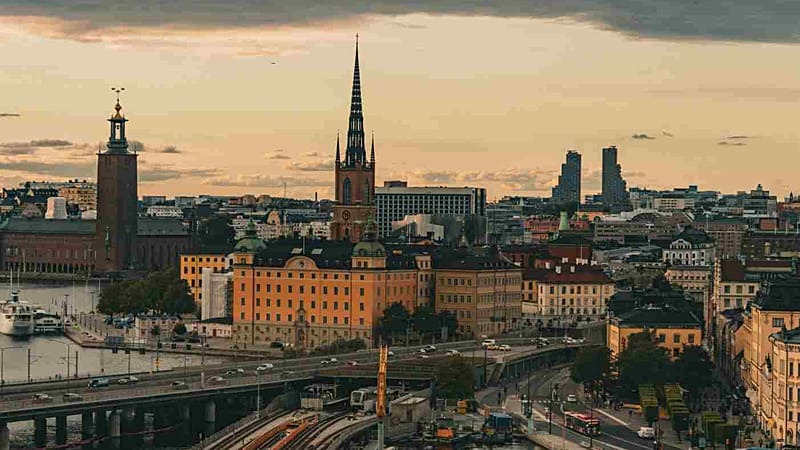
Between 2019 and 2024, Northvolt built two factories in Sweden, in Skellefteå and Västerås. “Over the next 10 years we will see the industrial landscape for the industry shaping. We think 150 GWh - or 25 percent market share - is not unrealistic, ” Carlsson told the Financial Times in 2019.
But it was.
First came reports of production delays at Northvolt's factory in September 2022 and the pushing forward of its timeline of 16 GWh production from 2023 to 2024. Then, news broke in late 2023 that Northvolt’s ‘secret’ third-quarter results had delivered just 0.5 percent of its planned capacity for 2024. Northvolt burned nearly $1 billion (€847m) in the first nine months of 2023. It failed to raise in 2024, and lost a deal with BMW that June, and laid off 1,500 workers.
Then came bankruptcy and Carlsson’s exit. In August 2025, lithium-sulfur battery operator Lyten acquired Northvolt's remaining assets in Sweden, Poland and Germany, including its manufacturing sites in Skellefteå and R&D hubs in Västerås, and all of its IP.
“For me personally, it remains key for Europe to have a homegrown battery industry, but it is a marathon to build such an industry. It needs patience and long-term commitment from all stakeholders,” said Tom Johnstone, interim chairman of Northvolt’s board of directors.
A press release also blamed geopolitical instability and market demand.
US President Donald Trump’s second stint in the White House - and climate change scepticism that has come along with it - undoubtedly played a role in that instability, but overall investment in green tech and the energy transition continues to rise. Green tech investment hit $2.3 trillion in 2025, with China, India, and Japan leading the charge, according to Bloomberg data.
So if Northvolt’s demise was not symptomatic of a global trend, what about a Swedish one? Is Europe simply incapable of building a billion-dollar green tech firm?
“I don’t think you should overestimate it,” said Jan Larsson, who leads consultancy firm Business Sweden.
“Naturally, it was a hard blow to the community in Skellefteå [...] but we still believe that we have a vibrant battery eco-system in Sweden, especially when we collaborate - which we do, very closely - with Finland and Norway. It is still very attractive. We have a lot of know-how and research,” he said.
Sweden’s other green tech companies have watched - and learned - from Northvolt’s Icarus-like journey over the last decade. Northvolt was both an investor and a customer of Altris, the Swedish sodium-battery startup. Speaking on the sidelines of the Techarena event in Stockholm, CEO Christer Bergqvist said: “It forced us - and other companies - to think about how you do incremental growth. How do you take conscious steps towards having a product? How do you stay close to your customers?”
“I think that the time of signing an offtake and using that to get funding and then hiring and scaling - it’s not as imminent anymore,” Bergqvist told Euronews Next.
“What we've learned is we're really good at developing our technology to a certain point. The next step is producing that at industrial scale. That's a different mindset.”
For Altris, Bergqvist said, that has been recognising that sustainable scale requires partners. In January 2026, the firm formed a partnership with the Czech firm Draslovka to manufacture its sodium-ion cathode active material (CAM) on which its batteries run, a markedly different approach to Northvolt, which aimed to build its batteries in-house.
“Northvolt was trying to was vertically integrate and get a much higher financial upside [...] If they would have been successful, fantastic [...] but they didn't get it off the line,” he said.
Outside the batteries sector, too, lessons have been learned. Eunice Silva, a technical project manager at CorPower Ocean, said that Northvolt’s example raised important questions about fundraising and the importance of “taking smaller steps instead of a big leap [...] Prove - step by step - that the company is doing everything in a healthy and structured way.”
Founded in 2012, CorPower is only now building a 10MW wave energy project off the coast of Northern Portugal, funded by a €40 million EU Innovation Fund grant.
And despite the hardening of attitudes towards clean energy projects across the Atlantic, where the Trump administration has cancelled hundreds of major green tech projects, European attitudes towards the green transition seem as robust as ever, Silva said.
Green energy will help Europe wean itself off oil and gas and, as such, the transition is as much about energy security as it is about sovereignty. As such, European clean and green tech startups would like to see more focus in the corridors of power on making building a green energy business easier - and less regulation-heavy - than it is at present.
“Ireland, Portugal, Scotland all have different licensing rules - and different entities- and in the country itself, you have to deal with a myriad of entities that have different perspectives, different demands, and sometimes they don't talk to each other. It makes the process quite bureaucratic and long,” Silva said.
It remains to be seen what US buyer Lyten does in Skellefteå, produce batteries - as Norvolt did - or focus on research and development. If the latter, he added, Sweden’s eco-system will “re-shape” and become less about manufacturing - which requires lots of labour and is capital intense - and more focused on innovation and research. “We still have an electricity system that is almost 100 percent fossil free,” Larsson said.
As for Northvolt specifically: “A lot of lessons, naturally, can be learned about scaling, about how much capital you can attract to one and the same project,” he said. It also raised questions about how feasible it is to set up an entire battery manufacturing industry from scratch - not just in Sweden, but in Europe as a whole.
For Larsson, the post-match analysis about the rise and fall of Northvolt will be on the minds of Europeans for some time, whether in green tech or otherwise, and will provide lots of interesting subject matter for business studies students, now and in the future.
“There should be doctoral theses written about [this],” he said.