Get all your news in one place.
100's of premium titles.
One app.
Start reading
Tom’s Guide
Tom’s Guide
Technology
John Velasco

One of the coolest gadgets of 2026 beats my phone at astrophotography — and captures unbelievable nighttime timelapses

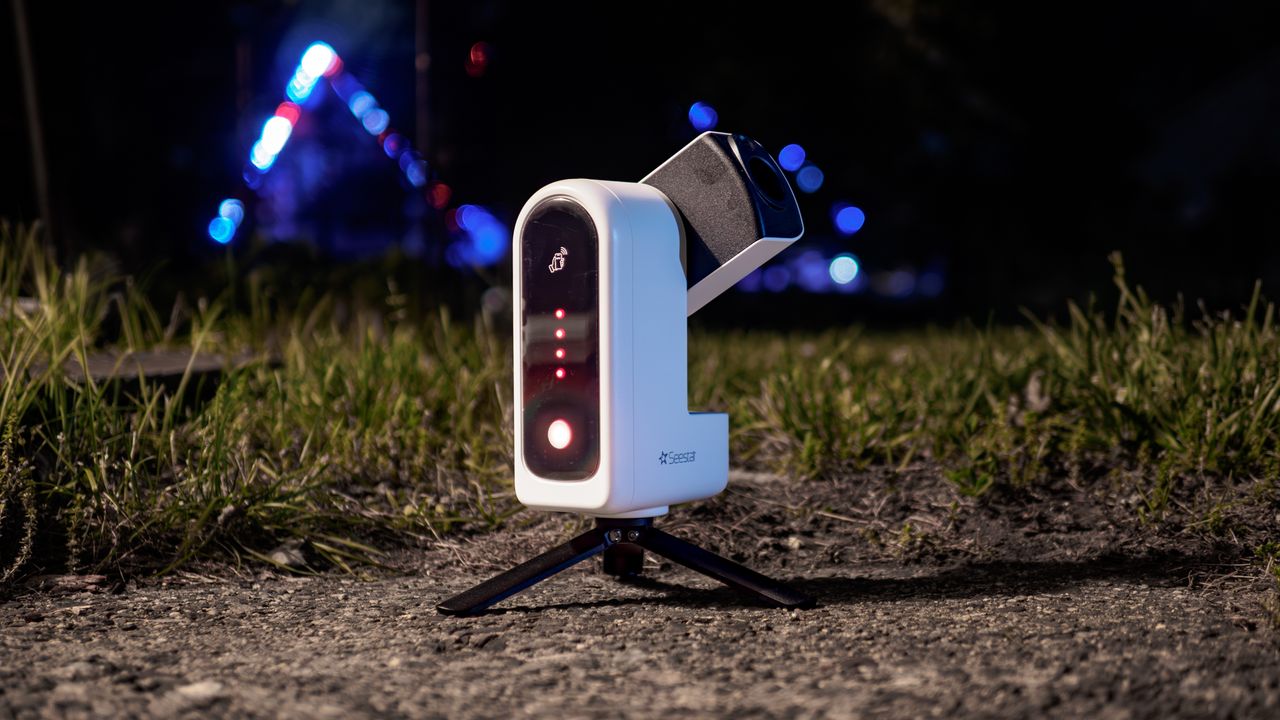
Seestar S30 Pro review.

Nothing relaxes me more than a nighttime astrophotography session in my backyard. Since the start of the year, I’ve been testing a new smart telescope: the Seestar S30 Pro. While it looks almost identical to the Seestar S30 I used last year, the nebulas, galaxies, and star clusters I’ve captured look far more polished thanks to the upgraded hardware.

It all stems from the Sony IMX585 (STARVIS 2) sensor in its telephoto lens. Unlike the standard S30, it delivers full 4K resolution and vastly superior dynamic range. At the same time, the larger sensor yields a much wider field of view, allowing it to capture larger deep-space objects — like the Horsehead and Flame nebulas — in their entirety.

But the coolest part isn’t just that it shoots better astrophotography than my phone, it also captures some of the most epic nighttime timelapse clips I’ve ever recorded. Honestly, it’s a machine built to capture time in the most amazing way possible.

Movement of the moon and sun

(Image credit: Tom's Guide / John Velasco)

You would think that by now I'd be tired of imaging the same things in the night sky. Because really, how many times do I need another shot of the moon? Most of the best camera phones on the market can pull off impressive lunar shots, capturing small details like craters and darker maria. But no matter how much phone manufacturers try to convince me otherwise, the Seestar S30 Pro proves why smart telescopes are lightyears ahead in terms of quality.

Just look at the shots I captured straight out of the telescope, without any additional enhancements or editing. The details are rich and plentiful, and even when I apply a digital zoom through the app, it still produces a true-to-life image that phones simply can’t match. But the coolest part is using the Seestar S30 Pro to record a timelapse.

A timelapse reveals how the moon subtly changes position and phase over a couple of hours — movements you can only appreciate when time is sped up. It’s a similar story with the sun once I install the included solar filter. Not only does the S30 Pro expose crisp sunspots on its surface, but a timelapse reveals how they shift across the solar disk due to the sun's rotation.

Unmatched performance

(Image credit: Tom's Guide / John Velasco)

Don’t get me wrong, smartphones have come a long way, and so has their astrophotography performance. Over the last six months, I’ve used the Galaxy S26 Ultra, Pixel 10 Pro XL, and iPhone 17 Pro to shoot the night sky. While they do a decent job of capturing those twinkling stars, they simply lack the telephoto reach to resolve distant galaxies and nebulas.

The Seestar S30 Pro can turn any beginner into an expert after just a few sessions because you just select a target through the companion app, and the telescope takes care of the rest. There is simply no comparison to the images it produces. The beauty of the S30 Pro's wider field of view is its ability to easily handle massive deep-sky targets. For instance, I love that I can capture the Horsehead and Flame nebulas together in a single, perfectly framed shot.

Other smart telescopes, like the Unistellar Odyssey Pro and Seestar S50, feature longer focal lengths that allow them to zoom in much closer — but they struggle with expansive targets like the Andromeda Galaxy. Thanks to the S30 Pro's broader view, some of my favorite captures over the past three months include the Rosette Nebula (NGC 2244), the Needle Galaxy (NGC 4565), the Pinwheel Galaxy (M101), and the stunning Whirlpool Galaxy (M51).

Astrophotography timelapse

(Image credit: Tom's Guide / John Velasco)

All of this brings me to why I’ve fallen in love with the Seestar S30 Pro: its remarkable timelapse ability. Because it stays completely stationary on its tripod, I can switch over to the secondary 4K wide-angle camera. Armed with a Sony IMX586 sensor and a wide 63-degree field of view, it keeps the horizon locked while capturing the mesmerizing sweep of the night sky.

The results are breathtaking. Most of the clips above are 15 to 30 seconds long, but I’ve sped them up and converted them into gif animations. It’s genuinely fascinating to see what happens to the sky over a few hours — and I’m not just talking about the stars. In fact, some of my favorite timelapses show fast-moving clouds rolling across the frame, dramatically parting to reveal the vibrant constellations hidden behind them.

Even though competitors like the Dwarf Mini are slightly more compact, the Seestar S30 Pro’s sheer performance and versatility remain unmatched. While I might have a tough time deciding which smart telescope to pack for a quick road trip, the Seestar is easily the better-equipped machine for tracking deep-sky objects and producing jaw-dropping nightscape timelapses.

Ultimately, the Seestar S30 Pro lives up to its promise as one of the coolest gadgets I've tested so far in 2026. It bridges the gap between casual smartphone photography and complex, traditional astrophotography rigs. By packing a crisp 4K telephoto sensor, advanced tracking, and a stellar wide-angle timelapse mode into a single portable package, it doesn't just look at the universe — it captures time itself.

More from Tom's Guide

Sign up to read this article
Read news from 100's of titles, curated specifically for you.
Already a member? Sign in here
Related Stories
Top stories on inkl right now
One subscription that gives you access to news from hundreds of sites
Already a member? Sign in here
Our Picks
Fourteen days free
Download the app
One app. One membership.
100+ trusted global sources.