Get all your news in one place.
100’s of premium titles.
One app.
Start reading
LiveScience
LiveScience
Brian Owens

Once-in-a-century floods set to become annual events in northeastern US in the next 75 years, study finds

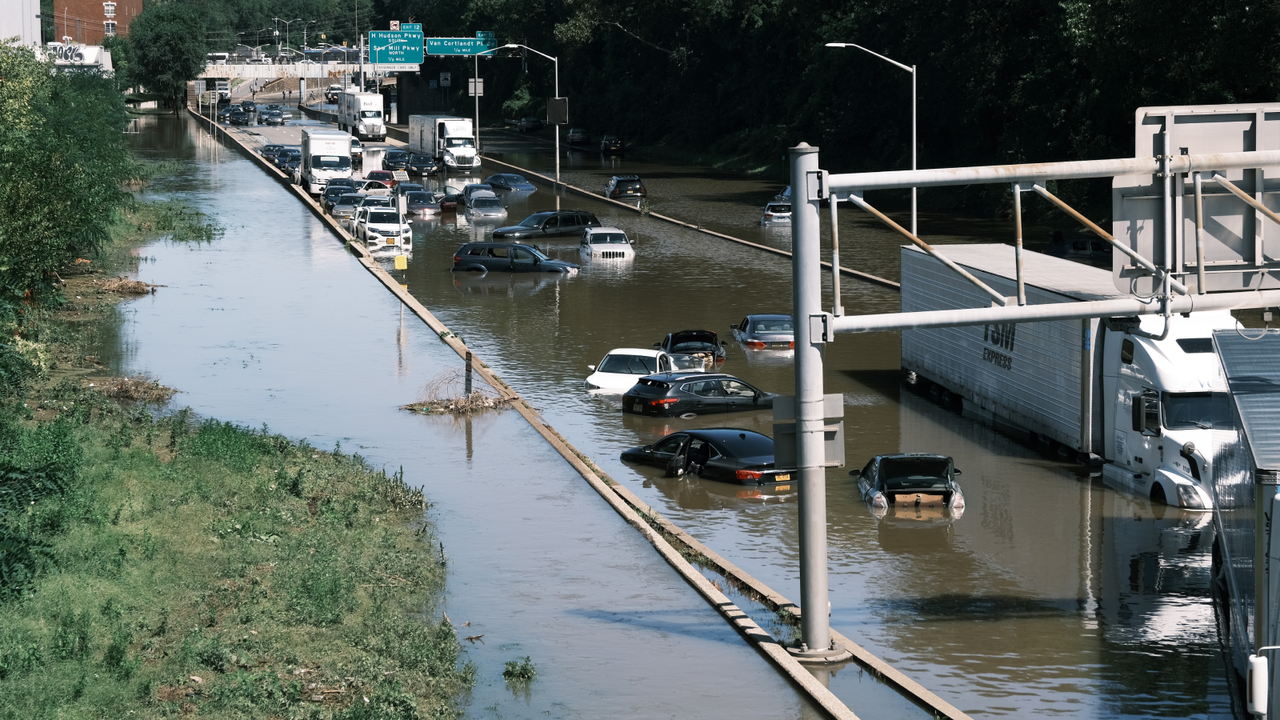
Cars sit abandoned on the flooded Major Deegan Expressway in the Bronx following a night of heavy wind and rain from the remnants of Hurricane Ida on September 02, 2021 in New York City. .

Extreme flooding events caused by hurricanes that used to happen once every 100 years in the northeastern U.S. may become annual occurrences by the end of this century, according to a new study.

Researchers wanted to predict how the changing behavior of hurricanes — they are expected to become more frequent and more intense — and sea level rise as a result of climate change will alter the risks of flooding in the region over the next several decades.
Their results were sobering. "By the end of this century, the flood hazard is going to go up tremendously," study lead author Amirhosein Begmohammadi, a civil engineer who worked on the project during his postdoctoral research at Princeton University, told Live Science. To predict the risk of flooding under different carbon emission scenarios, Begmohammadi and his colleagues developed a computer model to generate a series of synthetic storms and included predictions for sea level rise.

The researchers also adjusted their model to take into account the angle at which storms hit the coast. Most hurricanes that affect the northeast move parallel to the coast, but some, like Hurricane Sandy in 2012, hit it head-on, and can cause much more damage. "Those are extreme but rare," Begmohammadi said.

The model predicts that both sea level rise and changing storm features could make extreme flood events more frequent. Historical 100-year coastal flooding could happen every year by the end of the century, while historical 500-year floods may come every 1 to 60 years under a moderate carbon emissions scenario, and every 1 to 20 years under higher emissions. In more northern areas like Connecticut and New York, sea level rise may be the main driver of the increased flood risk, while storm changes are less important. Further south, in areas like New Jersey and Virginia, both factors may contribute significantly to higher flood risks.

The findings were published Nov. 7 in the journal Earth's Future.

Jeff Ollerhead, a coastal geomorphologist at Mount Allison University in Sackville, Canada, said that the study highlights how scientific uncertainty is the least important variable in predicting future climate risks. Ollerhead, who was not involved in the study, told Live Science that the majority of the variation in models comes from the "social uncertainty" of not knowing what emissions pathway the world will go down. "We don't know what people are going to do," he said, referring to how political leaders will respond to the climate crisis. "That's the biggest uncertainty."

The new study focused on the strength and frequency of hurricanes. For the more northern stretch of the coast, said Ollerhead, the impact of sea level rise means it almost won't matter if storms become more powerful because even smaller storms will be able to cause extensive flooding. So even if the frequency and power of storms remains roughly the same, the effect of each storm will increase as sea levels continue to rise.

Hurricane Fiona, which hit Ollerhead's region of Atlantic Canada in 2022, had storm surges of close to 6.5 feet (2 meters). But if sea levels rise by 3.3 feet (1 m) over the next 50 years or so, then a storm just half as powerful could cause similar damage. "It will take much smaller events to put water in your back yard," he said. "And they might happen every couple of years."

To prepare for this new reality, people living near the coast will have to adapt to more frequent flooding. The best defence, said Ollerhead, is to move up and back — to higher ground further from the coast. But not every community will be willing or able to do so, and it will be important to update building codes to take into account the changing conditions.

"People who design for resilience do so using the 100-year events, but they're not designing for the future changes,” said Begmohammadi. "A 100-year event now is not the same as one in the future."

Sign up to read this article
Read news from 100’s of titles, curated specifically for you.
Already a member? Sign in here
Related Stories
Top stories on inkl right now
One subscription that gives you access to news from hundreds of sites
Already a member? Sign in here
Our Picks
Fourteen days free
Download the app
One app. One membership.
100+ trusted global sources.