Get all your news in one place.
100's of premium titles.
One app.
Start reading
The Economic Times
The Economic Times
Trending Desk

On This Day in History, June 7: Mahatma Gandhi train incident, Vatican City's creation, Battle of Midway, Harry Potter's stage debut, Boeing 777's intro and many more events

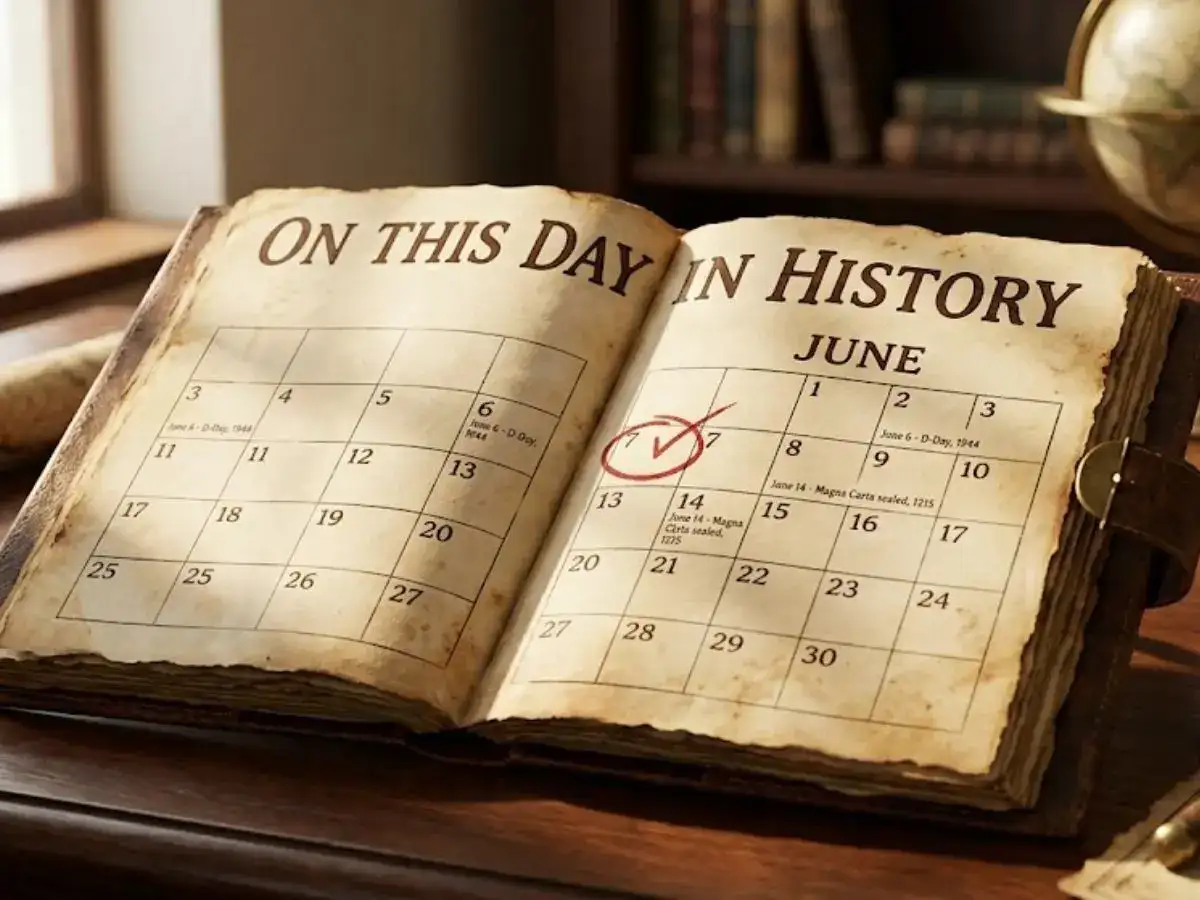
On This Day: June 7 occupies a notable place in world history for events that shaped politics, warfare, exploration and social movements. The date witnessed the Battle of Midway during World War II, key operations during the Normandy invasion, and Mahatma Gandhi's first act of civil disobedience after being removed from a train in South Africa. It also saw the implementation of the treaty that established Vatican City as a sovereign state, the capture of significant territories during the Six-Day War and major milestones in aviation, technology and space exploration. The date also commemorates the coronation of Chhatrapati Shivaji Maharaj in 1674 and the founding of the Basketball Association of America in 1946, the precursor to the modern NBA. Together, these events illustrate June 7's enduring significance across centuries and continents.
1340: Rotterdam founded

The city of Rotterdam was founded in the Netherlands on June 7, 1340. The establishment of the settlement marked the beginning of what would become one of Europe's most important urban centres and a significant location in Dutch history.

1494: Treaty of Tordesillas divides the New World

Spain and Portugal signed the Treaty of Tordesillas on June 7, 1494, agreeing to divide newly discovered territories along a meridian west of the Cape Verde Islands. The agreement played a major role in shaping the future of colonial expansion and influence.

1520: Field of the Cloth of Gold begins

A high-profile meeting between England's King Henry VIII and France's King Francis I began at Balinghem, France, on June 7, 1520. Known as the Field of the Cloth of Gold, the gathering symbolised diplomatic efforts between two powerful European monarchies.

1614: Addled Parliament dissolved

King James I dissolved his second parliament on June 7, 1614, after it failed to pass any legislation. The assembly later became known as the Addled Parliament because of its inability to produce legislative results.

1633: Aurangzeb survives elephant attack

Mughal prince Aurangzeb, then 14 years old and later Emperor Alamgir I, survived an elephant attack on June 7, 1633. The incident became a notable episode in the life of one of the Mughal Empire's most influential rulers.

1654: Louis XIV crowned King of France

Louis XIV was crowned King of France on June 7, 1654. His reign would become one of the most prominent monarchies in European history and strengthen the authority of the French crown.

1665: Great Plague recorded in London

Samuel Pepys wrote in his diary on June 7, 1665, about houses in London's Drury Lane being marked with red crosses to indicate plague infection. The markings signified quarantine measures during one of the deadliest outbreaks in the city's history.

1674: Chhatrapati Shivaji Maharaj crowned at Raigad Fort

The coronation, or Shivrajyabhishek, of Chhatrapati Shivaji Maharaj took place at Raigad Fort on June 7, 1674. Conducted by the Vedic scholar Vishweshwar Bhatt, also known as Gaga Bhatta, the ceremony formally established Hindavi Swarajya and marked Shivaji Maharaj's elevation as the first Chhatrapati. Following the coronation, he was bestowed with the title "Kshatriya Kulavantas Chhatrapati Raje Shivaji" and a new era, Rajya Shaka, was initiated.

1776: Independence proposal introduced

Richard Henry Lee of Virginia moved a proposal for American independence in the Continental Congress on June 7, 1776. The motion became an important step toward the United States Declaration of Independence.

1862: US and Britain act against slave trade

The United States and Britain agreed on June 7, 1862, to cooperate in suppressing the slave trade. The agreement reflected efforts by both nations to combat the practice.

1864: Lincoln renominated for presidency

Abraham Lincoln was renominated as the Republican Party's candidate for US president on June 7, 1864. The decision came during the American Civil War and reaffirmed support for his leadership.

1893: Gandhi removed from train in South Africa

Indian lawyer M.K. Gandhi was thrown out of a first-class railway compartment in Pietermaritzburg, South Africa, on June 7, 1893. The incident led to his first act of civil disobedience and became a defining moment in his political awakening.

1912: First machine gun tested on aircraft

The US Army tested the first machine gun mounted on an aircraft on June 7, 1912. The development represented an early milestone in the evolution of military aviation.

1916: Theodore Roosevelt declines nomination

Theodore Roosevelt declined the Progressive Party nomination on June 7, 1916, and instead endorsed Republican candidate Charles Evans Hughes. The move influenced the political landscape of the presidential election.

1917: Millions register for military draft

Around 10 million American men began registering for military service on June 7, 1917, following the country's entry into World War I. The registration campaign demonstrated the scale of the nation's wartime mobilisation.

1929: Vatican City becomes a sovereign state

The Lateran Treaty came into effect on June 7, 1929, establishing Vatican City as an independent sovereign state. The agreement created the world's smallest country and defined its unique status within Rome.

1938: Boeing 314 Clipper makes first flight

The Boeing 314 Clipper flying boat completed its maiden flight on June 7, 1938. The aircraft represented a significant advancement in long-distance air travel.

1938: Douglas DC-4E conducts test flight

The Douglas DC-4E carried out its first test flight on June 7, 1938. The aircraft formed part of ongoing developments in commercial aviation technology.

1939: British monarchs visit United States

King George VI and Queen Elizabeth became the first British monarchs to visit the United States on June 7, 1939. The trip marked a historic moment in relations between the two countries.

1942: Battle of Midway concludes

The Battle of Midway ended on June 7, 1942, with Admiral Chester Nimitz securing the first major naval defeat of Japan during World War II. The victory became a turning point in the Pacific conflict.

1942: German forces advance into Sebastopol

German troops marched into Sebastopol, Russia, on June 7, 1942, as military operations continued on the Eastern Front during World War II.

1942: Japanese troops land on Attu

Japanese forces landed on Attu in the Aleutian Islands on June 7, 1942. The operation expanded military activity in the North Pacific theatre.

1942: USS Yorktown sinks

The USS Yorktown sank near Midway Island on June 7, 1942, following damage sustained during the Battle of Midway. Its loss became one of the notable naval events of the war.

1944: British forces continue Normandy operations

British troops attacked Bréville and attempted to encircle Caen on June 7, 1944, as Allied forces continued operations during the Normandy invasion. These actions formed part of the broader campaign to liberate Western Europe.

1946: NBA's predecessor BAA founded

The Basketball Association of America (BAA), the organisation that would eventually become the NBA, was founded in New York City on June 7, 1946. Established by arena managers seeking to utilise indoor venues during the winter season, the BAA later merged with the National Basketball League in 1949 to form the National Basketball Association, which traces its origins to the original 1946 charter.

1948: Communist takeover completed in Czechoslovakia

Communists completed their takeover of Czechoslovakia on June 7, 1948, and President Beneš resigned. The development marked a major political shift in post-war Europe.

1953: First compatible colour network telecast

The first colour network television broadcast in a compatible format took place in Boston on June 7, 1953. The event represented a significant advancement in broadcasting technology.

1955: Eisenhower appears on colour television

Dwight D. Eisenhower became the first US president to appear on colour television on June 7, 1955. The appearance highlighted the growing influence of television in public life.

1955: Nehru visits Soviet Union

Indian Prime Minister Jawaharlal Nehru visited the Soviet Union on June 7, 1955. The trip reflected India's diplomatic engagement with major global powers.

1956: Singapore government resigns

The government led by David Marshall resigned in Singapore on June 7, 1956. The development marked a significant political change in the territory.

1963: Rolling Stones debut on television

The Rolling Stones made their first television appearance on June 7, 1963, and released their debut single, Come On . The occasion marked an early milestone in the band's rise to fame.

1964: Beatles tour Amsterdam canals

The Beatles travelled through the canals of Amsterdam on June 7, 1964, with a substitute drummer standing in for Ringo Starr. The visit formed part of the band's growing international popularity.

1965: Gemini 4 completes mission

Gemini 4 completed 62 orbits on June 7, 1965. The mission represented another step forward in the United States' space exploration efforts.

1965: Sony introduces home video tape recorder

Sony introduced a home video tape recorder priced at $995 on June 7, 1965. The product signalled advances in consumer electronics and home entertainment technology.

1967: Israel captures key locations

Israeli forces captured the Wailing Wall in East Jerusalem, along with Jericho and Bethlehem, on June 7, 1967. The developments occurred during the Six-Day War and carried major political and religious significance.

1968: Robert F. Kennedy lies in state

The body of assassinated US Senator Robert F. Kennedy lay in state at St. Patrick's Cathedral in New York on June 7, 1968. The event drew national attention following his assassination.

1980: Gary Numan's 'Cars' enters charts

Gary Numan's hit song Cars reached number nine on June 7, 1980. The track became one of the defining electronic music releases of its era.

1984: Tetris released in the Soviet Union

Alexey Pajitnov released the puzzle video game Tetris in the Soviet Union on June 7, 1984. Originally developed on a Soviet-built Elektronika 60 computer, the game was later adapted for the IBM PC, helping it spread rapidly across Moscow and other parts of the USSR. Its simple yet addictive gameplay would go on to make Tetris one of the most popular and influential puzzle video games in history.

1995: Boeing 777 enters commercial service

The Boeing 777 entered service with United Airlines on June 7, 1995. The aircraft represented a major development in long-range commercial aviation.

2016: Harry Potter play premieres

Harry Potter and the Cursed Child , written by Jack Thorne with J.K. Rowling, premiered in London on June 7, 2016. The production expanded the Harry Potter story onto the stage.

2017: Earliest Homo sapiens evidence announced

Archaeologists announced findings from Jebel Irhoud, Morocco, on June 7, 2017, identifying evidence of Homo sapiens dating back approximately 300,000 years. The discovery contributed to understanding human origins.

2025: National Guard deployment ordered in California

US President Donald Trump ordered the deployment of 2,000 National Guard troops to southern California on June 7, 2025, in response to protests linked to Immigration and Customs Enforcement operations in and around Los Angeles.

Sign up to read this article
Read news from 100's of titles, curated specifically for you.
Already a member? Sign in here
Related Stories
Top stories on inkl right now
One subscription that gives you access to news from hundreds of sites
Already a member? Sign in here
Our Picks
Fourteen days free
Download the app
One app. One membership.
100+ trusted global sources.