
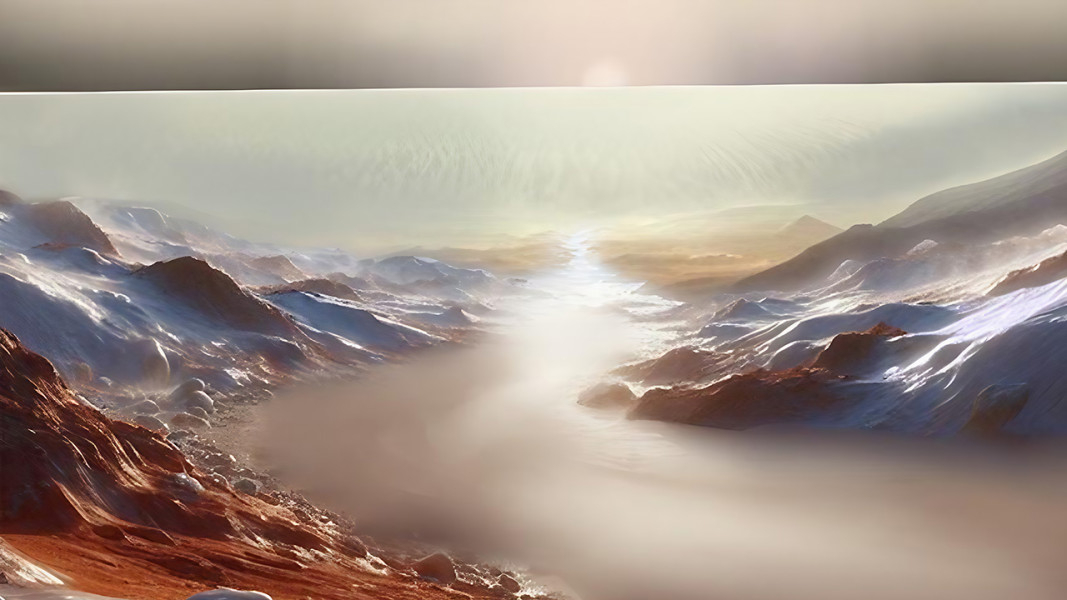
A lone researcher may have figured out how Mars was able to support rivers and seas even after the planet had begun to grow cold and its atmosphere thin, and it's all thanks to a cycle of water and carbon dioxide.
We know from geological and mineralogical evidence that, around four billion years ago, Mars was warm and wet enough to have extensive liquid water on its surface, from rivers and lakes to a vast northern sea. This period covers two geological eras: the Noachian, which ran from 4.1 to 3.7 billion years ago, and the Hesperian, which endured from 3.7 to about 3 billion years ago. The Noachian is characterized by warmer conditions, but by its latter stages Mars should have been starting to grow cold as it steadily lost its atmosphere to space. Yet there is still evidence of river channels and seas dating back to the late Noachian and into the Hesperian era. Planetary scientists have been mystified as to how Mars could still be wet at this time, and one theory is that the Red Planet experienced an unexplained period of global warming.














