
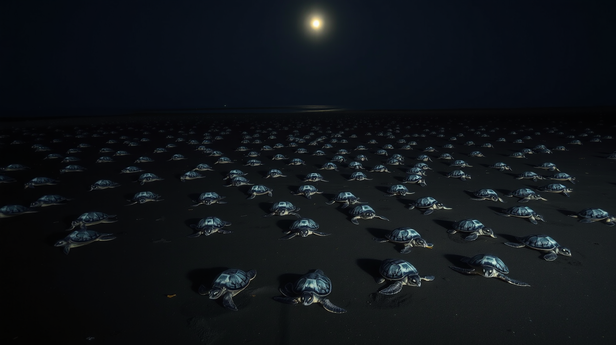
The Night the Beach Disappears Under Turtles
At Gahirmatha Marine Sanctuary on Odisha's northern coast, rangers have counted over 600,000 Olive Ridley turtles nesting in a single arribada, a Spanish word adopted by biologists for this mass synchronised nesting that has no equivalent in any other reptile species. The females arrive in the dark, drag themselves above the tide line, excavate a flask-shaped pit roughly 45 centimetres deep with their hind flippers, deposit around 100 to 150 eggs, cover the clutch, and return to the sea, all within 45 minutes to an hour. Then another female takes the same patch of sand. Then another. At peak arribada, the beach at Gahirmatha holds so many turtles that the sand itself is invisible.

Olive Ridley turtles (Lepidochelys olivacea) are the most abundant sea turtle species on earth, and Odisha hosts two of the three largest rookeries globally. Gahirmatha, declared a marine sanctuary in 1997, and Rushikulya in Ganjam district together receive the bulk of India's nesting population each year between November and March, with the mass nesting event typically peaking in January and February.
How They Find the Same Beach Across Open Ocean
The navigation mechanism behind the arribada is one of the more precise feats in vertebrate biology. Olive Ridley turtles use the Earth's geomagnetic field as a positional map. Research published in Current Biology by Kenneth Lohmann's team at the University of North Carolina showed that sea turtles imprint on the unique magnetic signature of their natal beach as hatchlings and use that signature to return as adults, sometimes after travelling thousands of kilometres through the Indian Ocean.
The turtles that nest at Gahirmatha feed in waters off Sri Lanka, the Lakshadweep Sea, and along the continental shelf as far as the Arabian Sea. They converge on Odisha not because of a single cue but because of layered signals: magnetic coordinates, water temperature gradients, and chemical traces in the water column that correspond to the river outflows near their birth beach. The synchrony of the mass arrival, thousands of females arriving within the same tidal window, is thought to be triggered by a combination of sea surface temperature dropping below a threshold and the lunar cycle, though the exact hormonal cascade is still being studied.
Gahirmatha and Rushikulya: Two Beaches, Different Pressures
Gahirmatha sits at the mouth of the Brahmani and Baitarani rivers, buffered on the seaward side by Wheeler Island (now Abdul Kalam Island), which has historically reduced trawler access. The Indian Navy and ISRO have testing facilities on the island, which inadvertently created a zone of reduced human intrusion near the nesting beach. Rushikulya, by contrast, is flanked by active fishing villages. The beach is more accessible, the hatchlings face a longer run to the waterline, and the surrounding area has more artificial light.
Both sites are protected under the Wildlife Protection Act of 1972, and the Odisha Forest Department deploys seasonal camps with trained guards during nesting season. The Supreme Court of India has, on multiple occasions, issued orders banning mechanised fishing within a defined exclusion zone around Gahirmatha between November and May.
What Is Actually Threatening the Arribada
Three pressures operate simultaneously, and none of them is simple to fix.
Trawler bycatch remains the largest documented killer of adult Olive Ridley turtles in Indian waters. Turtles drown in gill nets and trawl nets when they cannot surface to breathe. The Wildlife Institute of India estimated that thousands of turtles die annually in Odisha's coastal waters from incidental capture, though precise annual figures vary by season and enforcement. Turtle Excluder Devices (TEDs) are legally mandated on trawlers operating near the sanctuary, but compliance is inconsistent and enforcement at sea is difficult.
Light pollution from coastal development, fishing boats anchored offshore, and even the headlights of vehicles on coastal roads disorient both nesting females and, more critically, hatchlings. Sea turtle hatchlings orient toward the brightest horizon, which in an undisturbed environment is the sea reflecting the sky. Artificial light pulls them inland, where they dehydrate and die within hours.
Beach erosion driven by sand mining and altered river sediment flows has reduced the width of nesting habitat at several points along the Odisha coast. A narrower beach means higher nest density, which raises the risk of females excavating and destroying earlier clutches.
What Conservation Has Actually Changed
The seasonal fishing ban around Gahirmatha, when enforced, produces measurable results. Nest counts at Gahirmatha have shown recovery in years with stricter enforcement compared to years when trawlers operated closer to the exclusion boundary. The Odisha government's Sea Turtle Protection Programme, run in partnership with the Wildlife Society of Odisha, trains local fishermen as turtle monitors, which has reduced both deliberate poaching of eggs and incidental nest destruction near Rushikulya.
Satellite tagging studies conducted by the Central Marine Fisheries Research Institute have tracked individual Olive Ridley turtles from Odisha's coast to feeding grounds off the coasts of Andhra Pradesh, Tamil Nadu, and Sri Lanka, establishing for the first time the full migratory corridor that needs protection, not just the nesting beach.
The hatchlings that survive the beach, reach the water, and clear the nearshore zone face open-ocean mortality rates that mean only roughly one in a thousand will reach reproductive maturity. That ratio has not changed. What changes with conservation is how many eggs are laid to begin with, and how many hatchlings make it to the water.
The arribada at Gahirmatha is not a wildlife spectacle that happens despite human activity. It persists in the narrow gap between what the trawling fleet takes and what the nesting beach can still produce. The turtles return to the same magnetic coordinates their bodies memorised as hatchlings, indifferent to whether the beach has changed. The question of whether Odisha's coast can keep receiving them is entirely a human one.