Get all your news in one place.
100's of premium titles.
One app.
Start reading
Fortune
Fortune
Eleanor Pringle

Oil prices are on the march once again after the U.S-Iran conflict intensifies—it's yet another headache for Warsh and the Fed

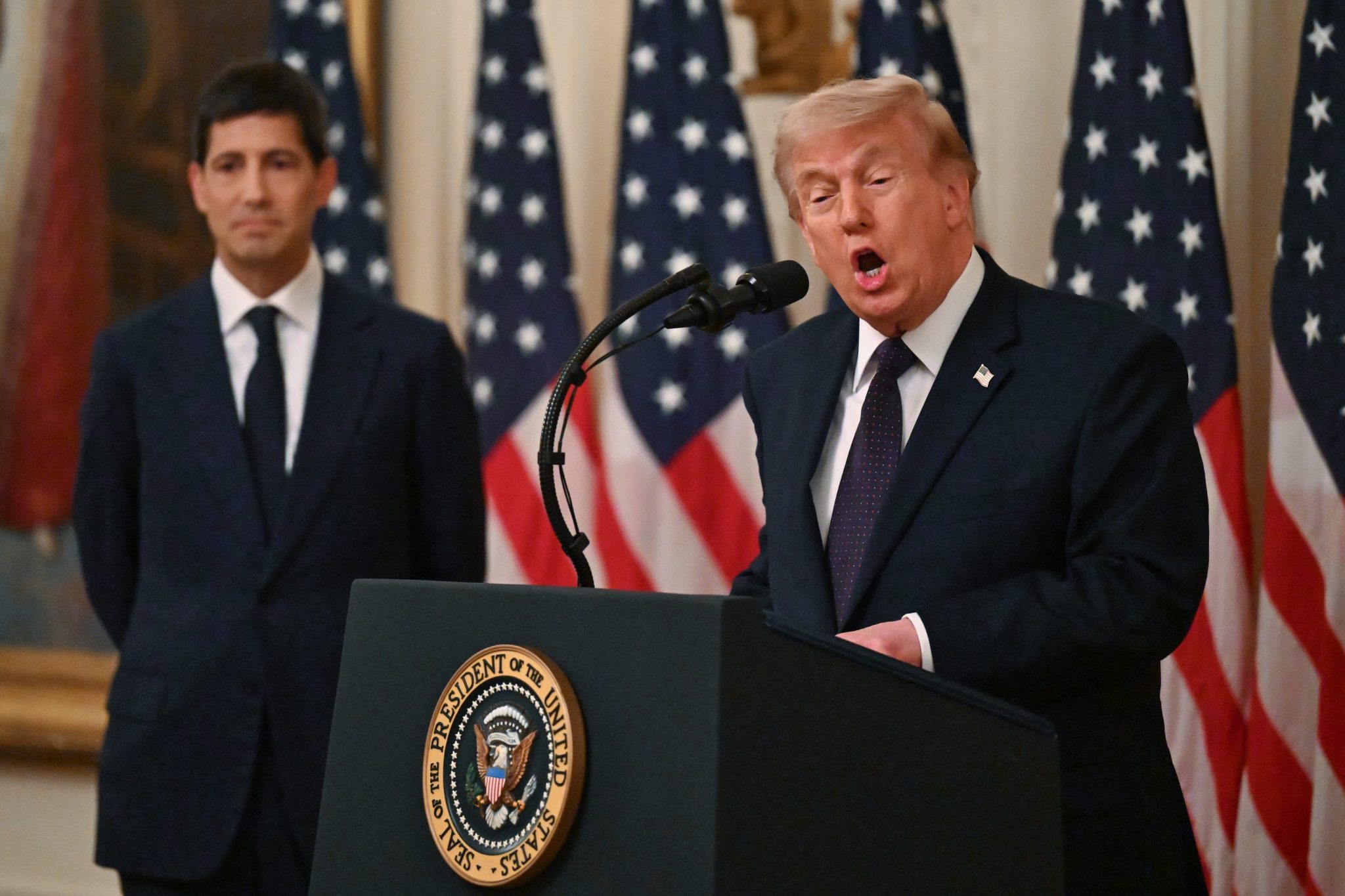
President Donald Trump speaks during the swearing-in ceremony for the new Chairman of the Federal Reserve, Kevin Warsh (L) in the East Room of the White House on May 22, 2026 in Washington, DC. (Credit: Roberto Schmidt/Getty Images)

Wall Street is looking nervously at the Middle East this week, after the conflict between the U.S. and Iran escalated over the weekend. At the time of writing, Brent crude is back up to $78 a barrel, meaningfully above its pre-war level of a little under $70.

This has a knock-on effect for inflation expectations and, as a result, the trajectory of the U.S. Federal Reserve’s base interest rate, Goldman Sachs wrote in a note published Sunday.

Over the weekend, Tehran and Washington exchanged strikes in what Deutsche Bank’s Jim Reid described as a conflict that has “intensified sharply.” Despite the action, President Trump insisted that the Strait of Hormuz—a key shipping lane in the global oil trade—remains open.

The regime in Iran—which borders the Strait—insists the waterway is “closed,” meaning ships will be nervous to leave or enter the Persian Gulf and choking oil supply as a result.
The fallout is also spreading: The Islamic Revolutionary Guard Corps (IRGC) reportedly claimed it attacked U.S. bases in Bahrain, Kuwait and Jordan, while U.S. Central Command (CENTCOM) said it was prompted to act after Iran attacked another commercial ship in the Strait.

The back-and-forth doesn’t lend itself to the rhetoric of de-escalation that Wall Street had been hoping for. Oil futures indicate crude oil prices are expected to rise over the next few months and remain around $72 a barrel through the end of the year.

Inflation expectations

Concern over a more protracted conflict has implications for inflation and, as a result, will fall into the in-tray of the interest rate-setting Federal Open Market Committee (FOMC), led by new Federal Reserve Chairman Kevin Warsh.

Goldman Sachs’s chief U.S. economist, David Mericle, weighed these risks in a note over the weekend. A number of factors should bring inflation down in the coming months, he said, such as the war potentially winding down, the declining effect of tariffs, and “mismeasured and overstated” AI demand. This should be enough to keep the Fed on hold for the rest of the year rather than hiking, Mericle notes, though it “leaves little margin for error.”

However, he wrote that if the conflict re-escalated oil to $100 per barrel, as it did earlier this year, the bank’s modeling suggests monthly core inflation could be boosted by 3 to 4 basis points in the coming months. That’s on top of the current reading of 4.2% recorded by the Bureau of Labor Statistics for May—well ahead of the Fed’s 2% target.

To this end, Mericle adds: “The impact of yet another supply shock on the monetary policy debate could be more significant than the pass-through math alone suggests because it would add to frustration about what has already been a long series of supply shocks and the difficulty of knowing when they will end and would raise concern that they might eventually be enough to unanchor inflation expectations.”

Short-term discomfort is likely to give way to longer-term gain, however, added Mericle’s colleagues on the commodity team. Alexandra Paulus’s team wrote that the disruption caused by the Strait will act as motivation to build other pipelines out of the region.

A note written by the Goldman team on Sunday highlighted: “The recent oil price rally … demonstrates how critical Hormuz flows remain for prices in the short-term. However, in the long-term, we estimate that enough pipeline capacity will likely be added in the Mideast region to insulate over 45% of the pre-war level of Persian Gulf producers’ exports by end-2027 and more than 60% by end-2028 from any potential future Hormuz shocks.”

Sign up to read this article
Read news from 100's of titles, curated specifically for you.
Already a member? Sign in here
Related Stories
Top stories on inkl right now
One subscription that gives you access to news from hundreds of sites
Already a member? Sign in here
Our Picks
Fourteen days free
Download the app
One app. One membership.
100+ trusted global sources.