
Get all your news in one place.
100’s of premium titles.
One app.
Start reading
MusicRadar
MusicRadar
Entertainment
Roland Schmidt

“Offers power, warmth, charm and usability, in a highly convincing virtual analogue reproduction, with real heart and soul”: Cherry Audio SH-MAX review

Cherry Audio SH-MAX.

What is it?

It's difficult to imagine now, but Roland was a little late to the classic-synth party. Inaugurated in 1972, Roland quickly built on the success of the American synth pioneers by using Japanese production techniques to create instruments with a slightly different colour and flavour.

This was exemplified through its series of SH-branded synths, which have often played poor cousin to the likes of the Jupiters and Junos, but as the years have marched on, they have acquired somewhat cult status, driven by their reliable design and enormous sound.

Cherry Audio wowed us with its last outing – its interpretation of the Jupiter-8 – but now it embraces not one but three of the SH series from the '70s, with a little sequential spice from another classic, the System-100.

(Image credit: Cherry Audio)

Performance

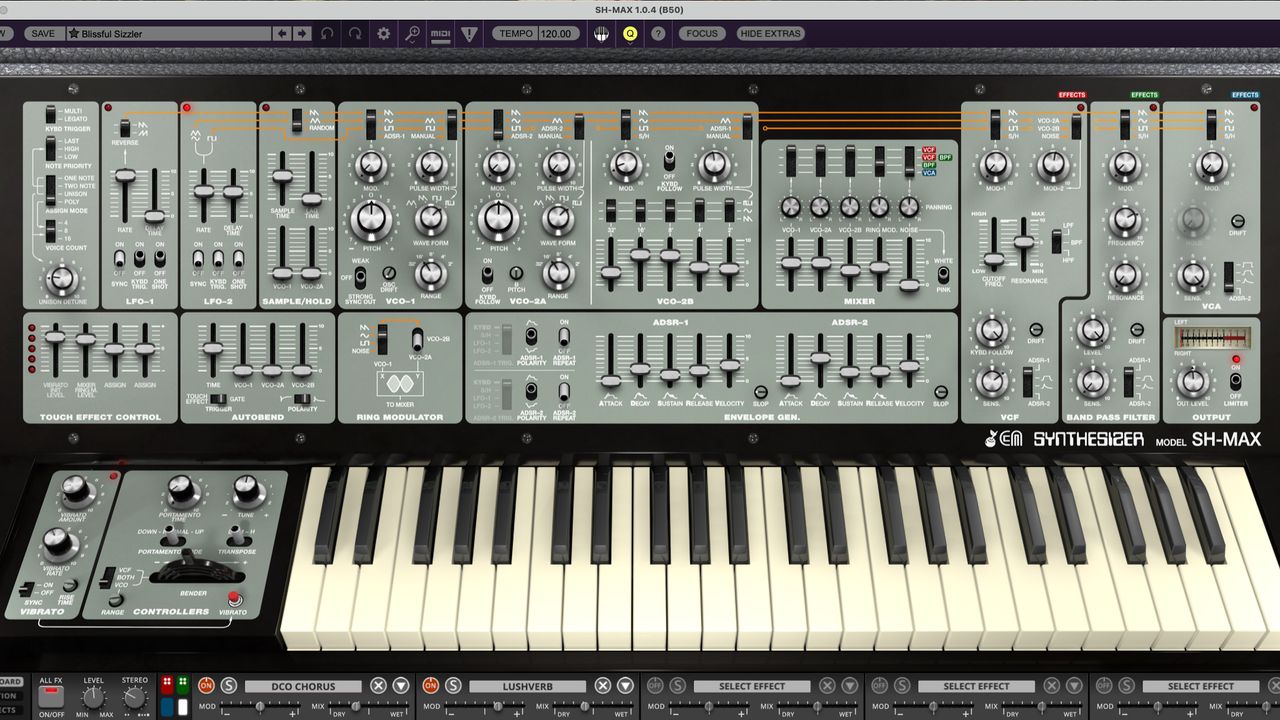
SH-MAX is a fairly literal description of what we have here, being a blend of the SH-3a, SH-5 and SH-7 synths, all culled from the '70s and resplendent in their green/grey colour scheme. You can even dive into the settings to choose the exact colour scheme for each model, if the default shade doesn’t chime with your desktop aesthetic! While there are clearly similarities between these three machines (and the later, classic SH-101 from 1982), it's generally recognised that the earlier models in the SH series had a slightly beefier sound, and this was in no small part due to their interesting design and makeup.

The SH-MAX signal path begins with three oscillators, which all offer their own distinct facets. VCO-1 is the most basic and traditional, offering triangle, saw and square waves, with an added pulse wave which is open to modulation, either manually or from a modulation source within the instrument. There is a Mod pot included in the VCO-1 section, which quickly pushes PWM to a highly recognisable early Human League state. Less ‘dehumanisation’ and more organic synth!

VCO-2 (described as VCO-2A) provides very similar functionality to VCO-1, but lends itself to detuning, for the purposes of creating open fifth style patches, or discordant timbre for bells and the like. VCO-1 also offers detuning, but our level of OCD would always dictate that VCO-2 is likely to be employed for detuning duties – it’s enshrined in synth law! However, VCO-2A is perfectly placed to create really harsh sync tones too, in fact, you can get a really good idea of the instrument’s '70s flavour by just using these two oscillators.

In true Roland style, the oscillators feed a fader-based mixer section, which allows the perfect blending of signals, both in amplitude and stereo pan position. That's a useful trick! The summing of these two signals as an entrée sounds incredibly warm and enticing, with beautiful detailing in the depths of the lower-mid frequency. This also gave us opportunity to explore two-note (duo phonic) operation, where the oscillators blend in unison when played monophonically, or split to generate a note each, when playing two notes simultaneously. Over on the far left of the panel, the various note priority and assign modes make it possible to use SH-MAX in mono, unison, duo or poly settings. You can go ‘full polysynth’, up to a maximum voice count of 16 notes. Unsurprisingly, it sounds huge, but interestingly, it also sounds enormous in its most basic makeup.

(Image credit: Cherry Audio)

VCO-2B, not VCO-3

This isn't the end of the oscillator story though, as a third oscillator, described as VCO-2B, draws inspiration from the original SH-3 design, offering divide-down circuitry to provide a perfectly tuned and phase-locked drawbar-style oscillator. There is capacity to blend five octave ranges, much like organ drawbars. However, it could also be considered an early form of additive synthesis, thanks to the ability to select subtractive waveforms at the register level. As it provides 32’ to 2’, this can be a useful asset for creating very thick tonal constructs, or adding pure and high-pitched harmonic content. There is even the addition of PWM, which can again be manually controlled or modulated, including modulation from one of the two onboard envelopes.

Filter lanes

For the most part, it's pretty easy to get a sound going through the use of the oscillators and the mixer section, particularly as the mixer provides individual control of noise volume, and the unbelievably impressive ring modulator section, where you can generate an exorbitant amount of metallic colour with total ease.

In the upper part of the mixer section, you can dictate where each oscillator signal goes next. It’s the equivalent of opening up Pandora's sonic box of tricks! This could obviously include the incredibly characterful filter section, with the main VCF providing selectable low-pass, band-pass and high-pass filter options, accompanied by the usual cutoff and resonance controls. You can engage the drift parameter here too, which, much like the drift controls in the oscillator section, is designed to mimic a degree of analogue instability.

In its most basic form, the low-pass filter sounds sublimely warm and accurate. There are many views on the best filter circuit from this time, with contenders from ladder and diode designs, but either way, Cherry’s usual attention to detail is highly recognisable when compared to an original. While we didn't have an original SH to hand, we have extensive experience of Rolands from this era, and our sonic memories were vibrantly recalled.

Alongside the main VCF, there is an additional band-pass filter, equipped with its own set of controls and modulation sources. It's wonderfully wispy, in its own way, and made all the more usable thanks to the previously mentioned routing capabilities, within the mixer section. You can dictate whether individual signals go to either of the filters or directly to the VCA section, which can be useful for VCO-2B, where filtering may not be required.

(Image credit: Cherry Audio)

Playability and sequencing

Cherry has also borrowed a couple of elements from other Roland devices. The Touch effect is inspired by the SH-2000, from 1973, although it's been brought wholly up-to-date, in the form of four assignable faders. By clicking on the ‘assign’ legend, below each fader, you immediately decide what you would like to control through the use of aftertouch.

One of our other favourite elements was lurking in the Motion menu, which reveals a full 16-step sequencer, equipped with four different lanes. This takes inspiration from the 104 sequencer module, from the System-100. While it adopts a similar visual look, its functionality goes so much further. It can be used in a standalone form or employed like a traditional step sequencer, and we certainly took much delight in creating interesting patterns, which could be triggered while playing a note.

Verdict

Like so many other Cherry Audio products, describing SH-MAX as a reincarnation of a Roland SH just does not cut the mustard. Speaking sonically, this plugin shook the floorboards at MR towers, and it's hard to overstate exactly how good this thing sounds. It's deep and detailed, and has a unique sense of warmth, which you could clearly mistake for being real analogue, if it wasn't for the presence of a computer screen and a mouse!

The flexibility of the instrument is not only unique, but an ultimate strength. The oscillators range from beautifully basic to complex, with inspiring capabilities from the likes of ring modulation and the engaging VCO-2B. All of this before you even get to the backend section, where Cherry provides its usual stunning lineup of FX, selectable in five different slots. You can even go full-Roland and try their Tape Echo, which is based on the legendary Space Echo.

Finally, throw in an incredibly comprehensive sequencer section, and you have an instrument which can entertain for hours, even in its hugely engaging standalone version. Plug in to your DAW for all those retro-Roland sounds, or thumb through the comprehensive set of presets, to get you started. Either way, it's SH-ere joy!

Hands-on demos

Cherry Audio

Alternatives

Specifications

Price

$59

Key features

3 x Oscillators

Mixer control of amplitude and panning

2 x LFOs

2 x ADSR Envelopes

Ring Modulation onboard 

Unique Touch Effect control for aftertouch assignment 

5 x simultaneous effects

Over 300 presets included

AU, VST/3, AAX & Standalone formats

Contact

Cherry Audio

Sign up to read this article
Read news from 100’s of titles, curated specifically for you.
Already a member? Sign in here
Related Stories
Top stories on inkl right now
One subscription that gives you access to news from hundreds of sites
Already a member? Sign in here
Our Picks
Fourteen days free
Download the app
One app. One membership.
100+ trusted global sources.