Get all your news in one place.
100's of premium titles.
One app.
Start reading
The Conversation
The Conversation
Environment
Rachel Blaser, Professor of Neuroscience, Cognition and Behavior, University of San Diego

Octopuses and their relatives are a new animal welfare frontier − here’s what scientists know about consciousness in these unique creatures

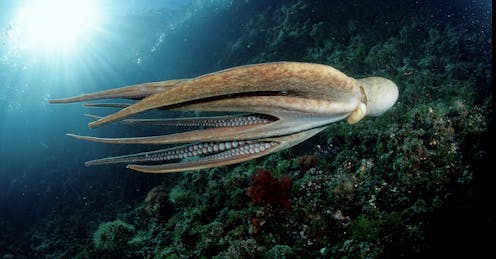
A common octopus (Octopus vulgaris) off Croatia in the Mediterranean Sea. Reinhard Dirscherl/ullstein bild via Getty Images

We named him Squirt – not because he was the smallest of the 16 cuttlefish in the pool, but because anyone with the audacity to scoop him into a separate tank to study him was likely to get soaked. Squirt had notoriously accurate aim.

As a comparative psychologist, I’m used to assaults from my experimental subjects. I’ve been stung by bees, pinched by crayfish and battered by indignant pigeons. But, somehow, with Squirt it felt different. As he eyed us with his W-shaped pupils, he seemed clearly to be plotting against us.

Sign up to read this article
Read news from 100's of titles, curated specifically for you.
Already a member? Sign in here
Related Stories
Top stories on inkl right now
One subscription that gives you access to news from hundreds of sites
Already a member? Sign in here
Our Picks
Fourteen days free
Download the app
One app. One membership.
100+ trusted global sources.