Get all your news in one place.
100's of premium titles.
One app.
Start reading
TechRadar
TechRadar
Mike Moore

Nvidia's Earth-2 models, including 'climate in a bottle', want to change weather forecasting for everyone across the world

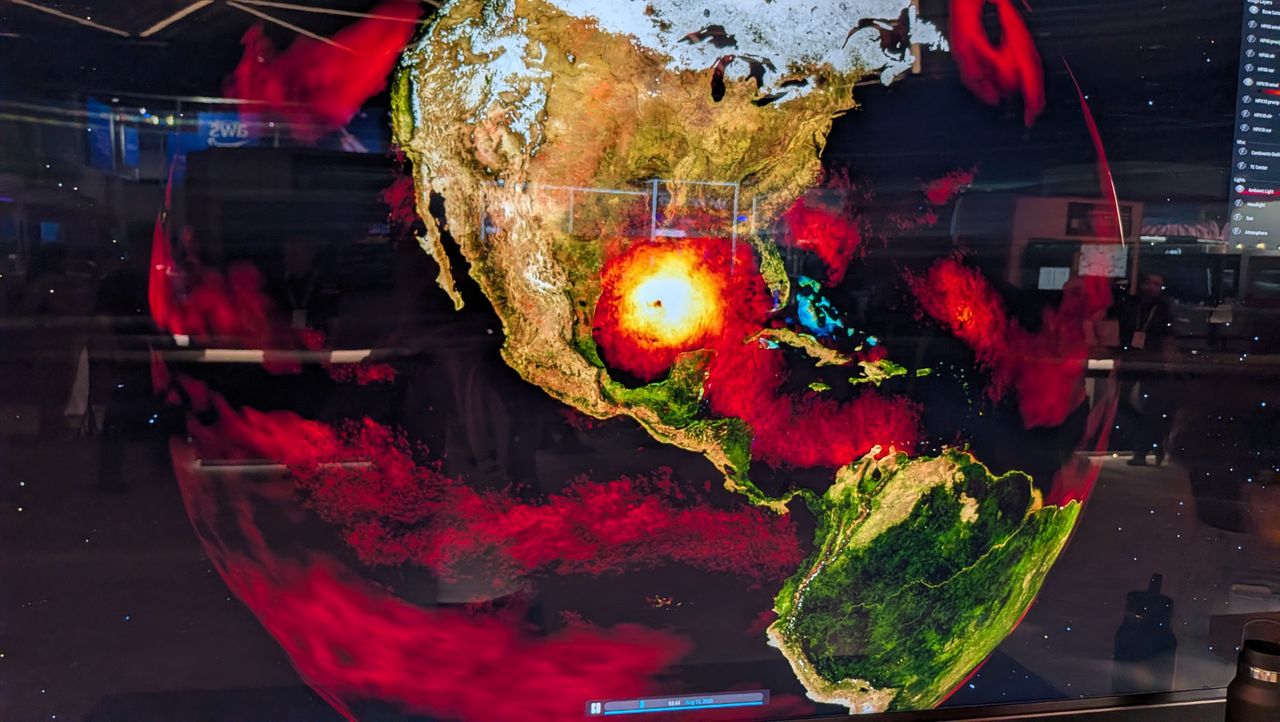
Nvidia Earth-2 weather prediction model.

Nvidia revealed new models for its Earth-2 digital twin platform in January 2026, promising advances in training and fine-tuning AI models across a range of use cases such as weather forecasting and climate prediction as we know it.

The models bring together high-resolution data from satellites, radar, and weather stations to provide continuous estimates of atmospheric conditions, allowing for greater accuracy and insights than ever.

To find out more on these latest developments, we hit the floor at Nvidia GTC 2026.

Faster and more accurate

The demos we saw included a model with the ability to take a range of different weather observations from satellites, weather balloons and weather stations, bringing them all together to give a coherent depiction of the atmosphere at any given moment.

This process previously used to take hours, but can now be condensed into just a few seconds.

Developed with NOAA (the National Oceanic and Atmospheric Administration) and MITRE, another model we saw can use these initial observations to provide a global prediction of up to 14 days, predicting wind speeds and directions, or even regional-scale weather forecasts of up to six hours on storms.

Another demo, brilliantly entitled “climate in a bottle”, can take 50 years of weather observations, condensed down into a couple of gigabytes, to create synthetic scenarios - simulations of weather which can be useful for government planning or financial modelling, and even estimating how solar power can be more effective.

We’re shown how any day in the past 50 years can be zeroed down on, in this example looking at ocean temperatures, which can then be extended with a variety of parameters, say specific weather conditions, to form a prediction of the future.

The models can all run on a single machine, in this case powered by a dual Nvidia RTX Pro 6000 - one for inference and the other for the visualizations, meaning there’s no need for off-site computing.

“The goal would be to get to a place where people could run thousands of these kinds of predictions,” Steve Levay, product marketing manager for AI physics at Nvidia told us, “find the outlier events and then harden their infrastructure.”

“We also want to make all these models open source, so that people all over the world, especially in the global South, can run these kinds of prediction operations without relying on other institutions.”

“We say over a traditional numerical weather prediction, which is essentially just running a big solver in the entire world, it’s a thousand times faster to do with AI…and you can also get to better accuracy, and it’s faster.”

Rainfall, wind speed, extreme weather events and more could all be easily anticipated and prepared for if these models prove successful, and Nvidia looks set to lead researchers to find the answers.


Sign up to read this article
Read news from 100's of titles, curated specifically for you.
Already a member? Sign in here
Related Stories
Top stories on inkl right now
One subscription that gives you access to news from hundreds of sites
Already a member? Sign in here
Our Picks
Fourteen days free
Download the app
One app. One membership.
100+ trusted global sources.