Get all your news in one place.
100’s of premium titles.
One app.
Start reading
MusicRadar
MusicRadar
Entertainment
Jonathan Horsley

“Nobody can play better than that guy, man!”: In a new in-depth interview, guitar virtuoso Steve Morse discusses the supernatural powers of John Petrucci, Eric Johnson, Angel Vivaldi and Deep Purple legends Jon Lord and Ritchie Blackmore

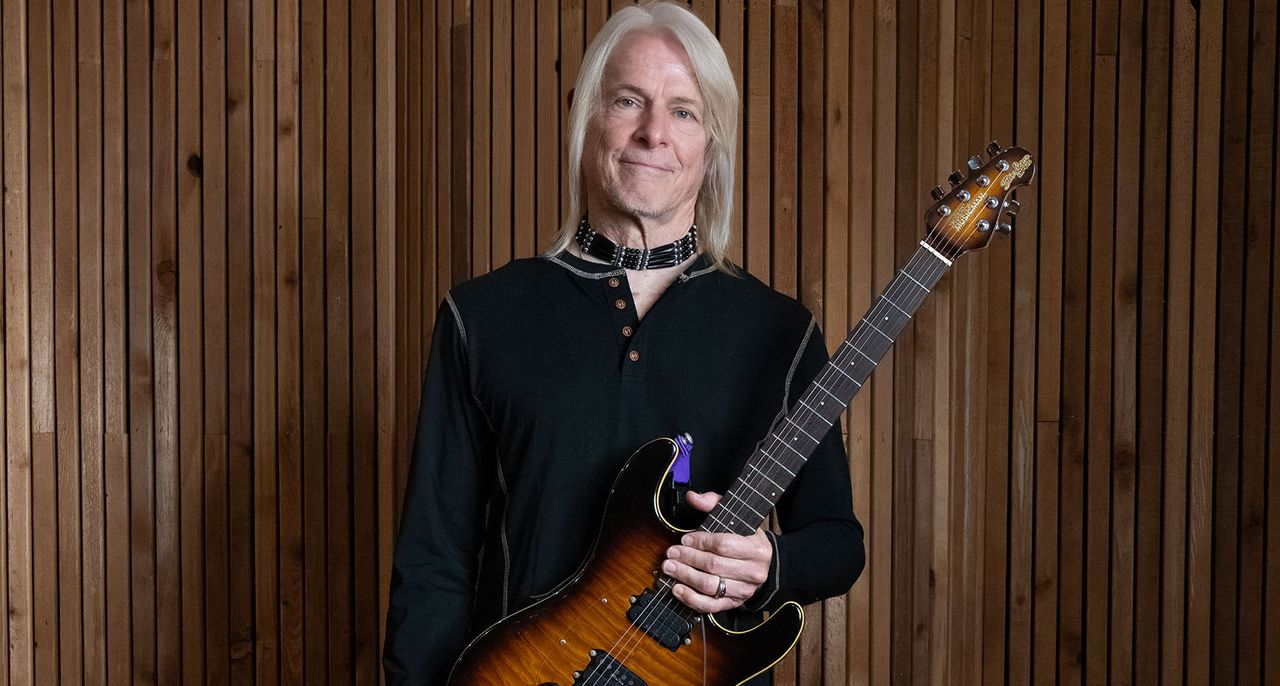
Steve Morse poses in the studio with his Ernie Ball Music Man signature model – not the guitar synth at the bridge.

At one point in our conversation with Steve Morse he pauses in awe at the abilities of Angel Vivaldi, who has been recently drafted into his live band, and wonders whether he’s an “alien”.

It’s not just that Vivaldi can recreate the parts Eric Johnson played on the Steve Morse Band’s new album, Triangulation, and the parts John Petrucci played – it’s that he can also dig into the Dixie Dregs back catalogue and reinterpret an electric piano part for electric guitar like it was no big deal.
“I think Angel is great. He’s versatile and smart, quick, great soloist, great performer, positive individual,” says Morse, joining MusicRadar via Zoom, a few hours before show time. “I don’t know. I mean, I’m a little bit worried he doesn’t seem to have any problems! [Laughs] You can’t trust somebody like that, right? Maybe he’s an alien.”

We might turn that question right back at Morse. He would have been one we might have suspected as landing here from somewheres interstellar.

His chops, and in particular his picking style, have bamboozled mere earthbound mortals for decades, ever since he was pushing boundaries with Dixie Dregs, when he was recruited to replace the great Ritchie Blackmore in Deep Purple, going on to become the British rock institution’s longest-serving guitarist.

The way he approached guitar – the way he customised his own instruments – was like he was working to a different playbook.

But Morse, however, is reassuringly human, and has endured all that comes with that. Triangulation marks the welcome return of The Steve Morse Band with their first studio album since 2009’s Out Standing In Their Field (and yes, it has puns too… Tumeni Partz, TexUS).

It’s the first new music from Morse since he stepped down from Deep Purple in July 2022 to care for his late wife, Janine, who had cancer. A tribute to her, Taken By An Angel, which was written for her memorial service, closes out the album.

Morse is also enduring physical pain when he plays. His arthritis is forcing him to adapt his style. Listening to Triangulation, and some of Morse’s phrases, his this is hard to believe. But as Morse says, he’s not sure that when he wakes up tomorrow his hands will be able to do what he needs them to do.

“I have had to come up with new way of picking – several new ways – because different bones in my joint have different pain levels when I change the angles,” he says.

But he has no plans to quit. His playing might be “broke” but he’s going to fix it.

(Image credit: Nick Nersesov)

Triangulation sounds very much like you getting in the room together and seeing how far you can push the limits of a trio

I heard Eric Johnson with the Electromatics, on the recording and that was awesome. He blew me away with how clean and perfect and melodic his playing was

“Yeah, I think that’s a good description. what you just said. It is us exploring what we can do as a trio, and really putting a lot of effort into it. Whereas, we’ve had so many gigs that have happened [just] because it’s in between Purple tours and things like that.”

You allude to it in the liner notes but it is as though Dave LaRue is playing lead bass. You’re playing simple and his bass guitar is carrying the musical information.

“I agree. He’s so versatile that that becomes like the focal point of of each tune. He’s finding a guitar part and a bass part, and a bass part is not really sometimes a bass part, like on The Unexpected – on that tune, it’s really like a cello part that I wanted him to play, and of course, once we put the drums and everything in, it works and sounds like it does, but sometimes I write that way, where it’s not an obvious bass part.”

It’s like the band is in conversation with itself.

“Yeah, that’s cool. I like that! We interchange things a lot. Thank goodness for Dave, you know. That’s kind of like the basis of our band, really. It has to be Dave. [Laughs]”

Eric Johnson guests on TexUS. You go way back with Eric, to when he was in the Electromagnets. He credits you with getting his career up and running. How did you help him?

“Oh he didn’t need any advice! He was immaculate. No, I had had a couple of Guitar Player interviews, and when I got my cover story, I mentioned him as being the most impressive guitarist, and that’s what he’s referring to. That really helped, you know, bring his awareness to people. There was no advice.

“That was a big deal to see him with the Electromagnets, or right after he was in the Electromagnets. I heard him with the Electromatics, on the recording and that was awesome. He blew me away with how clean and perfect and melodic his playing was. That was wonderful. And so the tune I wrote was a melodic tune, where we could play in harmony and it changes melodies back and forth, written so I could duet.”

(Image credit: Nick Nersesov)

Going back to the record. You’ve John Petrucci guesting on this record. Did you give him much direction?

“I gave him the tracks. A guitar on one side was me, and a guitar on the other side, that would be him. And then another version with a guitar, with just me and nothing, so he could hear where I was intending him to be playing. And so it was arranged out beforehand.

He did it perfect. John always does everything perfect! He did incredible. Nobody can play better than that guy, man

“But he did it perfect. John always does everything perfect! He did incredible. Nobody can play better than that guy, man.”

It must be liberating having Angel in the band, because then you can play anything live?

“Yes, and he does. He plays the Eric Johnson solo, kind of in the style of Eric, and he does the Petrucci solo in the style of a shredder. And we’re doing a song that I wrote for the Dregs 50 years ago, and he plays this solo where the electric piano was, and he starts it like the electric piano sound – it’s really amazing.”

The Rosetta stone for understanding any guitar player is what they do to their guitars when they’re young, and what you did to your Frankenstein Tele hybrid tells us everything.

“Yes, I know. I have no respect! [Laughs] I have no respect for an instrument. No, to me, it’s a piece of wood until you make it into a useful tool, useful for the person. So I will make changes. I grind away parts.

“Even on my current guitar, I ground down the heel when I got a cast. I broke my wrist, right before a Purple show and I couldn’t reach some of the notes on the neck with the cast on. So I got a grinder and cut down the heel of it to help facilitate that – including the steel plate. I took the steel plate off and ground that down and well…”

And here’s Ernie Ball Music Man sending it out of the factory with hand-rubbed wax and gunstock oil on the neck… But it’s whatever works.

“Yes. It’s like my mute, the mute on my guitar.”

Steve Morse plays his Frankenstein Telecaster onstage in 1978: note the pickup configuration. It would later inform his signature model with Ernie Ball Music Man (Image credit: Tom Hill/WireImage)

Tell us me about the mute. Is it allowing you to play things that you would worry about playing otherwise?

“During the show tonight, I’ll be changing positions constantly, so I have to practise those different ways of holding the pick, and the different angles, and whether to bend my arm or pick from the elbow. It’s… it’s a lot. I mean, you have to really, really, really want to play, to deal with the advance of arthritis.”

Are there some tunes you can’t play because of it?

“I can’t play the C section of Tumeni Notes I can’t go across the strings fast enough, so I can’t do it. It’s very frustrating.”

How does the mute help? And do you think Ernie Ball might release this mute because you are not the only player out there who has this problem?

“They didn’t think too much of my mute on the nut. But I am working on one for the bridge. I think that’s gonna be real good. The reason I didn’t perfect it is because I’m using a guitar synth that sits in that position, and it is a tough choice to make between the guitar synth and being able to mute there, so I’ve got work to do still.”

There is already a lot of real estate taken up in your guitars with all the electronics you’ve got there.

“Sure! Yes, my guitar is designed to where I can play a gig from the beginning to end, doing any kind of music, and not have to change guitars. And that’s what I want.”

I’d say, finish-wise, quite a bit has changed, because I’ve played this in typhoons and sweated over it, you know that corrosive kind of sweat burns after 40 years so it looks different

Have you thought of updating the Steve Morse signature model? Is there there anything that you would change to it?

“Yeah, the 40th anniversary is probably going to be [the time]. I hope they are going to do reissue, and one idea is to make it like mine is now. There has been a few changes [Laughs].”

What changes have you made? Besides, shaving the heel off!

“I’d say, finish-wise, quite a bit has changed, because I’ve played this in typhoons and sweated over it, that corrosive kind of sweat burns after 40 years so it looks different. And the pickups, I don’t know what changes on a pickup, if it loses magnetism or what from sitting next to other pickups, but maybe the sound is a little different. So I’ve had to measure that.”

Is there any style or technique that you find hardest to get under your fingertips?

“Anything that’s written on keyboards is gonna have some difficult stretches in them. In the past, it was not so much of a problem, where I could cross-pick, like an upstroke on the G string, downstroke on the B string, very quickly, as I’m going across the strings. And I don’t want to suddenly turn into a sweeping guitarist, so things involve big intervallic jumps are harder than they used to be.

When I hang up from you, I’ve got to take a shower and work on the fingering for a part that I’ve been having a little trouble with. It’s because I can’t suddenly push forward with my thumb – I used to be able to 10 days ago

“And things where you trill, like in some traditional Irish music, I can write things in that style, but if I was to play piece for hornpipe or something, in order to get those little mordents and trills, the fingering may not always lay out good for guitar. Those kind of challenges.”

Reading between the lines, it’s like you can find the workaround but you don’t want to change your style wholesale, like sweeping arpeggios.

“Yeah, yeah, it’s very, very, very frustrating at times, dealing with this stuff, but on the other hand, my friends that know me know me as a handyman and I will try to fix anything better than accept the fact that it’s broke. I will take it apart and rewire it. I will change it.

“I will take a switch, I will replace it with a whatever, but I will make it work somehow. And that’s the way I feel about my playing. It’s broke, but I’m gonna find a way.

As frustrating as that is, you can still take great satisfaction in finding a way to mend it, whether it’s a workaround or something. It’s in your nature.

“Well, when I hang up from you, I’ve got to take a shower and work on the fingering for a part that I’ve been having a little trouble with. It’s because I can’t suddenly push forward with my thumb – I used to be able to 10 days ago – so it’s a result of just pushing it too hard... [Holds up his hand] There, I got radiation burns.

“I had six radiation treatments on my wrist. It’s supposed to help the inflammation. But anyway, yeah, [there are] just surprises. Suddenly, I can’t do this motion. Holding a pick like this, so I got to change. It’s hard.”

How you hold the pick is key. You said way back that the old Dunlop nylon picks were a real secret to your sound.

“Yeah, I went back to the nylon picks. I’m back on the nylon picks now.”

I have to ask you a Deep Purple question. When you joined Deep Purple, you were officially replacing Ritchie Blackmore. Did you feel a sense of freedom in that, because no one could be Ritchie, the band wouldn’t want you to be?

I see a future but I don’t see me being a hired gun because I couldn’t stand up to the level of players that you can get now.

“Yeah, I did. I did. The first album was magic because in the band, nobody knew what to expect, so everybody was open to ideas and open to experimenting, and it was the best. It was just awesome. And the stuff I’ve heard of Ritchie playing live was him experimenting. He would go off. He would go off and take it out, take it out and then bring it back. He led the way for that.

“Now, the fans, when I played the Purple songs and took it out, some of them, a certain percentage of them about 30 per cent of them, just hated me, and pretty much stayed in that position till 28 years later! [Laughs] But the band decided to go to a lot of different new places, and so, when I joined, we played a lot of new places, and that was neat. It sort of gave me a more room ‘cos people didn’t know what to expect. They didn’t know what it was going to be like.

“I tried to incorporate my stylistic mixture with respect for what Ritchie did but with some of my own personality, too. And the people there that hadn’t heard us, they had the old albums, of course – that’s why they came and bought tickets – but they sort of got used to me being me and that was kind of new.”

What was it like playing with Jon Lord? He played it as if he was trying to put electric guitar on his place or to compete with electric guitar. Did you enjoy that push/pull with him. He had this physical power to play off of.

“Yes, in fact, I loved it. In fact, I was always pushing him to go back to playing the organ through an amp for some solos – y’know, the sound that he had in the Machine Head days.

Jon was the guy that listened to my ideas and thoughtfully added to them, rather than just saying, ‘That doesn’t sound like Purple.’

“My job with Purple became providing ideas for the writing sessions, and one out of 20 might get used. So, 95 per cent of the time I was hearing, ‘That’s not going to work.’ And when Jon was around, he would hear something and say, ‘That’s a little bit leftfield, but what if we do this?’ And he would play it with a slight twist, and that’s what we had there when we did Sometimes I Feel Like Screaming on the first album.”

(Image credit: Rob Verhorst/Redferns)

“It came from me just noodling to a guitar part, as a guitar solo piece. We were during a break, and you know how it is in the UK, everybody stops and drinks tea after so many minutes of doing anything. In fact, in the soccer games, they do the same thing! All of a sudden everybody stops moving and they bring out tea.

“We were in a tea break, and Jon sat down his cup and says, ‘Ah, that’s something there.’ I said, ‘I wasn’t thinking that that would be a tune for Purple. I was just practising an idea I had.’ And he said, ‘Well, I like it. Let’s do it. Let's try ending on the four chord here.’ And by the end of the day, we had the song mapped out on tape because of Jon.”

Before you go, you’ve got all these shows for the trio. But what’s next for you? Are you for hire? If, say, Paul Rodgers or someone like that called up and wanted to put a band together. Is that something you would entertain?

“I don’t think I could. I couldn’t be. I’m not rock solid. When I say I’ll do something, I’m used to doing it, and doing it excellent. Right now, I don’t know. I don’t know what’s gonna happen. When I wake up, am I gonna be able to move my hand or not? I don’t know. So far, I have been able to.

“So far, I've been able to make every gig, but I don’t know. I think my time of doing the performance grind is closing. That window is closing. But my time for writing and possibly performing those kind of things, with some help, with some other musicians, is very possible.

“I see a future but I don’t see me being a hired gun because I couldn’t stand up to the level of players that you can get now. Guitarists are literally dime a dozen. Yeah, for a dime, you can get two dozen.”

You just want to feel comfortable in your playing, workaround the condition.

“Yeah. When I do my own stuff, I can pick and choose, so that’s why I’m more comfortable being where I am now. Absolutely.”

I see a future, but I don’t see me being a hired gun, because I couldn’t stand up to the level of players that you can get now

You mention all these great players. But who’s blowing your mind at the moment?

“Oh, man, a bunch of the young kids! I mean, Angel is blowing my mind. The young Italian guy that plays with his thumb, [Matteo] Mancuso. And there’s more than just him – I can’t remember all the names. The breadth of knowledge that people can acquire from the internet, it’s showing that the internet can be used for good… as well as evil! [Laughs]”

There’s always more to discover with guitar. It keeps on growing.

“Yeah, really – and one thing for a guitarist, I don’t know if it would give you hope or makes you defeated but to see a five-year-old Chinese kid shredding, beyond belief on YouTube. With AI coming and nothing’s real, and you don’t know what’s real anymore, everything’s getting really mixed up. I don’t know, shredding in and of itself, I think, will be less important than the basic kind of songwriting skills.”

Sign up to read this article
Read news from 100’s of titles, curated specifically for you.
Already a member? Sign in here
Related Stories
Top stories on inkl right now
One subscription that gives you access to news from hundreds of sites
Already a member? Sign in here
Our Picks
Fourteen days free
Download the app
One app. One membership.
100+ trusted global sources.