Get all your news in one place.
100's of premium titles.
One app.
Start reading
The Conversation
The Conversation
Jennifer Mathers, Senior Lecturer in International Politics, Aberystwyth University

No surprise as Putin’s party wins election billed as ‘referendum’ on war in Ukraine

In one of the least surprising pieces of election news this year, preliminary results indicate that the ruling party, United Russia, is on track to retain its overwhelming majority in the national parliament, or Duma.

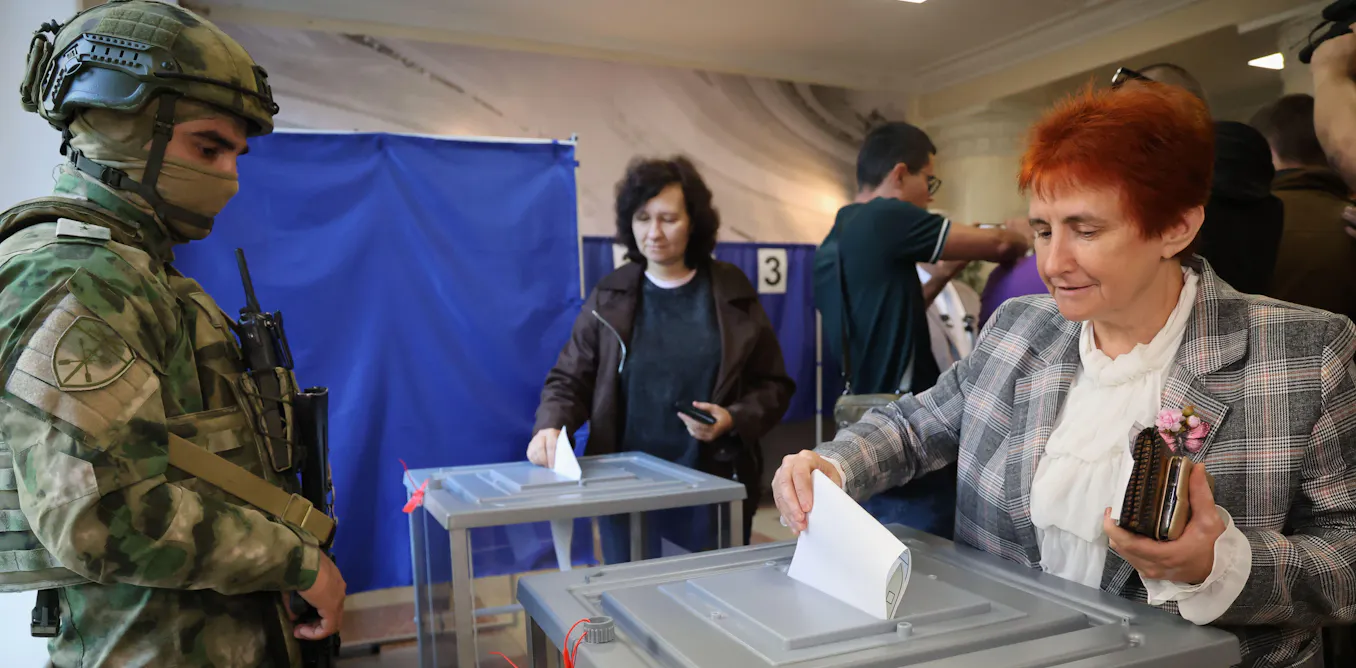
There is a striking degree of continuity in the results of this election with the previous one. United Russia, the party of the president, Vladimir Putin, has reportedly received 57.5% of the vote compared with 57.9% in 2021. United Russia will be joined in the parliament by the same political parties represented last time. These are the so-called systemic opposition parties.
The existence of these parties on the ballot gives the voter the illusion of choice. But in reality they always vote with Putin’s government on the issues that really matter – such as the war in Ukraine.

The results were never in any real doubt. But the 2026 election campaign has exposed some significant insights into the mindset of the country’s ruling elite, as well as the public mood.

The state has all but abandoned the fiction that Russia’s “special military operation” in Ukraine is proceeding according to plan and that life can continue as normal, at least for middle class Russians living in the major cities. Even Putin has acknowledged that the damage to Russia’s oil industry caused by Ukraine’s drone strikes has created petrol shortages that are experienced by motorists and businesses on a daily basis.

This did not mean that Putin was ready to promise an end to the war and a more peaceful and prosperous future if Russians supported United Russia at the polls. Instead, the Russian president explicitly presented the elections as a referendum on society’s support for the war.

Speaking just days before voting began, Putin instructed citizens to participate in the elections in large numbers to demonstrate that millions stand behind the soldiers fighting in Ukraine.

Even without Putin’s instructions, it was hard for ordinary Russians to ignore the war during this election when so many of the candidates are famous – or infamous – for their roles in it. Almost 200 war veterans were standing for seats in the Duma. These include former military officers who had been instrumental in brutal operations, such as the siege of Mariupol and the killing of civilians in Bucha.

Russia’s children’s commissioner, Maria Lvova-Belova, was also on the ballot for United Russia. Her candidacy was a symbol of Russia’s defiance of the authority of the International Criminal Court (ICC). The ICC wants to put her (as well as Putin himself) on trial for allegedly kidnapping Ukrainian children and bringing them to Russia for adoption. Lvova-Belova herself has adopted a child from the Donbas in eastern Ukraine.

But while Russia’s top political leaders handed candidates a script full of patriotic zeal for the war, many apparently had no desire to read from it. There was a notable difference between the enthusiasm expressed for the war by the political elite in Moscow and the attitudes of candidates further down the ballot. Some of them seemed to want to avoid the topic entirely.

The campaign was marked by televised debates where one or all of the candidates failed to turn up. And often the candidates who did attend their own debates quickly ran out of positive or even uncontroversial things to say. Viewers were reportedly treated to some candidates standing silently during the rest of their allotted time.

Managed election

Despite the apathy shown by many candidates, the state’s election officials worked overtime to ensure that United Russia would win a comfortable victory. The Russian election monitor project, a group of European scholars, former and active politicians, and public officials aiming to ensure free and fair elections, reported incidents of ballot box tampering. This included a case in Krasnodar where officials added ballots after the polls had closed, undeterred and unimpeded by the presence of a police officer.

Election monitors representing political parties – including from systemic opposition parties such as the Communists – were turned away and not permitted to observe the process. In at least one case, an election monitor was arrested and physically injured by the police.

Opportunities to vote online were expanded, with Putin himself participating, despite his famous lack of interest in the internet. Online voting was viewed with suspicion by many ordinary Russians, on the grounds that it would be easier for the state to manipulate the results.

Contrasting the overall lacklustre mood of the campaign with the very high proportion of online votes for United Russia does suggest, at the least, that the online vote might have been massaged to achieve the record 59% turnout.

When elections are so thoroughly managed, it is difficult for voters to register disapproval of the status quo. One potential outlet for the disgruntled citizen was removed during the summer. In August, the Russian Supreme Court banned the political party Yabloko when it looked as though it might become too popular. Yabloko adopted an anti-war platform and was barred from fielding candidates in the party list ballot, which determines 225 seats.

However, Yabloko did manage to field a small number of candidates for single ballot seats and also for the regional parliament in Novgorod, where it looks to have won some seats.

One visible sign of disillusion with the whole process of elections in Russia was the vandalism of 74 electoral commission premises during the three days of voting. The fact that electoral commission premises sustained damage in all of the Ukrainian territories that Russia has claimed to annex is an indication of the ongoing resistance in occupied Ukraine.

These elections may have provided the results that Putin demanded. But the campaign has revealed growing cracks between a political leadership that is determined to continue Russia’s disastrous war in Ukraine and the ordinary citizens who are called upon to pay the human cost for that conflict.

This article was originally published on The Conversation. Read the original article.

Sign up to read this article
Read news from 100's of titles, curated specifically for you.
Already a member? Sign in here
Related Stories
Top stories on inkl right now
One subscription that gives you access to news from hundreds of sites
Already a member? Sign in here
Our Picks
Fourteen days free
Download the app
One app. One membership.
100+ trusted global sources.