
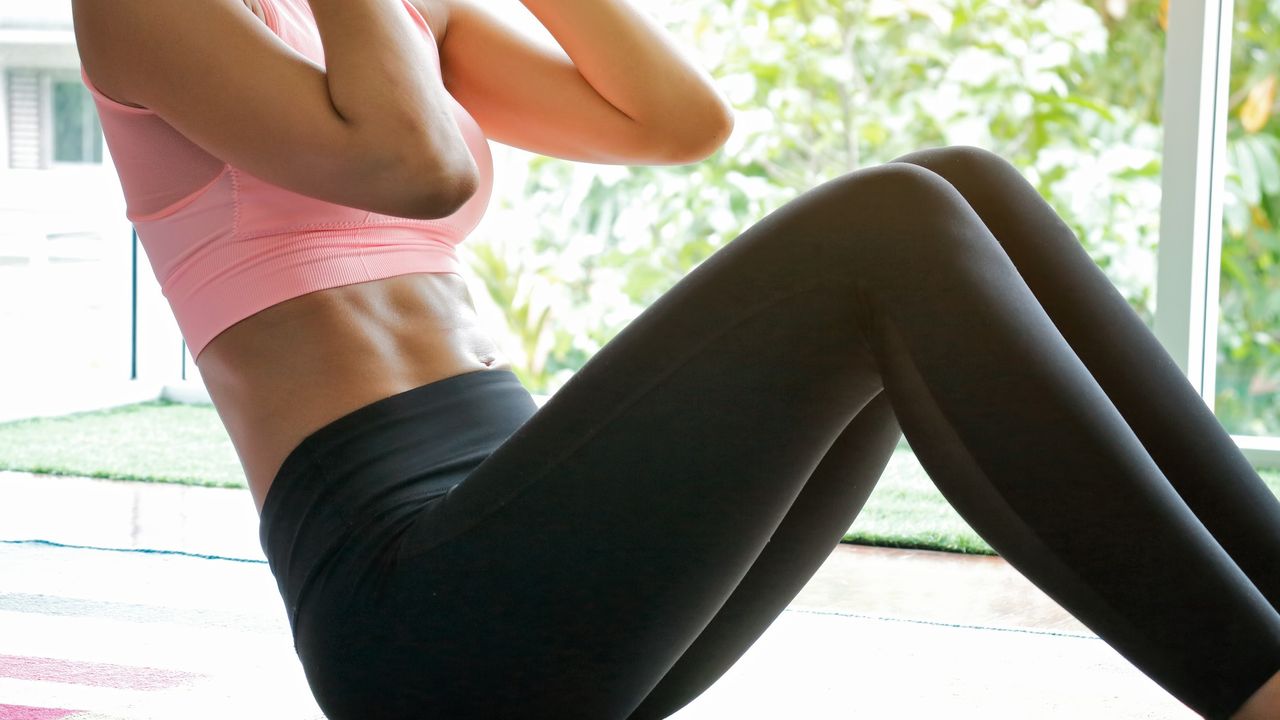
I’ve been practicing Pilates for over a decade, and one exercise I fall back on time and time again to target the deep muscles in my midsection, as well as build balance and flexibility in my spine, is the Pilates V-sit. It’s a challenging exercise, but it’s a powerhouse move. Read on to find out how to do it, plus the progressions to try once you’ve mastered the move.
As a reminder, what works for me might not be right for you and your body. If you’re a complete beginner, you’re pregnant or postpartum, or you’re recovering from an injury, particularly to the lower back, it’s best to check with a qualified professional before trying something new.

What is the exercise?
Unlike a V-sit you might do in the gym, a Pilates V-sit has a real focus on scooping your abdominal muscles and articulating your spine — by this we mean really flexing your spine, which can counteract the stiffness many of us struggle with after too long sitting behind a desk.
Here’s how to do the Pilates V-sit with perfect form. As always, the key here is to move slowly and with control. You won’t need any additional equipment for this move, but sitting on a yoga mat can make things more comfortable.

- Sit tall on your seat bones, with your knees bent and your feet flat on your exercise mat. Place your hands lightly on the back of your thighs and engage your abs.
- Tilt your pelvis back slightly, scooping your belly button in towards your spine.
- Lift one leg into tabletop, then the other, keeping a bend in your knee. Find your balance and engage your core.
- Hold here, with your body making a ‘V’ shape. If you have the balance, extend your arms out parallel to the floor.
What are the benefits?
This simple-looking move is doing a lot more than you might think. Here’s the muscles you’ll be targeting:
Deep core
This move requires the transverse abdominis muscles, the deepest muscles in your midsection, to really fire up to stop you from falling backwards. These deep core muscles act as the body’s corset, but also protect your spine from injury. If you don’t feel your core firing up, lean your torso back a little further. You should get the Pilates shakes in this exercise!
Spinal flexibility
As you roll up and down from the V-sit, you should think about lifting or lowering one vertebrae at a time, rather than flopping back to the mat. This spinal articulation helps build flexibility in the spine and counteract stiffness that might come from spending too much time sitting down.

Hip flexors
In the V-sit hold, your hip flexors will be working to keep your legs raised in the air. This trains the hip flexors to work with the core, rather than against it.
What are the progressions?
Once you’ve mastered the move, the next progression is to build up to a Pilates teaser. To do this, start by making the V-sit a little more challenging by extending your legs for 30 seconds. From tabletop, slowly straighten your legs toward the ceiling at a 45-degree angle. This makes the lower abs and quads work harder. If you start to round your back to hold this move, go back to regular V-sits.
The next progression is “Teaser One.” Start in a V-sit position, and, keeping your legs in tabletop, roll your torso slowly down to the mat, one vertebrae at a time. Once your head touches the floor, roll back up into the “V”.
Finally, once you’ve mastered that, you’re ready for the full Teaser. Start by lying on your back with your arms overhead. Lift your legs off the mat into a 45-degree angle, and at the same time, lift your upper body into the “V” position.
Pilates essentials we love
More from Tom's Guide
- Not sit-ups, planks, or crunches: I do this simple Pilates exercise every single day to build a strong and stable core and work on my hip flexor mobility
- Not sit-ups or lunges — I use this simple Pilates exercise to sculpt strong obliques, inner thighs and hip stabilizers
- 'I’m a Pilates instructor, and I recommend these 5 core exercises to help older clients build strength and improve posture'







