Get all your news in one place.
100's of premium titles.
One app.
Start reading
TechRadar
TechRadar
Ed Cooper

'No barbell, no special equipment and no gym membership required': the forward lunge is the best simple move you're not doing, and it's vital for over-50s

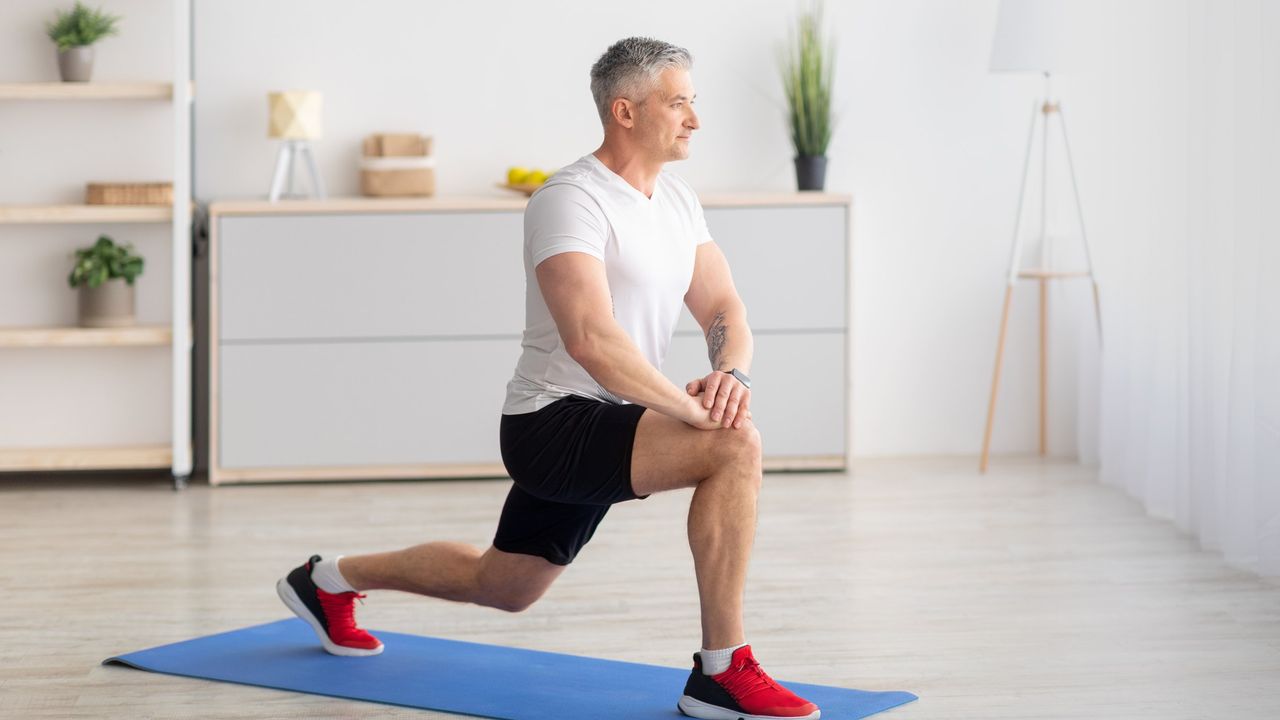
Older man at home lunging on a yoga mat.

Ask any exercise scientist what they would prescribe to someone serious about staying strong into their 50s and beyond, and the answer is rarely what you'd hope for — and certainly not what the fitness industry is currently trying to sell you.

It isn't long sessions on one of the best under-desk treadmills or a stationary bike like the Peloton, nor the kind of machine-based exercises that isolate muscles without ever teaching them to work together.

The movement that matters most at this stage of life looks deceptively simple — no barbell, no specialist equipment and no gym membership required. It's a fundamental, functional move, like the farmer's walk. It trains balance, hip stability, and unilateral strength that determines whether your body holds up or breaks down in the decades ahead.

Think about what you actually do every day — climbing stairs, stepping off a curb, recovering your footing on an uneven surface. Every one of those moments asks your body to produce and absorb force through a single leg while the rest of you stays controlled.

Most people are far weaker in this pattern than they realise and it’s exactly why we spoke to leading exercise scientist and functional medicine doctor Pete Williams to find out which single exercise he returns to again and again, why it becomes so critical at this stage of life and how to build it into your routine safely and progressively.

The forward lunge

(Image credit: Getty Images / skynesher)

“As we age, our exercise goals should evolve beyond simply lifting heavier weights,” says Williams. “For people over 50, the ability to generate force quickly — known as muscle power — becomes more crucial than maximal strength.” This methodology is exactly why Williams recommends the forward lunge as a key movement pattern for those looking to maintain strength for those in their sixth decade.

This particular focus on power over outright strength is rooted in Williams’ deep understanding of biomechanics. As we age, the ability to produce and maintain power “fundamentally shapes how we move, how we respond to sudden challenges, like trips or slips and how safely we navigate everyday life,” he says, noting that “power declines faster with age than strength alone.”

All of which make the forward lunge the ideal exercise to work on these points, Williams says, as it “builds not just muscle, but neural responsiveness and coordinated control.” By building the functional power to protect against falls and maintain independence in later life, he says, “power and control are the qualities that make movement safe and effective in the real world.”

Why it works

For Williams, the appeal of the forward lunge isn’t just about building lower-body strength, but also about recruiting and supporting the recruitment of the central nervous system (CNS).

“A forward lunge requires controlled descent into the lunge position, then a powerful push back to standing,” he explains. “This rapid coordination falls under the domain of the CNS, the brain and spinal cord must swiftly sense perturbations and activate muscles to respond.” Simply, by working on muscle power, you can offset the decline that comes with ageing.

Williams points to several everyday scenarios in which the forward lunge can help offset accident risk, including descending stairs, stepping down from curbs and lowering into a chair. “These are not passive movements, as they require muscles to absorb force, decelerate the body, and stabilize joints,” he says. This is called 'eccentric' control. Movement patterns that incorporate slow and controlled lowering trains these braking systems, making “accidents on stairs and curbs become far more likely”.

Most of the best smartwatches now come with fall detection, allowing the wearer to send an alert if they fall or have some sort of accident. For older adults, training with forward lunges will reduce the risk of this happening.

Building power with the lunge

"Strength is a measure of how much force a muscle can produce, whereas power reflects how fast that force can be applied," says Williams. To illustrate the difference, he describes two people: one who can lift heavy weights slowly, while the other can lift a medium weight faster. "If both trip on an uneven surface, the person with greater power — and thus faster muscle and neural response — is far more likely to catch themselves and avoid a fall".

This is why Williams argues that exercise programs for older adults must move beyond purely heavy lifting.

Instead, they should incorporate "power training exercises," such as "faster concentric lifts" and "quick sit-to-stands from a chair," alongside "functional real-world drills". This specific focus on "speed and rapid force production" is increasingly recommended for older adults and, according to Williams, "should always be considered."

Add the lunge into your routine using the instructional video above, and browse our article series The Fit List for more muscle-building and life-lengthening advice.

Sign up to read this article
Read news from 100's of titles, curated specifically for you.
Already a member? Sign in here
Related Stories
Top stories on inkl right now
One subscription that gives you access to news from hundreds of sites
Already a member? Sign in here
Our Picks
Fourteen days free
Download the app
One app. One membership.
100+ trusted global sources.