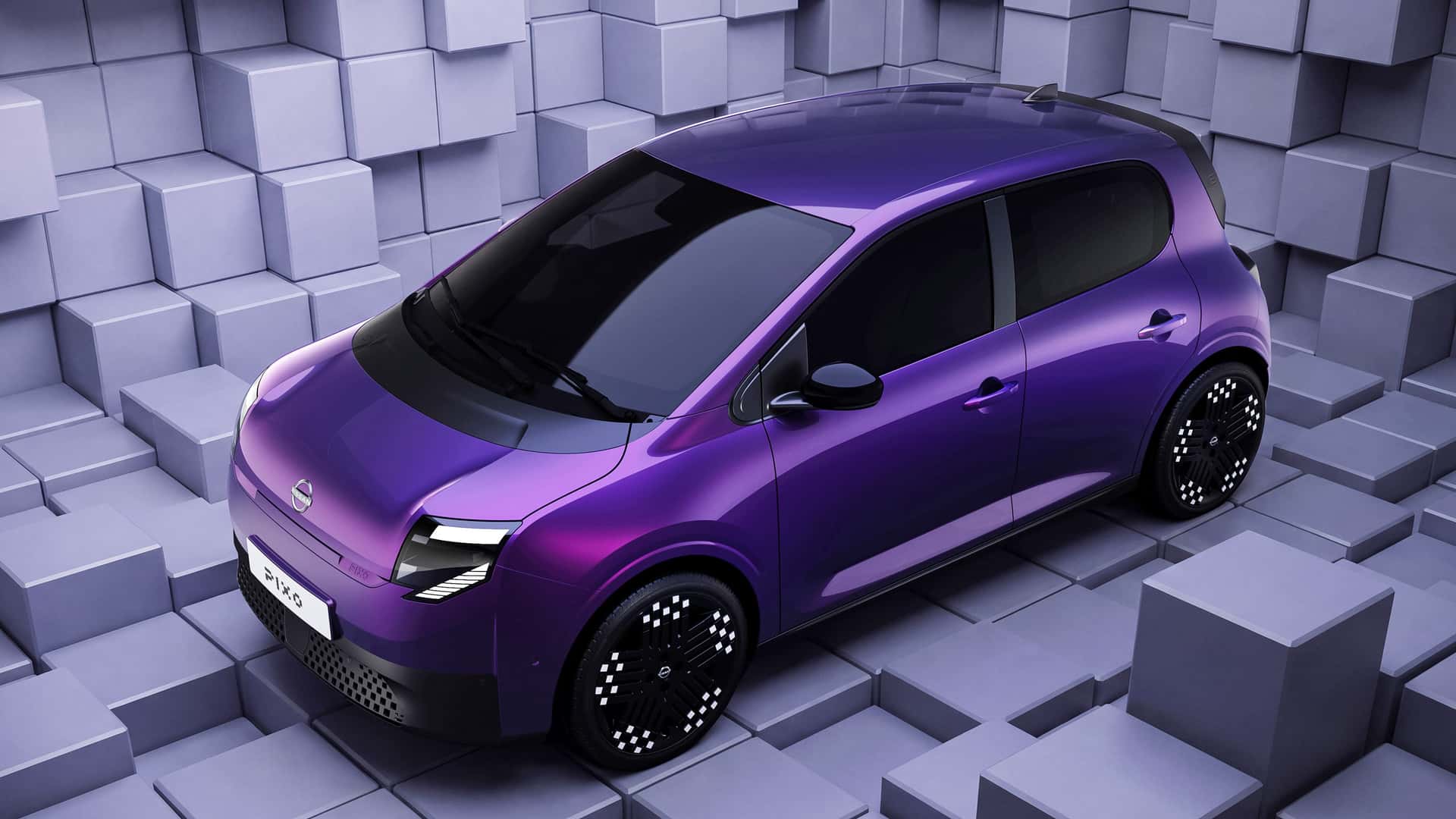
- Nissan’s new Pixo shares its hardware and much of its design with the Renault Twingo E-Tech.
- The related Dacia Spring looks more distinct, but all three offer similar performance and range.
- Standard DC fast charging helps the Pixo’s appeal, but its unannounced price will determine its value.
Squint at the new Nissan Pixo, and you might see a Renault Twingo. That’s because it is one, with a different front fascia and minor changes.

The biggest tweaks are at the front, where the Pixo looks nothing like the Twingo, adopting a chunkier, more angular nose that doesn’t really look like any other Nissan. Shift your perspective to the side of the Pixo, though, and it’s immediately apparent that its greenhouse is identical to the Renault's, as is the rear end, which is unchanged except for redesigned taillights with a more angular light signature.
That contrasts with the new Dacia Spring. That car also shares the same architecture and basic engineering, but Dacia went considerably further to give it a separate identity, with completely reworked bodywork. It has a much more rugged appearance than the Twingo, and you wouldn’t really know the two are related just by looks alone.
Underneath, all three follow the same formula and ride on a simplified version of the platform that underpins the larger Renault 5 EV (and its Nissan Micra spinoff). They have the same 27.5-kilowatt-hour lithium-iron-phosphate (LFP) battery and front-mounted motor producing 80 horsepower and 129 pound-feet (175 Nm) of torque.
Their maximum WLTP range ratings differ slightly: 161 miles (259 km) for the Pixo, 163 miles (263 km) for the Twingo and 155 miles (250 km) for the Spring.
Even with the exact same motor, their quoted acceleration figures differ. Nissan quotes 11.9 seconds to reach 62 mph (100 km/h), versus 12.1 seconds for the other two relatives. All three top out at 81 mph (130 km/h), which is the highway speed limit in most European countries. However, because they are designed primarily for lower-speed urban driving, their nearly identical turning circles of around 32.5 feet (9.9 meters) are arguably more relevant than their racing credentials.
The biggest difference between them comes in the form of standard charging gear. Nissan includes 50 kW DC fast-charging as standard, along with the higher-powered 11 kW AC charger. The Spring starts with 6.6-kW AC charging, offering 11-kW AC and 50-kW DC through an optional package.
Twingo equipment varies by market, but you may need to tick a box to get the faster charging. In Germany and the Netherlands, it’s standard, while in France, Italy, or Belgium, it’s optional, though it also means the entry price is lower.
Suitably equipped, the Pixo can charge from 15% to 80% in 28 minutes, the same as the Dacia Spring. Starting at 10%, Nissan quotes 30 minutes to reach 80%, which is the same as the Renault Twingo. The different starting percentages explain the two charging times but don’t indicate that one car charges faster than another.
All three have five doors, four seats, and the same 98.1-inch (2,492-mm) wheelbase, but their overall lengths differ. The Pixo measures 149.4 inches (3,796 mm), compared with 149.2 inches (3,789 mm) for the Twingo and 151.6 inches (3,850 mm) for the Spring. Dacia’s extra length comes from visibly longer overhangs.
That helps give the Spring different proportions despite its shared foundations. The Pixo also retains the Twingo’s independently sliding rear seats, letting owners choose between rear legroom or luggage space as needed.
Gallery: Nissan Pixo (2027)
All three will be manufactured in Novo Mesto, Slovenia. Sharing the expensive engineering has given Nissan another EV without starting from scratch, even if it is an obviously highly derivative model. They had an unusually short development time, with clear price targets to make them appealing and compete with Chinese cars.
Nissan hasn’t announced the Pixo’s price, but its relatives offer a useful benchmark. In Italy, the new Dacia Spring starts at €17,900, while the Renault Twingo starts at €19,500, both before incentives and both without the optional charging package. That leaves Nissan with a familiar car to sell against two already competitively priced alternatives, and it will be interesting to see how it fares in this familiar company.







