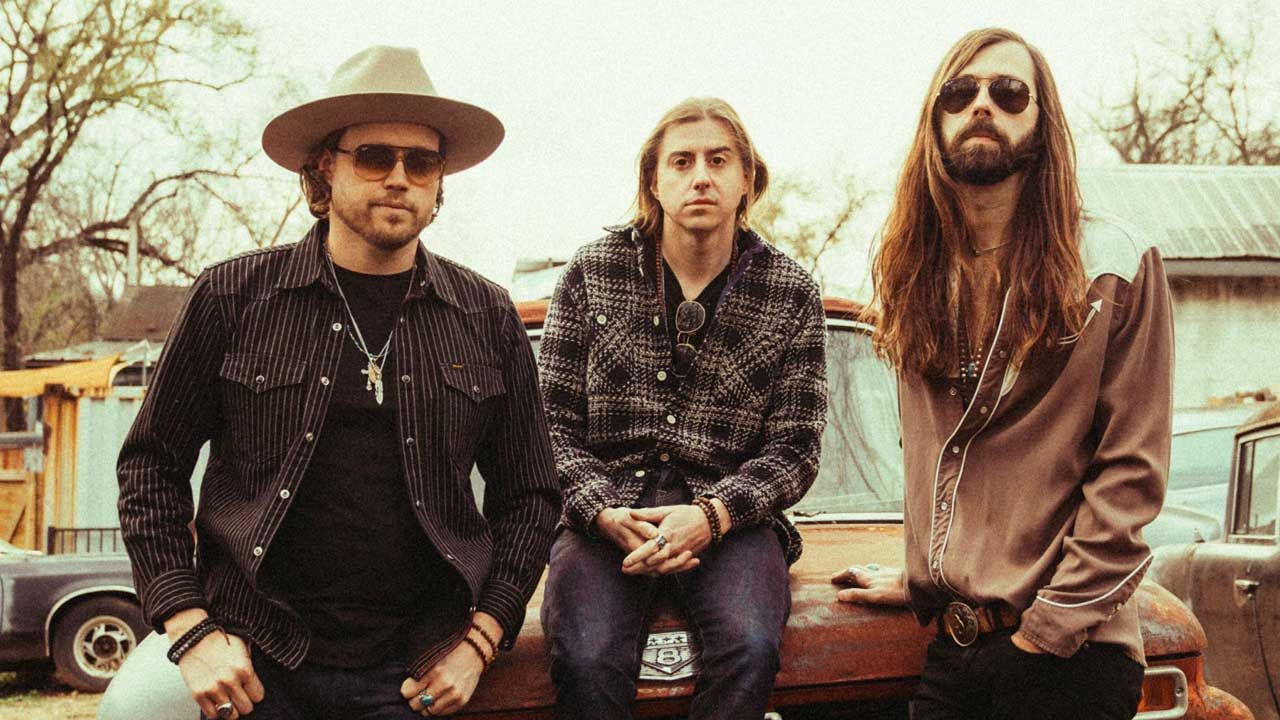
In August last year, A Thousand Horses released a new single titled Voices. A dark and expansive beauty, it was a foretaste of what the Nashville-based trio called “the full-throttle rock album that’s been sleeping in our souls all along”. The response from fans was overwhelming. So much so, in fact, that it outperformed the band’s platinum-selling signature song, 2015’s Smoke, within weeks of release.
“That was such a great thing to see, because you never know how people are going to respond,” says lead singer Michael Hobby. “We’d decided to be brave, artistically, with what we wanted to do. And I think people recognised that this felt real, that it felt honest.”
Voices covered deep psychic terrain: abandonment, isolation, torment, recovery. It’s indicative of the lyrical concerns of newly released parent album White Flag Down, by far the band’s most personal work. And heavy themes require heavy sounds. As promised, this is A Thousand Horses at maximal effect.
“Life came at us pretty fast and we had to figure out a way to get all that out of us,” Hobby continues. “There is a cathartic element to this record. I think you can hear that with the more aggressive side of things, because there was anger and pain in that, and frustration. And there was a lot of real emotion that came with it.”
It’s a beautiful, becalmed morning in Nashville, the sun flooding through Hobby’s window as he and lead guitarist Bill Satcher talk to Classic Rock. Just a week ago this scene was unthinkable. Music City was then in the grip of devastating ice storms that left a trail of carnage. Power lines were down, thousands of homes suffered severe damage, and travel was nigh impossible. Several fatalities were reported. Thankfully, though, as Satcher observes today, “the worst of it is over”.

Given A Thousand Horses’ recent history, the symbolism is difficult to ignore. These past few years have seen Hobby, Satcher and bassist Graham DeLoach weather a series of momentous changes, both privately and professionally. The departure of guitarist and founder member Zach Brown midway through recording their previous album, 2024’s The Outside, was only the least of it.
“Some big life events happened to all of us at the same time,” Hobby explains. “Unfortunately, Graham was going through a divorce, and with Bill and I it was sobriety and learning the new life of that. Plus I’d lost my father and Bill also lost his. And then we had families. So we’ve channelled all of that into White Flag Down.”
While much of this upheaval happened prior to The Outside, that album wasn’t the place in which to process it. Many of its songs had already been in the band’s locker for a while (10 years in some cases), and simply demanded to be recorded. As Satcher notes: “We needed to move through that back catalogue in order to move on creatively. In its own way, that was such a period of self-discovery.”
White Flag Down, then, is a very different beast. Where The Outside was lean and melodic, its followup is hard-driving and fierce. And while this isn’t exactly virgin territory for a band steeped in southern rock, A Thousand Horses have never sounded quite this intense.
“It’s just a natural progression of where we’re at,” reckons Hobby. “We’re not trying to thread any needle, we’re just trying to be us.”
“Michael and I started playing music together in a garage when we were fifteen and sixteen,” says Satcher, recalling their beginnings in Newberry, South Carolina. “That’s where we cut our teeth, playing punk clubs and all along the South. Our first love was nineties rock, so the spirit of this band has always been rock-centric in one way or another. We wouldn’t have been able to make White Flag Down without the artistic territory that we’ve covered before. To put it simply, it just feels right.”
Every project has to start somewhere. For White Flag Down, cinematic noise-ballad She Takes The Pain Away was the seed, setting the tone in terms of power and raw disclosure. ‘I could lie and say I’m doing my best/I’m alive, but I ain’t livin’,’ Hobby sings, seeking liberation from some kind of purgatory.
“I think that song really inspired the whole thing,” says Satcher. “When we found ourselves in this new territory, I discovered that what alcohol had done, at least for me, was create a lot of distortion. I was selfmedicating to not feel anxieties. And previously, without really knowing it, I was writing from a character-based perspective, trying to step outside of my own emotions. I wasn’t really cutting to the core. So one of our goals was to write very personally and keep it that way. For me, She Takes The Pain Away is about tackling the emotions of addiction recovery, kind of coming to the realisation of that experience.”
The similarly rooted Voices feels like a companion piece. Nighttime falls, walls close in, destructive thoughts invade. All the protagonist can do is hang tight.
“That song comes from the loneliness of recovery, in the battles of isolation,” Hobby expounds. “It also taps into a relationship going bad. Which is why Graham gravitated towards it, because he was feeling that after his divorce. Sobriety does feel isolating in the beginning, but then you get through that. So Voices is about the ups and downs of that journey – a new high, a new low.”

Not everything on White Flag Down is so nakedly confessional. With its references to Nevermind and cold Seattle rain, the intriguing Cobain might seem like a fairly straight character study. Except it’s not specifically about the late Nirvana hero. Instead it’s more representative of certain human qualities. The enigmatic central figure is female, for starters. She’s haunted and a little lost, yet undeniably magnetic.
“Cobain is probably the most ambiguous song on the record,” offers Satcher. “The girl is somebody that might not feel comfortable in her own skin, but she doesn’t understand that, from the outside looking in, her insecurities are what gives her a sense of value. It’s a song about admiration.”
“You admire all the beauty of this character’s flaws,” Hobby adds. “There’s this mysterious aspect to it too, and a kind of melancholic thing. She’s always late, but always on time. She’s really perfect for you as an admirer. It’s a romantic song and one of my favourites off the record. I’ll never forget the day we wrote it.”
There’s no escaping the inference of its title.
“It was an interesting one to wrap up,” agrees Hobby, who co-wrote the song with Satcher and fellow Nashville songwriters Blair Daly and Zac Maloy. “If you think about Kurt Cobain, what a beautiful, troubled soul. The character in that is very similar.”
As frontman with alt.rock veterans The Nixons, who released two major-label albums in the 90s, Maloy’s involvement in Cobain is a throwback to Hobby and Satcher’s formative days. Growing up, Incubus and Foo Fighters were key touchstones for both men, while Garth Brooks pointed the way (vocally at least) for the more countryleaning Hobb.
The singer’s passion for The Black Crowes, however, was more profound. Not least because Chris and Rich Robinson happen to be his second cousins.
“I fell in love with what they did at an early age, and kind of immersed myself in their world,” says Hobby. “I’d go to their shows, and I watched their documentary, Who Killed That Bird Out On Your Window Sill [1992], a thousand times.”
You can certainly hear The Black Crowes’ DNA in A Thousand Horses’ music. The same goes for Tom Petty & The Heartbreakers. Satcher believes them to be “the best American rock band”; Hobby cites 2007 documentary Runnin’ Down A Dream as “my Bible growing up”.
Jamming together as teenagers prepared A Thousand Horses for the sometimes difficult road ahead.
“There weren’t many people in our small town that played music, so that’s where we bonded over records,” Hobby recalls. “Bill was a big Beatles and Oasis fan, and we both loved Led Zeppelin. I remember learning Stairway To Heaven from the back of a guitar magazine. That stuff was like oxygen.”
“Michael and I played our first gig and won a Battle Of The Bands competition at a local rock station in Columbia, South Carolina,” says Satcher. “We won a thousand bucks. We were like: ‘We’re good at this!’”
Before long, DeLoach – Satcher’s cousin from nearby Savannah, Georgia – had joined them. Another Georgia native, Zach Brown, completed the line-up that released their country-rocking debut album, Southernality, in 2015.
The success of first single Smoke, which topped the Country Airplay chart in the States and racked up download figures of nearly half a million, suggested A Thousand Horses might be set for imminent superstardom. But the path to glory rarely runs smooth. Mainstream country is an unforgiving area, especially for a band who preferred to rock out than make any cheap commercial concessions.
A Thousand Horses decided to leave their integrity intact and take the road less travelled. The trials of human existence only added to the challenge.
“It’s a miracle that we’re still together as a band,” Satcher marvels. “I think about our lives and I’m like: ‘Man, there must be a reason why we’ve kept going,’ because ninety-nine per cent of bands would have broken up after what we’ve been through.”
Hobby nods in agreement. “What do they always say? If you don’t feel like quittin’, you’re not doing it right. It’s a tough business, for sure. We’ve learned that over the years. But at the end of the day we’re doing what we love.”
Such resolute talk brings us back to White Flag Down. For all its themes of struggle and despair, the album is ultimately about transformation and renewal. Not only are A Thousand Horses very much alive, they appear to be positively thriving. And certainly they seem better equipped for whatever fate, good or bad, might throw their way. The album title is significant. Lifted from the lyrics to pugnacious closing track War – ‘I’m gonna take my white flag down, and tear it up/Cos it’s been enough’ – it confirms that the band are in no mood to capitulate any time soon.
“When we wrote War, that lyric stood out to me a lot,” Hobby concludes. “So when it came to titling the record, we asked ourselves what this album signified. Artistically it’s a bold approach for us, a move in a new direction. It’s a rebirth. It’s also showing our hand: we’re not gonna quit, we’re not gonna surrender. We know who and where we are. And we’re not going down without a fight.”