Get all your news in one place.
100’s of premium titles.
One app.
Start reading
We Got This Covered
We Got This Covered
Fred Onyango

Nicki Minaj champions making ‘every American child a capitalist from birth,’ so Donald Trump rewards her with a ‘Gold Card’

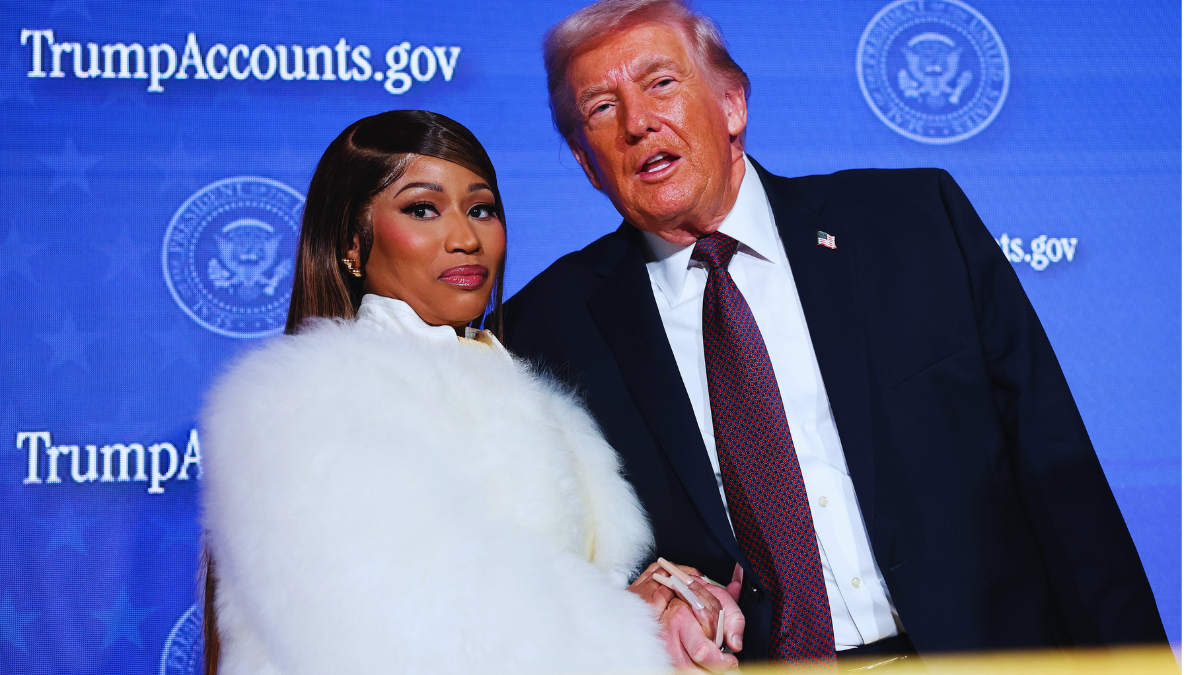
Nicki Minaj and Donald Trump quite literally joined hands at the latest policy announcement in Washington, D.C., unveiling what the administration is calling “Trump accounts.” The president made the glossy announcement surrounded by celebrities and business owners, pitching the initiative as a way of “making every American child a capitalist from birth.”

In quick succession, global payments company Visa announced it would allow cardholders to send rewards directly into Trump accounts. Minaj publicly voiced her support for Trump and revealed she had received a “Gold Card.” But amid the spectacle and celebrity endorsements, the noise may have made it harder for many to understand what a Trump account actually is.
At first glance, Nicki Minaj and Donald Trump seem to have little in common. One is a real estate mogul turned politician, the other a rapper and actress. But the parallels become harder to ignore the closer you look. Both grew up in Jamaica, Queens. Both have been described as bullies. And, more disturbingly, both have faced accusations of protecting pedophiles. In that sense, Minaj was a perfectly calculated, headline-grabbing addition to Trump’s rollout — a similarity New York Governor Kathy Hochul also pointedly highlighted on X.

As Trump wrapped up his remarks, he invited Minaj onstage to enthusiastic applause, adding that the rapper had just donated “hundreds of thousands” of dollars to the children of her most vulnerable fans through the Trump accounts.

Under the plan, every child born between Jan. 1, 2025, and Dec. 31, 2028, would qualify for $1,000 in seed money deposited into a Trump account. That money would be invested in the stock market and managed by private investment funds until the child turns 18. Parents who wish to enroll their children can begin doing so in July 2026 by filing IRS Form 4547.

According to Waka, venture capitalist and close Trump ally Brad Gerstner has emerged as one of the initiative’s most vocal champions, framing it as a counter to the rise of “openly socialist” candidates. “The answer to more socialism is more capitalism,” Gerstner said. “This makes every child in America a capitalist from birth.”

Trump’s proposal isn’t the first attempt at a “baby bonds” program, but it is unusual in how deeply it relies on the private sector. States like California and Connecticut, along with Washington, D.C., have explored similar ideas, though those programs envisioned state-managed funds rather than private investment firms overseeing the money.

Critics have also raised concerns that the plan disproportionately benefits wealthier households. Parents who can afford it may contribute an additional $5,000 per year to their child’s account, while lower-income families are left hoping that charities might help close the gap.

Assuming a hypothetical return of 7 percent, the original $1,000 investment would grow to about $3,570 by the time a child turns 18. That figure, however, comes alongside proposed cuts to Medicaid, SNAP, and other social programs that might have made those same children’s lives meaningfully easier in the meantime.

Ultimately, the biggest winners may be the private investment firms themselves. While about 58 percent of U.S. households hold some form of stock, the wealthiest 1 percent still control roughly half of the market.

Sign up to read this article
Read news from 100’s of titles, curated specifically for you.
Already a member? Sign in here
Related Stories
Top stories on inkl right now
One subscription that gives you access to news from hundreds of sites
Already a member? Sign in here
Our Picks
Fourteen days free
Download the app
One app. One membership.
100+ trusted global sources.