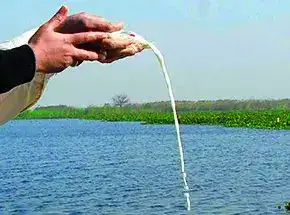
The National Green Tribunal’s central bench in Bhopal has sought responses from the Central Pollution Control Board and the Madhya Pradesh Pollution Control Board on whether the ritualistic pouring of milk into rivers can be treated as a form of water pollution and whether the practice requires regulatory guidelines, reported TOI.
The tribunal was hearing a petition filed by Siddarth Singh Rajpoot, a resident of Satdev village in Madhya Pradesh’s Sehore district, who raised concerns over a recent religious event held in the area.
According to the plea, organisers of the gathering poured nearly 11,000 litres of milk into the Narmada river as part of a ceremonial offering and also immersed around 210 saris in the water.
Rajpoot argued that such practices, despite being linked to religious customs, could adversely impact the river ecosystem. He told the tribunal that large quantities of organic substances entering the river may affect aquatic life, alter water quality and contribute to contamination.
TOI further reported that the petition also claimed that the act violated provisions of the Water (Prevention and Control of Pollution) Act, 1974.
Tribunal flags lack of scientific clarity
During the hearing, the bench comprising Justice Sheo Kumar Singh and expert member Sudhir Kumar Chaturvedi noted that no scientific material had yet been placed before the tribunal conclusively proving whether pouring milk into a river leads to measurable pollution or ecological damage.
At the same time, the tribunal observed that there are currently no dedicated guidelines issued by the CPCB specifically addressing the practice of offering milk in rivers during rituals. The judges pointed out that the issue falls into a grey area where cultural practices intersect with environmental concerns.
In its interim order, the tribunal raised a broader question: whether large quantities of milk discharged into a river should be considered an organic pollutant capable of reducing oxygen levels in water bodies or harming aquatic organisms.
The bench also noted that the practice has triggered debate in recent years, particularly on social media, with questions being raised about the environmental cost of ritual offerings in rivers considered sacred, the news outlet said.
The NGT directed that copies of the petition and related documents be sent to the regional director of the CPCB in Bhopal and the member secretary of the MPPCB. Both agencies have been asked to conduct an expert assessment, collect scientific data on the impact of such practices and submit a detailed report before the tribunal.
The tribunal further said that if existing regulations are found to be inadequate, the pollution control authorities should recommend an appropriate framework or guidelines governing such activities.
The matter has now been posted for further hearing on July 17.
For more news like this visit The Economic Times.