Get all your news in one place.
100's of premium titles.
One app.
Start reading
The Times of India
The Times of India
World
TOI World Desk

New Jersey teacher turns sheep into solar field workers, growing flock to 450

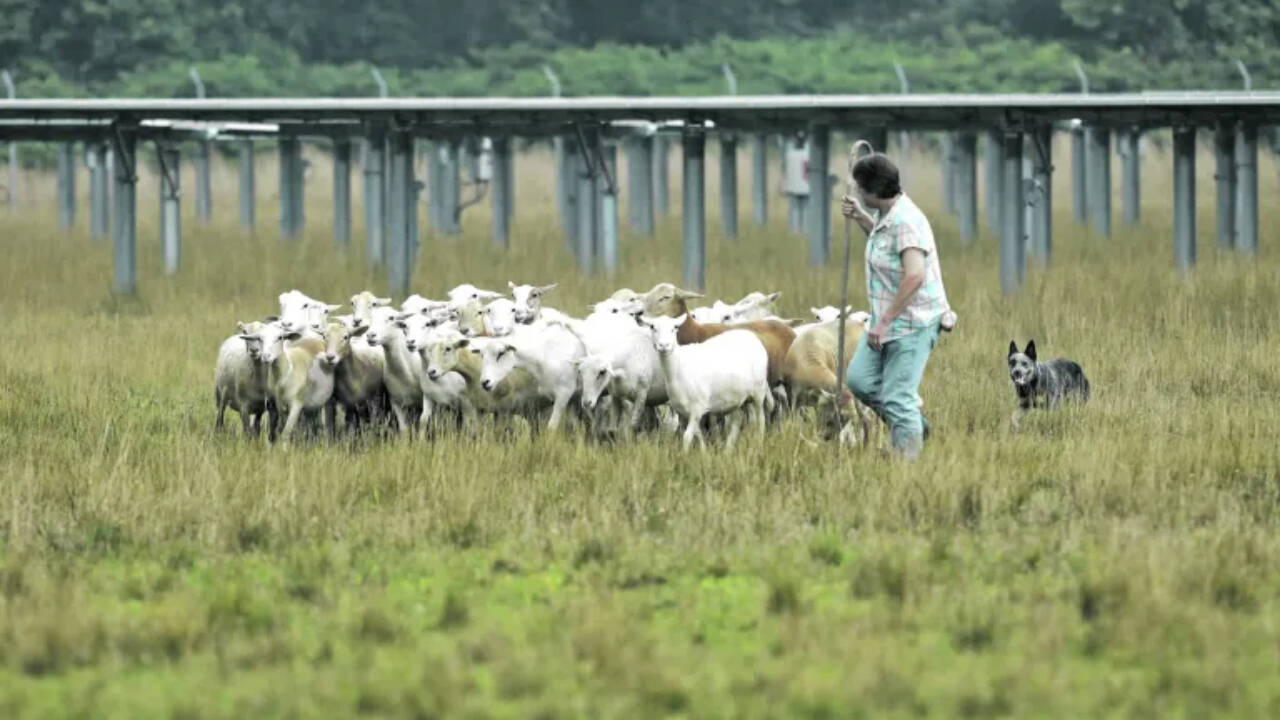
What began with a simple observation beside a solar field turned into an unusual farming business in New Jersey. When Julie Bishop noticed workers repeatedly mowing vegetation beneath and around solar panels, she saw an opportunity to put her sheep to work instead. What started as a small flock grazing a single site eventually grew into a full-time solar-grazing operation, pairing livestock with renewable-energy infrastructure, states an online observation piece by the Cornell University’s College of Agriculture and Life Sciences.

Get breaking news anytime, anywhere. Download the TOI app now!

From six acres to solar fields

According to the website report, Bishop's journey into solar grazing began at her six-acre farm in Newfield, New Jersey. With limited pasture available and a growing need for space for her sheep, she began looking for alternative grazing land.

A fenced solar array caught her attention. Instead of relying on machinery to keep vegetation under control, the site could be managed naturally by grazing animals. Bishop approached the solar company and eventually secured a vegetation-management contract. Solar Sheep LLC was born from that arrangement. The operation initially involved around 50 sheep grazing 15 acres of solar panels. By 2021, Bishop was managing approximately 85 acres across multiple solar sites with a flock of 450 sheep.

Sheep as solar-site workers

As per the report, solar grazing requires considerably more planning than simply turning livestock loose in a field. Bishop uses portable fencing where a site allows it, creating paddocks that can be rotated as the flock moves through the vegetation. Not every solar installation is suited to extensive fencing, however. At smaller or awkwardly shaped sites, she relies on water and mineral stations to encourage the sheep to move toward areas that need attention. Transport is another part of the operation. Bishop uses a 24-foot stock trailer capable of carrying about 50 sheep at a time, while her Australian Cattle Dog, Mandy, helps gather the flock and locate animals during moves between sites.

The flock consists primarily of mature yearlings and ewes. Lambs remain at the home farm, where Bishop can closely monitor their health and development. She raises Katahdin sheep, with lambing generally taking place in January and February. The resulting lambs are sold for meat, pets and to other solar grazers.

A business that keeps expanding

The growing operation has also taken Bishop beyond routine vegetation management. Her experience has led to involvement in the planning of a proposed 700-acre utility-scale solar facility designed specifically for grazing. The planned site includes infrastructure such as lambing barns, feed storage, water and electricity, allowing sheep to remain on the property throughout the year. Bishop's expanding flock was expected to approach 1,000 animals as the operation developed.

Solar grazing still comes with practical complications. Trucks and trailers must navigate sites that were often designed for equipment rather than livestock, while gates, cable trays and electrical infrastructure require careful coordination.

Sign up to read this article
Read news from 100's of titles, curated specifically for you.
Already a member? Sign in here
Related Stories
Top stories on inkl right now
One subscription that gives you access to news from hundreds of sites
Already a member? Sign in here
Our Picks
Fourteen days free
Download the app
One app. One membership.
100+ trusted global sources.