"In a place where they burn books, they will burn people."
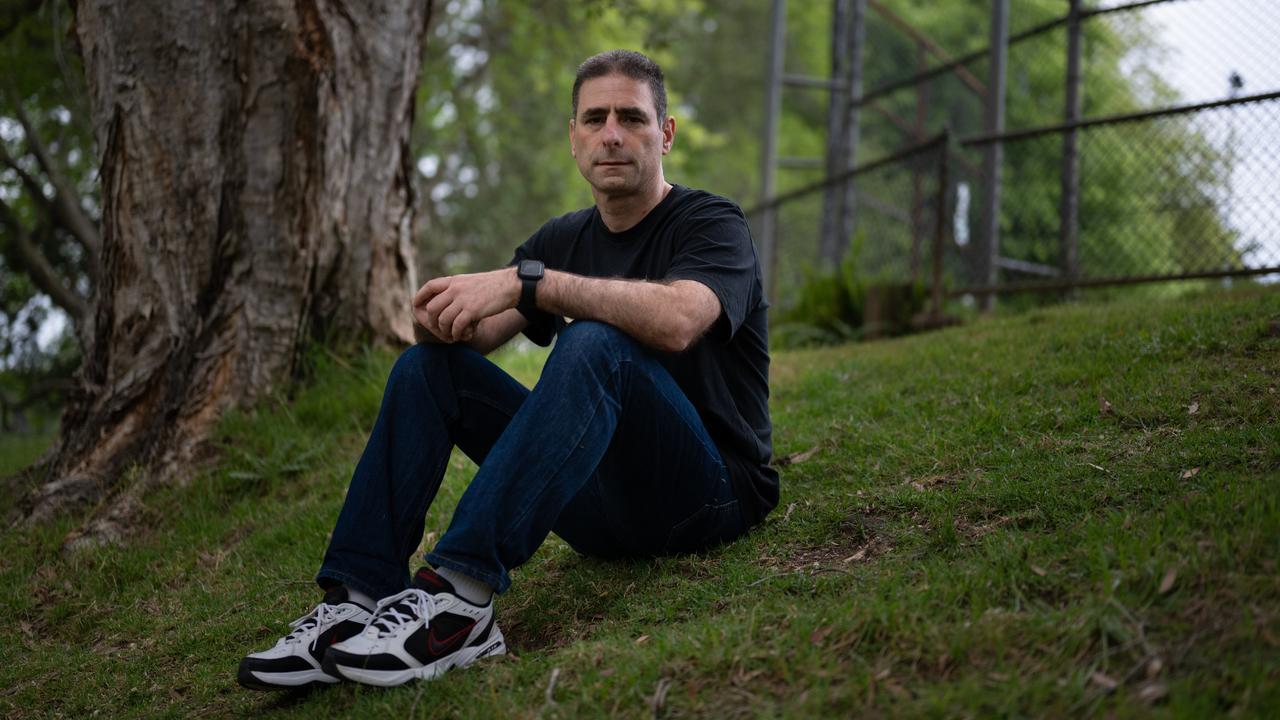
So thought Zack Shachar when he found pages of the text that underpins his Jewish faith torn and scattered through the streets of an Australian city.

The words paraphrase a quote from German-Jewish writer Heinrich Heine that prophesied the Nazi book burnings a century later.
It was December 2023 and Mr Shachar, who migrated to Sydney from Israel more than a decade before, was visiting the Gold Coast with his family.
While out on a walk together, Mr Shachar's daughter found a piece of paper bearing what she recognised as Hebrew script.
Soon, they found a second fragment, and then more, until they had collected enough sheets of the Hebrew Bible to fill a small bag.
Mr Shachar reported the matter to Queensland Police, who found CCTV of a person of interest, but were unable to identify the suspect.
Reluctant to discard the fragments, Mr Shachar brought them back home to Sydney, where he gave them to his synagogue to be buried.
"We were shocked that people (could) take something that is very important and holy to some culture, and they decide to tear it to pieces," he tells AAP.
Two months earlier, his cousin had been kidnapped by Hamas-led militants during a series of cross-border raids into southern Israel.
Footage of Naama Levy - who had only recently joined the Israel Defence Force as an observer - being violently pulled from a vehicle by her captors was among the first clips to emerge following the October 7 attacks.
It would be 477 days before the 19-year-old was freed - one of the 251 people taken hostage, added to some 1200 killed.
Mr Shachar watched the incident unfold from afar, protected from the violence that was unleashed on his family back home.
That someone would think to tear pages from the Hebrew Bible so soon after the attacks, however, confirmed his worst fears.
In Australia, he says, it seemed "people were losing sight of the atrocity".
Wednesday will mark the third anniversary of the October 7 attacks, with events planned by pro-Israel and pro-Palestine groups.
For the former, it is an opportunity to pay respects to the lives lost and forever changed on the deadliest day in Israel's history.
For the latter, it's a time to draw attention to the ensuing escalation of Israel's war on Gaza, which has killed more than 74,000 people and wounded some 175,000, according to Gaza's health ministry.
The fallout from Israel's attacks, which have continued amid stalled negotiations since a US-backed ceasefire in October 2025, extends to Australia.
Sameh Murad's family was among the first to be swept up by Israel's attacks on Gaza in the days after October 7.
On October 13, his wife Dina bundled into a truck along with their children and Mr Murad's mother and brother, after Israel ordered civilians to evacuate south.
They were a short distance from home when a bomb struck their vehicle, killing Dina, who had been cradling their infant daughter.
Mr Murad, a journalist, was filming at the Al-Shifa Hospital when his daughters were admitted by ambulance, followed by his wife.
"I saw her for a split second when they uncovered the white shroud," he tells AAP.
"That image still haunts me until today. She was fully disfigured."
Through the trauma, Mr Murad continued to document the onslaught until he resettled in Melbourne with his surviving family in early 2024.
"We survived a genocide without mercy," he says.
In the three years since October 7, Australia has grappled with fractured social cohesion and its diplomatic settings in the Middle East.
The Bondi Beach massacre of December 2025 was, for many, evidence of rising anti-Semitism and government policy failure.
Fifteen people were killed, including a 10-year-old girl, and dozens injured after gunmen opened fire on a crowd celebrating the Jewish holiday of Hanukkah.
For Executive Council of Australian Jewry co-chief executive Alex Ryvchin, it was in part the result of Australia's failure to take the attacks of two years earlier seriously.
"October 7 was one of those cosmic moments when you realise the world has changed and will never be the same again," he tells AAP.
For Mr Shachar, it was an extension of the violence he felt was required to tear pages from a sacred text and leave them scattered on the streets.
"Are you waiting for someone to die?" he recalls saying before the Bondi shootings.
In the end, he says, "not one person died, but 15".