Get all your news in one place.
100’s of premium titles.
One app.
Start reading
Space
Space
Science
Kenna Hughes-Castleberry

Neutron star photobombs baby star | Space photo of the day for Feb. 3, 2026

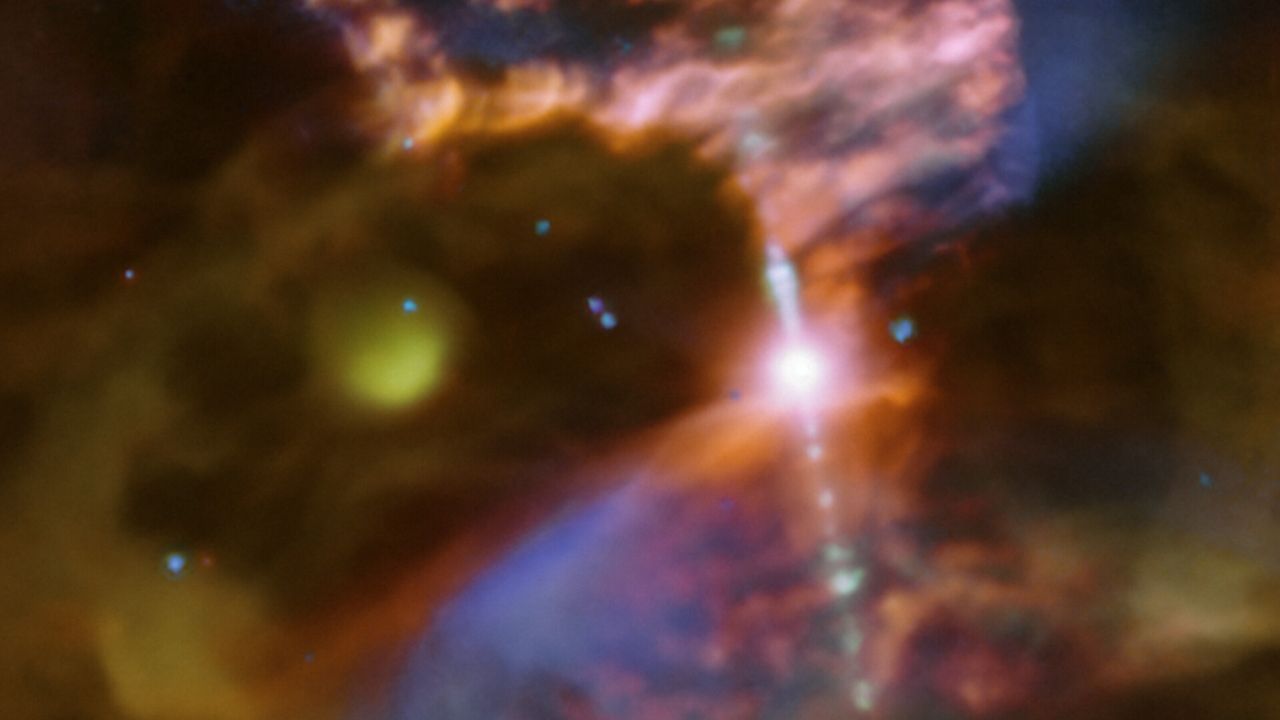
A blurry swirl of blue and yellow and red gas are seen in this image with a bright dot of light in the center.

In astronomy, appearances can be deceiving, especially when you're looking at objects that are both distant and complex. Glowing clouds of gas are often grouped under the catch-all term "nebula," but the processes that light them up can be radically different.

A planetary nebula, for example, marks the late-life shedding of material by a sun-like star. (It has nothing to do with planets; the name comes from the object's passing resemblance to a planet, as seen through early telescopes.) A stellar nursery signals the opposite: the messy, energetic beginning of a new star's life. Untangling which story you're seeing usually requires detailed measurements of how the gas is moving and what it's made of.

That's exactly the kind of work the European Southern Observatory's Very Large Telescope (VLT) is built to do. One of the VLT's powerhouse tools, the MUSE instrument, is an integral-field spectrograph, which takes snapshots and breaks down the spectrum of colors within the images to show chemical components, temperature and motion of corresponding areas.

What is it?

The VLT recently captured an image of an object known as Ve 7–27, which was long thought to be a planetary nebula. However, thanks to observations from the MUSE instrument, the image shows that Ve 7–27 is actually a still-forming baby star, helping to settle the debate.

The main clues came from the structure of Ve 7–27, as energetic jets studded with bright knots, also called "bullets," are emanating from the structure — a hallmark of newborn stars interacting violently with their surroundings.

"Instead of being the 'last breath' of a dying star, Ve 7-27 is a newborn one," said Janette Suherli, a Ph.D. candidate at the University of Manitoba in Canada and first author of the study that revealed this result, said in a statement.

Where is it?

Ve 7–27 is located around 4,500 light-years away and is part of the Vela Junior supernova remnant.

Object Ve 7–27 is considered a young star due to its jets of energy being shot out into its environment. (Image credit: ESO/J. Suherli et al.)

Why is it amazing?

The image contains both stellar beginnings and endings, as near the center of the image is a compact, yellowish-green smudge that hosts a neutron star, the ultra-dense remnant left behind when a massive star exploded as a supernova. This region belongs to the Vela Junior supernova remnant, part of a broader cloud of material launched outward by that ancient explosion.

With the help of MUSE's observations, astronomers found that Ve 7–27 is embedded within the material expelled by the Vela Junior supernova, which links the newborn star with the debris of a stellar death. The connection also helps to solve a long-running problem: the distance of Vela Junior. By tying it to Ve 7–27, whose distance is known, astronomers can place Vela Junior around the same distance of 4,500 light-years away, resolving inconsistencies about the remnant's true size, expansion rate and age.

Want to learn more?

You can learn more about star formation and supernovas.

Sign up to read this article
Read news from 100’s of titles, curated specifically for you.
Already a member? Sign in here
Related Stories
Top stories on inkl right now
One subscription that gives you access to news from hundreds of sites
Already a member? Sign in here
Our Picks
Fourteen days free
Download the app
One app. One membership.
100+ trusted global sources.