
Get all your news in one place.
100’s of premium titles.
One app.
Start reading
Livingetc
Livingetc
Amy Moorea Wong

Neuroaesthetics Can Help You Understand How Your Home Makes You Feel — "When a Space Engages Your Senses, It Feels Alive"

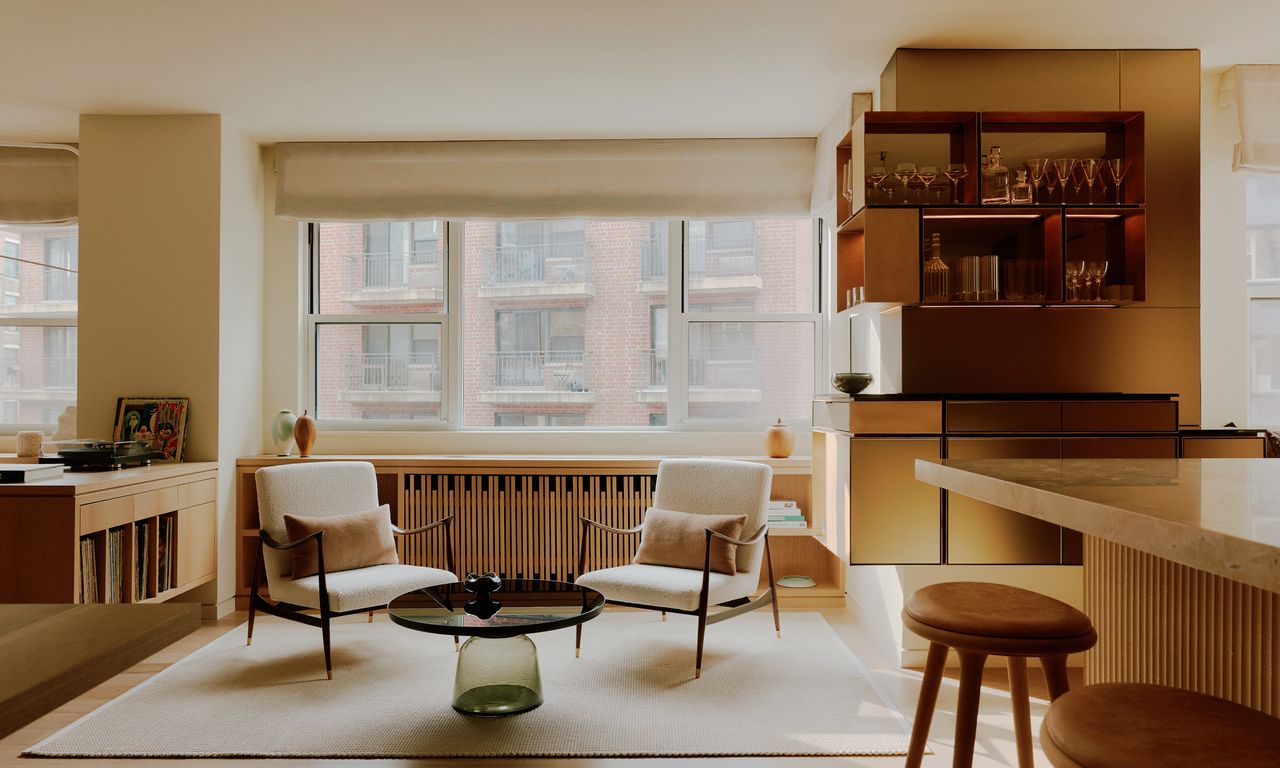
Kitchen-diner with lounge area.

There’s been a growing awareness for quite some time now that rooms are, in fact, about a lot more than how they look. Feelings — you know, the real life, human kind — have crept up on us, becoming just as relevant to our interiors as the likes of color, form, texture, material, and layout. It’s called neuroaesthetics. Sitting at the intersection of neuroscience, cognitive science, psychology, design, architecture, and aesthetics, it’s the study of the physical impact that aesthetic stimuli such as beauty, design, and art have on the body and brain.

We’re moving past spatial perception being the domain of the eyes alone — all of our senses can contribute to measurable brain activity, which occurs when we interact with a space, revealing how our surroundings truly shape the way we feel.

And don’t tick off the standard big five senses and think you’re sorted – received wisdom these days is that we have anything from 21 to 33 to 53 or more senses, with neuroscientists generally including the likes of proprioception (the perception of body position and movement), thermoception (heat) and chronoception (time) on the increasingly lengthening list of specialized senses at our disposal before we've even got to color psychology in interior design.

A project by multisensory design practice Jolie Studio. (Image credit: Jasper Fry. Design by Jolie Studio)

"Neuroaesthetics examines how the environments we live in affect us on a physical and emotional level," explains Suchi Reddy, founder of neuroaesthetics-focused New York architecture and interior design practice Reddymade. "When you walk into a room and immediately feel calm, inspired, or uplifted, that’s your brain and body responding to design. The proportion of the space, the materiality, the texture, and the quality of the light all send signals to the brain to shape how we feel."

In an age of ever-increasing overstimulation, burnout, and stress, neuroaesthetics feels like a timely reprieve. It gives us not only the awareness of how physicality and psychology interact, but also the language to clarify it, and the tools to turn practical rooms into spaces that feed our souls and nurture our wellbeing.

"Understanding how our environments affect our nervous systems is now more important than ever," says Laura Perryman, founder of London-based color and material research studio Colour of Saying. "Neuroaesthetics enables us to design intentionally for how people actually feel and function. It turns 'this feels better' into 'here’s why this works for our stress levels and how we can optimize it'."

Emergence, a multisensory wellbeing experience in New York by Kinda Studios and 113 Spring. (Image credit: Kunning Huang / CKA. Design by Kinda Studios)

How would we — and the world — be different if every room was designed to foster wellbeing, comfort, security, and inclusion? Wouldn’t we be looking at a smoother, easier, more joyful future? "Neuroaesthetics shows that design has the power to heal, to restore balance and foster creativity," say Robyn Landau and Katherine Templar Lewis, co-founders of London-based neuroscience lab and creative house Kinda Studios.

"It’s particularly relevant to interior design right now because it reveals that our aesthetic responses are not superficial; they’re hardwired into our biology. Design doesn’t just shape how a space looks; it shapes how we feel, think, and connect — we need to reconsider how our environments can actively care for us."

What it all means, in terms of decorating, is that a room shouldn’t be deemed functional until it evokes positivity within us. "Neuroaesthetics invites us to decorate from the inside out, starting with what feels good," says Suchi. "Maybe it’s a certain kind of light in the morning, the softness of a fabric or the quiet rhythm of repeated shapes… when you approach the design of your home this way, it becomes an extension of your emotional landscape — something that responds to and supports you."

A Greenwich Village apartment project by Reddymade. (Image credit: William Jess Laird. Design by Reddymade)

Of course, this isn’t a one-size-fits-all situation: what we find calming or stimulating is often subjective, shaped by our own personal histories and cultures. While a city-dweller may find industrial textures reassuringly familiar, someone raised in the country would likely disagree, and while a bold personality may find strong contrasts and geometry serene, they would be jarring to a minimalist. And "what you need in different spaces varies, too," adds Laura.

There are certain universal markers that, in general, we all find physiologically appealing; they often come from the natural world and allow the parts of our brains that sense threat to stand down. These collective crowd-pleasers include blues and greens, which remind us of the habitat we came from; natural materials and scents, which ground us; curved, organic shapes, which follow brain-pleasing, flowing rhythms; and daylight, which synchronizes our circadian rhythms and lifts mood.

Laura Perryman’s guest apartment design for The Eades, a rental community project between Way of Life and interior design studio Nicemakers. (Image credit: Ellen Christina Hancock on behalf of The Eades. Design by Laura Perryman)

"There are biological truths, but the experience of them is infinitely individual — that’s why two people can stand in the same room and feel different things," explains Suchi. "Neuroaesthetic design acknowledges that subjectivity, while still drawing from universal patterns of human perception. For me, this always begins with connection. When a space reflects who you are and engages your senses, it feels alive."

Sign up to read this article
Read news from 100’s of titles, curated specifically for you.
Already a member? Sign in here
Related Stories
Top stories on inkl right now
One subscription that gives you access to news from hundreds of sites
Already a member? Sign in here
Our Picks
Fourteen days free
Download the app
One app. One membership.
100+ trusted global sources.