
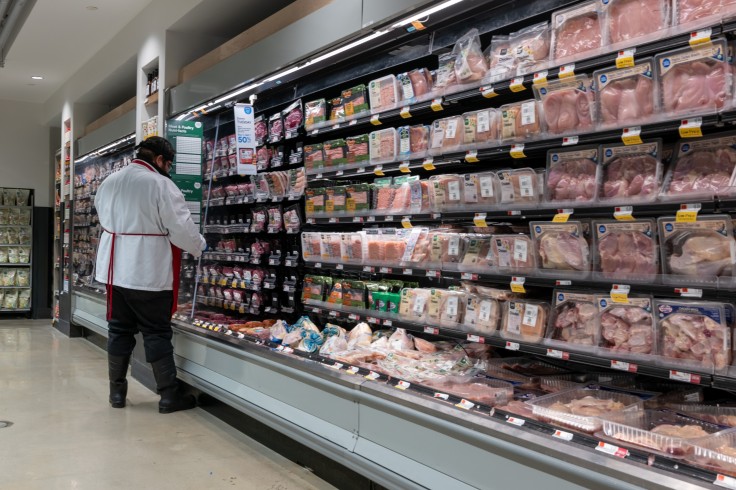
A Boston company shipped roughly 24,900 pounds of frozen buffalo chicken products into foodservice kitchens across five New England states over the course of a year, and none of it was federally inspected. The U.S. Department of Agriculture's Food Safety and Inspection Service announced the recall on Wednesday, saying the products carried false inspection marks. FSIS has listed the action at Class I, its highest risk category.
Shanghai Ravioli Corporation is recalling boxes of "BUFFALO CHICKEN RANGOON," packed 100 pieces to a case, and "BENEDETTO'S BUFFALO CHICKEN MOZZARELLA STICK," packed 120 pieces to a case. Both carry sell-by dates running from July 8, 2026 through June 29, 2027, and both bear the establishment number "EST. 18004," which does not hold a federal grant of inspection. The products were made between July 8, 2025, and June 29, 2026, and shipped to foodservice locations in Maine, Massachusetts, New Hampshire, Rhode Island, and Vermont.
No illnesses or injuries have been confirmed. FSIS surveillance activities, rather than a consumer complaint or an outbreak investigation, found the problem, Food Safety News reported.
An Uninspected Product Is Treated as a Risk on Its Own
No pathogen or allergen was identified. That absence is exactly what makes the category confusing to readers, because the recall is not about something that was found. It is about a body of checking that never happened.
Federal inspection of meat and poultry plants covers sanitation, temperature control, ingredient verification, and label accuracy. When product moves without it, FSIS treats every one of those as unverified at once. The agency's own language is direct: food produced without inspection may contain undeclared allergens, harmful bacteria, or other contaminants that put consumer health and safety at risk.
For a buffalo chicken product specifically, the unverified label is the part worth pausing on. Buffalo sauces and breaded coatings routinely involve dairy, egg, wheat, and soy. A cream cheese-filled rangoon and a breaded mozzarella stick both contain milk by design. Nobody has established that these particular labels were wrong. The point is that no federal inspector confirmed they were right, and a foodservice kitchen relaying ingredient information to a customer with a milk or wheat allergy was relying on that confirmation without knowing it was absent.
The Recall Sits in Commercial Freezers, Not Home Kitchens
This is a foodservice recall, and that changes who has to act. These are 100- and 120-piece cases sold to restaurants, bars, cafeterias, and institutional kitchens. No consumer bought a box of 100 buffalo chicken rangoon at a supermarket.
FSIS said it is concerned that some product may still be sitting in foodservice refrigerators and freezers, and urged operators who purchased it not to serve it. Operators should throw the product away or return it to the place of purchase. Operators can check case labels for the establishment number and the product names, and the full notice is posted on the agency's recalls and public health alerts page.
The sell-by window is wide, which is the operational problem. Product made in mid 2025 could still be legitimately in inventory under a 2027 sell-by date. Frozen appetizer cases turn over slowly in small kitchens, and a box bought last autumn may be at the back of a walk-in freezer today.
Diners have no practical way to identify what they ate. Someone who ordered buffalo chicken rangoon at a New England restaurant this year cannot trace it to a supplier. That is not a reason for alarm, given that no illnesses have been reported, but it is a reason not to expect a personal action item from this notice.
Where the Accountability Question Sits
A false establishment number is a different category of failure from a mislabeled allergen or a contamination event. It means product entered commerce while presenting itself as something it was not, for close to a year, across five states.
FSIS found it through surveillance, which is the system working. The interval is what invites scrutiny. The agency has not said publicly how the false mark went undetected across that period, how many foodservice accounts received the product, or whether any enforcement action beyond the recall is under consideration. FSIS routinely conducts recall effectiveness checks to confirm that customers were notified and that product has been pulled, and it posts distribution lists when they become available. Federal food recalls also tend to stay open longer than the news cycle around them, as with the egg recall in which investigators kept the case open well past the last affected sell-by date.
This is the second time in roughly two months that a labeling problem in the same broad category has surfaced in MedicalDaily's coverage. In June, the agency issued three food safety actions in a single day, including a product sold as pasta salad that may have actually been chicken salad containing undeclared egg and milk. Different failures, same underlying vulnerability: a label is only as reliable as the verification behind it.
Reasonable Steps for Diners and Kitchen Staff
For most households, the answer is nothing. No retail product to check and no consumer-facing brand to avoid.
Anyone who runs or works in a foodservice kitchen in the five affected states should check inventory against the product names and establishment number today, before the next service, and discard anything matching. People who ate buffalo chicken appetizers recently and feel fine do not need testing or medical attention. Anyone with a food allergy who had an unexplained reaction after eating out should describe it to a clinician, mentioning what was eaten and when.
Consumers with food safety questions can reach the USDA Meat and Poultry Hotline at 888-674-6854. Reports of suspected foodborne illness go to a state or local health department, which is also how a cluster would first become visible if one existed.
Key Questions Answered
What was recalled? About 24,900 pounds of frozen, not ready-to-eat buffalo chicken rangoon and buffalo chicken mozzarella sticks made by Shanghai Ravioli Corporation of Boston, announced by USDA on August 26.
Why is it being recalled? The products were produced without federal inspection and carried false inspection marks with establishment number "EST. 18004," which has no federal grant of inspection.
Where did the products go? To foodservice locations in Maine, Massachusetts, New Hampshire, Rhode Island, and Vermont. They were not sold in retail packages to consumers.
Has anyone gotten sick? No confirmed illnesses or injuries have been reported. The issue was found through FSIS surveillance activity.
Why does missing inspection matter if nothing was found? Because inspection is what verifies sanitation, temperature control, ingredients, and label accuracy. Without it, all of those are unconfirmed, including allergen declarations.
What should restaurants and kitchens do? Check case labels for the product names and establishment number, do not serve the matching product, and throw it away or return it to the place of purchase.
What should someone do if they feel ill after eating out? Contact a health care provider and describe what was eaten and when. You can also report suspected foodborne illness to a local or state health department.







