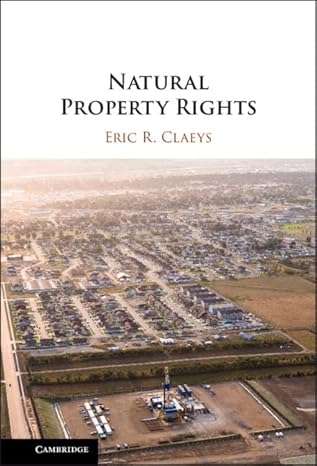
I'm blogging this week about my new book Natural Property Rights, published with Cambridge University Press and available for purchase now digitally and in hardbound version, at a variety of bookstores. Yesterday, I summarized the book's normative theory. I also promised readers that, for the rest of this week, I would explain how that theory applies to property through the prism of a 1L property course.
Before starting, let me explain in a little more detail two points I made yesterday. First, in a natural law framework, a natural property right isn't a sweeping right of autonomy. When people want to establish rights in relation to particular ownable resources, they need to satisfy two requirements: They must put the resources to morally-productive uses, and they need to communicate to their neighbors their property claims reasonably clearly. Even then, the rights are subject to two provisos: one for cases of necessity, and another when proprietors' claims leave neighbors with insufficient access to resources like the ones covered by those claims.