Get all your news in one place.
100's of premium titles.
One app.
Start reading
International Business Times
Business

Nasdaq Rewrote Its Rules for SpaceX; Now $4.3B in Passive Buying Forces Index Funds' Hands

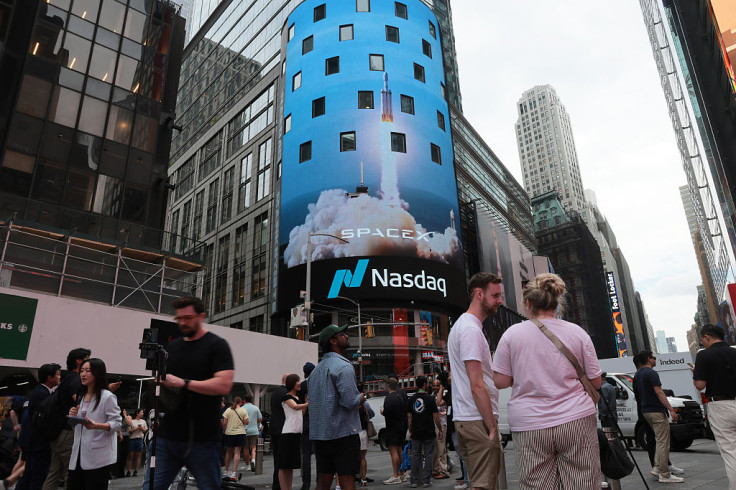
SpaceX began trading publicly in June. (Credit: Getty Images)

Tens of millions of Americans who hold a Nasdaq-100 index fund — in a 401(k), an IRA, or a brokerage account — became involuntary SpaceX shareholders tonight, as fund managers executing mandatory rebalancing purchases bought an estimated $4.3 billion worth of SPCX shares at market close. The purchases required no decision on the part of any individual investor. They are the mechanical consequence of a rule change Nasdaq enacted on May 1, 2026, one that was specifically structured to accommodate SpaceX's $1.75 trillion debut — and that critics from Acadian Asset Management to the American Federation of Teachers have called one of the most consequential shifts in index design in a generation.

The rebalancing executions happened automatically after the 4:00 PM ET market close today, July 6. When trading opens Tuesday, July 7, SpaceX (Nasdaq: SPCX) becomes an official Nasdaq-100 constituent — the fastest any company has ever joined a major U.S. benchmark — and every fund benchmarked to the index will carry a position of roughly 0.5% to 0.7% in the rocket and satellite company, whether its holders chose that exposure or not.

How the 15-Day Fast-Track Rule Works — and Who It Serves

Under the prior Nasdaq-100 methodology, newly public companies had to wait a minimum of three months before becoming eligible for index inclusion, and were required to maintain at least 10% of their shares in public hands. Both requirements are now gone for mega-cap newcomers.

The replacement is the fast-entry rule: any company whose full market capitalization ranks it within the top 40 existing Nasdaq-100 members becomes eligible after just 15 trading days of public trading, with as few as five days of advance notice to the market. The rule went into effect May 1, 2026 — approximately six weeks before SpaceX's June 12 IPO. Nasdaq acknowledged in a February 2026 consultation document that the change reflects the reality of companies staying private longer and listing "at larger scale" with "more complex ownership and share structures." Critics, including Acadian Asset Management's Owen Lamont, a senior vice president at the firm, offered a more direct assessment: "Bad idea — that's too short for price discovery to occur."

The rule change benefits three parties simultaneously. The listing company collects far more IPO capital than it would if passive funds sat on the sidelines during a longer waiting period — research cited by Kiplinger suggests the fast entry process allows newly public companies to raise roughly 6% more capital than they otherwise would. The company's pre-IPO investors get guaranteed non-discretionary buying pressure driving the stock upward, an exit ramp critics have characterized less charitably. And Nasdaq collects the trading fees from a larger, more active index while locking in one of the most valuable new listings in financial history. The passive investor — the pension saver, the 401(k) holder — absorbs whatever price the market set before the mechanical buying began.

"This is the most shameless structural manipulation of a major index I've ever seen," George Noble, the chief investment officer of a hedge fund, told Kiplinger. Wall Street Journal columnist Jason Zweig called the rule "arbitrary, unfair and potentially risky." Financial Times correspondent Robin Wigglesworth characterized the combination of fast-track index inclusion and mega-IPO as potentially "the biggest bagholder exercise of all time."

Passive Investors as Exit Liquidity: The 6% Problem

The core structural critique of the fast-entry rule is not just that passive investors bought SpaceX — it is that they bought it at a price inflated by exactly the process that made the buying mandatory.

When an index change is announced in advance, algorithmic traders and momentum funds legally buy the inclusion candidate ahead of the forced rebalancing date. This practice, known as index front-running, is well-documented: academic research cited in Wikipedia's index fund article estimates that profits transferred from index investors to algorithmic traders reach 21 to 28 basis points annually just in S&P 500 tracking funds, and 38 to 77 basis points annually in Russell 2000 funds. Under Nasdaq's old three-month waiting period, potential inclusion candidates had a longer, less predictable inclusion window that was harder to front-run at scale. Under the new 15-day window with a five-day advance notice, the front-running opportunity is precise, brief, and enormous.

SPCX's price trajectory illustrates the mechanism. The stock peaked at $225.64 on June 16 — four days after the IPO — before falling to $147.11 on June 23, a 35% decline, before recovering to trade around $162 as of last Friday. The inclusion announcement came on June 26. Whether the peak was driven by index front-running, retail enthusiasm, or both, the passive funds that must buy today are doing so roughly 28% below that peak but still 20% above the IPO price — and against a float so thin that supply dynamics, not fundamental valuation, dominate short-term price formation.

SpaceX's public float is only 3% to 5% of its total shares outstanding. To compensate for the resulting index weight distortion, Nasdaq's methodology applies a float-weight multiplier of up to three times a low-float company's prevailing float ratio for companies with under 33.3% of their shares publicly traded. This multiplier, confirmed by Morningstar's analysis and Nasdaq's own FAQ document, triples the effective demand passive funds must meet compared to what SpaceX's actual tradeable share base would normally suggest. Put simply: Nasdaq's formula is requiring funds to buy more SpaceX than SpaceX's thin float would ordinarily support — concentrating a massive demand shock into a stock with almost no supply buffer.

S&P 500 Funds Are Unaffected — and Why That Gap Matters

Not every passive investor is in the same position tonight. The roughly $6 trillion benchmarked to the S&P 500 — including the SPDR S&P 500 ETF (SPY), Vanguard's VOO, and iShares' IVV — will not be forced to buy SpaceX shares tonight, this summer, or anytime in the near future.

S&P Dow Jones Indices, following a public consultation that ran through May 2026, announced on June 4 that it would hold firm on all three of its contested requirements: a 12-month minimum seasoning period, four consecutive quarters of positive GAAP earnings, and a minimum 10% public float. SpaceX reported a $4.28 billion GAAP net loss in the first quarter of 2026, following a full-year 2025 loss of $4.94 billion on $18.67 billion in revenue. Under S&P's current rules, SpaceX cannot be considered for inclusion before mid-2027 — and only then if it demonstrates consistent GAAP profitability it has not yet shown.

S&P's decision creates a structural divergence with significant implications. Nasdaq moved to a 15-day window. FTSE Russell moved to five days. S&P concluded that eligibility exceptions should not be granted based on market capitalization alone. The practical result is that Nasdaq-100 tracking funds absorbed a forced $4.3 billion demand shock tonight, while S&P 500 tracking funds held their existing positions untouched. Investors who are comparing their exposure — and deciding whether to shift Nasdaq-100 funds toward S&P 500 equivalents to avoid future fast-track inclusions — now have a clearly documented policy difference to act on.

Emily Spurling, Global Head of Index at Nasdaq Global Indexes, offered the exchange's defense in a May 8, 2026, published Q&A. She argued that the float-based weight cap designed into the new methodology addresses critics' concerns, and that the change reflects the reality that "companies stay private longer, list at larger scale, and come to market with more complex ownership." The three-month waiting period under the old rules was, she acknowledged, designed to ensure price discovery and stabilization — but she argued it was designed for "traditional IPOs" rather than for companies that arrive at the public market with "institutional-scale investor bases before their first day of trading."

What Your Fund Actually Bought: A Company With High Revenue and Higher Losses

For passive QQQ or QQQM holders now carrying SPCX as roughly 0.5% to 0.7% of their portfolio, the underlying business profile is worth understanding.

SpaceX priced its shares at $135 on June 12, raising roughly $85.7 billion in what became the largest IPO in history — nearly three times the previous record set by Saudi Aramco in 2019. The company's $1.75 trillion market capitalization represents a price-to-sales ratio above 90 times trailing revenue, a multiple more typical of high-growth software companies than aerospace manufacturers, and the company has not yet demonstrated GAAP profitability.

The investment case is almost entirely built on Starlink. The satellite internet segment generated $11.4 billion of SpaceX's $18.67 billion in 2025 revenue and is its only profitable business, reporting a 63% adjusted EBITDA margin. Starlink's global subscriber count surpassed 10 million — including 10.3 million as of March 31 — and has more than doubled since the IPO six weeks ago. For investors, the critical question is how quickly Starlink can grow from its current position as the dominant satellite broadband provider into a broader global communications platform.

The AI segment, which SpaceX absorbed through its February 2026 all-stock merger with Elon Musk's xAI, complicates the picture. The division posted a $6.36 billion operating loss in 2025 and burned a further $2.5 billion in the first quarter of 2026 alone. Morningstar, one of the few independent research firms to publish a formal valuation on SPCX, has described the stock as "demanding" at its current price, citing the AI segment's losses and what the firm called a "material threat of value destruction" in its xAI assessment. Morningstar's independent equity analysis placed SPCX's fair value substantially below its trading price. Analysts at New Street Research and Oppenheimer take a more constructive view, with price targets of $165 and $190 respectively.

History Says Index Inclusion Pulls Forward Demand, Not Stock Performance

For passive investors who do not intend to act on their new SpaceX exposure, it is worth understanding what index inclusion itself tends to predict about near-term returns — and what it does not.

An analysis of 35 Nasdaq-100 additions since the start of 2022 that were announced at least 10 days in advance — a comparable subset to SpaceX's situation — found that only 12 of those stocks rose on their first day as an index member. The average change on day one was a loss of 1.13%. The average change over the first five trading days following inclusion was a loss of 3.41%, according to data published on Seeking Alpha.

The pattern reflects a well-documented dynamic: anticipation of index inclusion tends to pull forward demand, as momentum traders and algorithmic front-runners buy ahead of the mandatory rebalancing date. Once that demand is satisfied — once the passive funds have completed their purchases — the mechanical buyer disappears, and the stock loses its most predictable near-term buyer. Strategy, formerly MicroStrategy, added to the Nasdaq-100 in December 2024 following a 358% run in that year, subsequently fell 68% by the end of 2025. Peloton and Okta experienced similar post-inclusion trajectories. None of those outcomes were foreordained by the inclusion itself, but none were prevented by it either.

SpaceX is a materially different company from those precedents, with a real and large revenue base, a profitable core business, and a plausible long-run growth thesis. The historical pattern is a reminder that index membership is a lagging recognition of past performance, not a forward-looking signal of future gains — and that the $4.3 billion in non-discretionary buying completing tonight is a one-time structural event, not a recurring demand source.

August 6 Is the Structural Inflection Point, Not July 7

For passive investors and active SPCX holders alike, the date that matters most in the near term is not tomorrow's open but August 6, 2026.

That date is when SpaceX is scheduled to report its first quarterly earnings as a public company — and when the first insider lockup window opens, at which point roughly 20% of locked insider shares become eligible for sale. A further 10% could unlock if the stock trades at least 30% above its $135 IPO price for five of any ten consecutive trading days. The remainder of locked shares is expected to release gradually through December 2026.

What tonight's forced buying sets up is a significant near-term supply constraint. Passive funds are executing billions in purchases against a float of only 3% to 5% of total shares — thin supply meeting non-discretionary demand — before any meaningful new supply enters the market. That dynamic may support near-term price stability. But when August 6 arrives, the structural picture flips: the mechanical buyer (the index-rebalancing fund completing its purchase) disappears, and the first window for insider selling opens at the same moment the company reports its first financial results.

That confluence — demand removal plus potential supply addition — is the structural reason both analysts and critics have pointed to August 6 as the more consequential near-term inflection point for SPCX. Tonight's $4.3 billion in forced buying is only the opening act.

For anyone already holding a Nasdaq-100 fund: no action is required. By tomorrow's market open, your fund will simply include a new position in the most talked-about company in the world. Whether that position was obtained on terms favorable to you — or to the insiders and front-runners who had been positioned since the announcement — is a question the fast-entry rule now makes impossible to answer differently for future mega-IPOs as well. OpenAI and Anthropic, both preparing for public offerings, are structured to qualify under the same 15-day window that brought SpaceX in tonight.


Frequently Asked Questions

Does my QQQ or 401(k) fund now hold SpaceX?

If your fund tracks the Nasdaq-100 — including QQQ, QQQM, TQQQ, or any 401(k) plan that uses a Nasdaq-100 index fund — then yes, your fund automatically added a SpaceX position as part of tonight's rebalancing. The position will represent roughly 0.5% to 0.7% of your Nasdaq-100 fund's total value. If your fund tracks the S&P 500 (SPY, VOO, IVV, or equivalent), you were not affected tonight — S&P held firm on its 12-month seasoning and GAAP profitability requirements, which SpaceX does not yet meet.

What is Nasdaq's fast-entry rule, and why did it change?

The fast-entry rule, effective May 1, 2026, allows any newly listed company whose full market capitalization ranks within the top 40 existing Nasdaq-100 members to join the index after just 15 trading days — eliminating the prior minimum three-month waiting period and 10% float requirement. Nasdaq's stated rationale is that mega-cap companies arriving at the public markets with large institutional investor bases already in place do not need the same price-discovery runway that traditional IPOs do. Critics argue the rule was specifically engineered to benefit SpaceX, its insiders, and investment bankers at the expense of ordinary passive investors, pointing to published research suggesting the mechanism allows companies to raise roughly 6% more capital than they otherwise would — with that premium coming from index fund holders.

Did passive investors get a fair price for their SpaceX exposure?

This is the structural question at the heart of the fast-entry rule debate. Because the index inclusion date was announced in advance, algorithmic traders and momentum funds had the opportunity to buy SPCX before passive funds were required to do so — a practice called index front-running. Research documented in Nasdaq-100 addition data shows that the average stock added to the index after an announced inclusion declined 1.13% on its first day as a member and 3.41% over the first five trading days. Whether that pattern holds for SpaceX depends on factors including the August 6 lockup expiry, first-quarter earnings results, and Starlink's subscriber trajectory. What is certain is that passive investors completed their mandatory purchases tonight at whatever price front-runners and the market had already established — with no discretion over timing or price.

When is SpaceX's insider lockup expiry, and what does it mean?

SpaceX's first insider lockup window opens on August 6, 2026, the same day the company reports its first quarterly earnings as a public company. At that point, roughly 20% of insider-held shares become eligible for sale. An additional 10% can be sold early if the stock trades at or above 30% over its $135 IPO price for five of any ten consecutive trading days. The remainder of locked shares is expected to release in stages through December 2026. The August 6 date is significant because it marks the end of the forced-buying phase — no new mechanical demand is expected to arrive after tonight — and the beginning of the potential insider supply increase. August 6, not July 7, is the structural inflection point that analysts have identified as the more consequential near-term date for SPCX's price.

Originally published on Tech Times

Sign up to read this article
Read news from 100's of titles, curated specifically for you.
Already a member? Sign in here
Related Stories
Top stories on inkl right now
One subscription that gives you access to news from hundreds of sites
Already a member? Sign in here
Our Picks
Fourteen days free
Download the app
One app. One membership.
100+ trusted global sources.