Get all your news in one place.
100’s of premium titles.
One app.
Start reading
LiveScience
LiveScience
Jamie Carter

NASA telescope spots first alien 'astrosphere' around a sun-like star: Space photo of the week

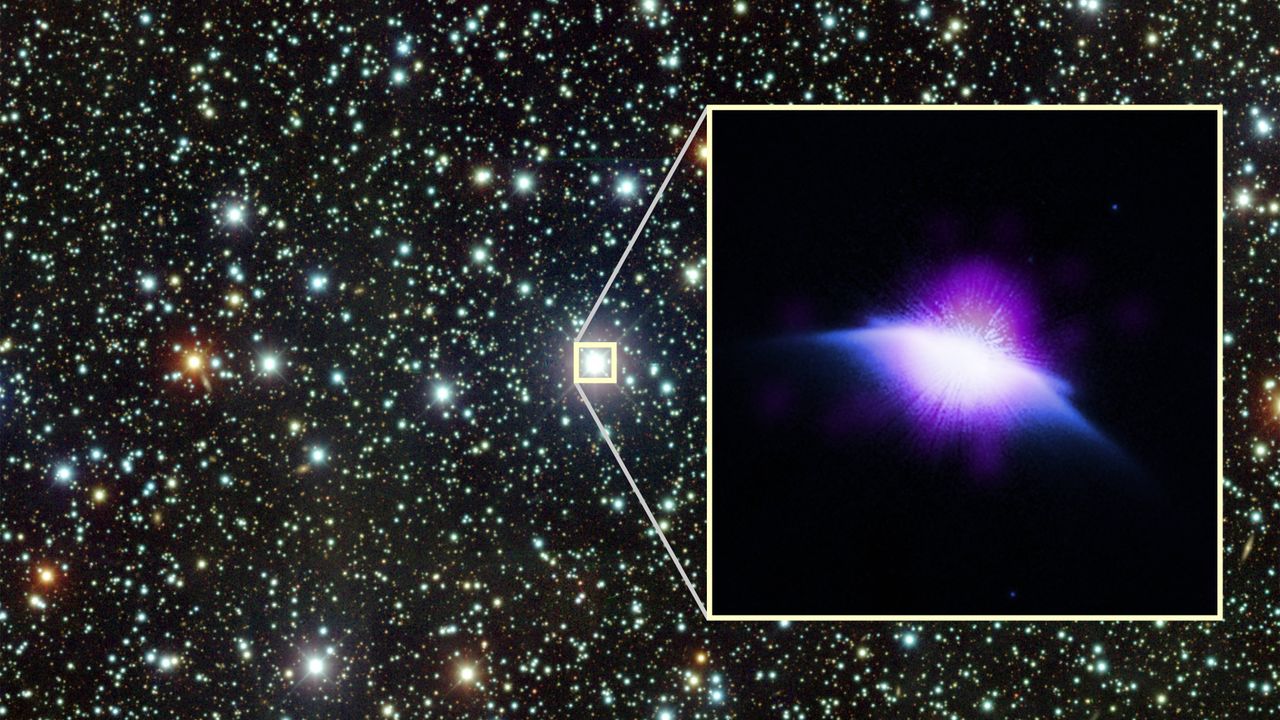
A star blowing a purple, wedge-shaped bubble in space.
quick facts

What it is: HD 61005, a sun-like star nicknamed the "Moth"

Where it is: About 117 light-years away in the constellation Puppis

When it was shared: Feb. 23, 2026

The sun orbits the center of the Milky Way wrapped in a protective bubble of its own making, dubbed the heliosphere. And for the first time, astronomers have spotted a similar protective bubble forming around an alien star.

Created by the solar wind — a stream of charged particles constantly pouring out from the sun — the heliosphere acts as a magnetic shield against interstellar radiation. Where the heliosphere ends, interstellar space begins, making it the outermost boundary of the solar system.

A star called HD 61005 has just been confirmed to have its own heliosphere, or "astrosphere.” And since HD 61005 is much younger than the sun (about 100 million years compared to 4.6 billion years), the discovery also offers astronomers a rare glimpse into what our home star may have looked like in its infancy.

This groundbreaking image uses X-ray data from NASA’s Chandra X-ray Observatory (purple and white in the image) alongside infrared (blue and white) and optical (red, green and blue) observations from other telescopes, including the Hubble Space Telescope and the Cerro Tololo Inter-American Observatory in Chile. Combining the data has enabled astronomers to capture a striking portrait of a stellar wind bubble in action.

A zoomed-in view of the 'Moth' and its astrosphere (Image credit: X-ray: NASA/CXC/John Hopkins Univ./C.M. Lisse et al.; Infrared: NASA/ESA/STIS; Image Processing: NASA/CXC/SAO/N. Wolk)

At the center of the image, there's a brilliant white X-ray core. Surrounding it is a neon-purple glow marking the astrosphere itself.

One of HD 61005’s most distinctive features is a wedge-shaped dust tail trailing behind it that looks like a pair of wings. This debris, left over from the star’s formation, has been swept backward as the star speeds through space, and its unusual shape has earned HD 61005 the nickname the "Moth.”

"There’s a saying about a moth being drawn to a flame," Brad Snios, a physicist formerly from the Harvard & Smithsonian Center for Astrophysics, said in a statement. “In the case of HD 61005, the ‘Moth’ can’t easily escape from the flame because it was born around it.”

Though similar in mass and temperature to the sun, HD 61005 is far younger and more active. Its stellar winds are estimated to be about three times faster and 25 times denser than those currently emitted by the sun. If it replaced the sun in the solar system, then our heliosphere would be up to 10 times wider, according to NASA.

Capturing the first alien astrosphere has been an ongoing mission since the 1990s. The breakthrough was made possible because HD 61005’s powerful wind collides with an unusually dense region of interstellar material, generating X-rays detectable by Chandra.

It's the first clue to what may have surrounded the early solar system billions of years ago — and perhaps how young planetary systems evolve in their cosmic neighborhoods.


See more Space Photos of the Week

Sign up to read this article
Read news from 100’s of titles, curated specifically for you.
Already a member? Sign in here
Related Stories
Top stories on inkl right now
One subscription that gives you access to news from hundreds of sites
Already a member? Sign in here
Our Picks
Fourteen days free
Download the app
One app. One membership.
100+ trusted global sources.