
Get all your news in one place.
100’s of premium titles.
One app.
Start reading
Digital Camera World
Mike Harris

NASA satellite data and aerial imagery played a huge role in reintroducing descendants of extinct species of giant tortoise back to Galápagos Islands

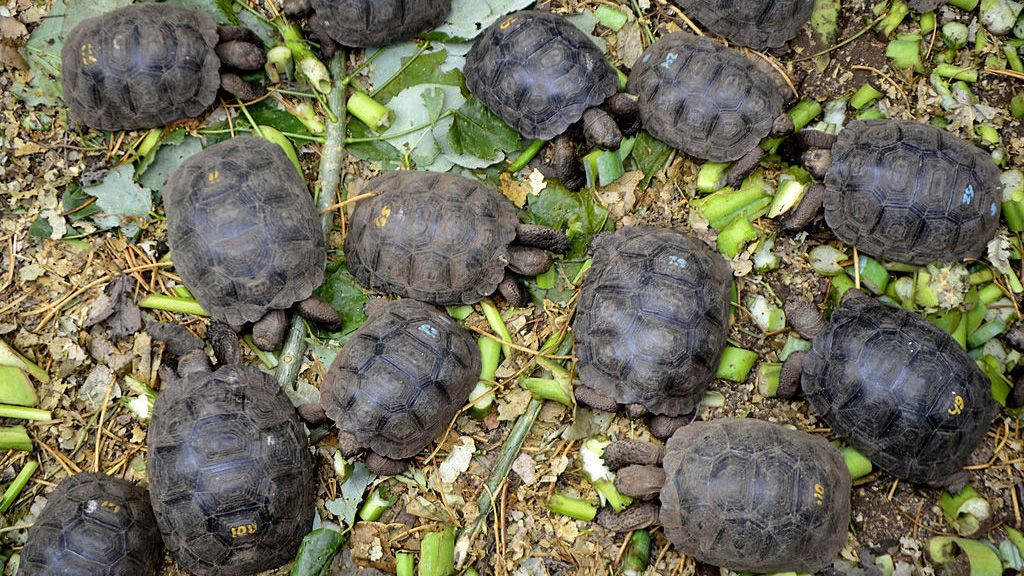
Little tortoises with genes of the Floreana Island giant tortoise species which were born in captivity, are fed in a breeding centre at the Galapagos National Park in Santa Cruz Island, in the Galapagos archipelago, located some 1,000 km off Ecuador's coast, on June 4, 2013. Experts will try to bring back in 2014 two species of the giant tortoise believed to be extint, the Chelonoidis abingdonii species of the Pinta Island (that of Lonesome George -- the last Pinta Island giant tortoise which died in June 2012) and the Chelonoidis elephantopus presumed extinct shortly after Charles Darwin's historic voyage there in 1835, as part of a captive breeding program directed towards resurrecting the species. Genes from recently extinct species can live on in mixed ancestry creatures. AFP PHOTO / RODRIGO BUENDIA (Photo credit should read RODRIGO BUENDIA/AFP via Getty Images).

A landmark giant tortoise reintroduction program on the Galápagos Islands used NASA satellite data and aerial imagery to help scientists pinpoint the perfect location for the reptiles’ release. It’s been roughly 180 years since the Floreana giant tortoise was driven to extinction due to over hunting and habit loss. The Floreana giant tortoise is famous for having been witnessed by Charles Darwin himself, where the species was already said to be in steep decline.

However, a long-term conservation program has put relatives of these incredible reptiles back on home soil for the first time since the mid-1800s. I say relatives, because they aren’t pure Floreana giant tortoises. Instead, they’re bred from descendants of the Floreana giant tortoise, first discovered by scientists including Dr. James Gibbs in 2000 at Isabela Island’s Wolf Volcano. Despite thinking that the Floreana line was all but extinct, these tortoises were found to have “significant Floreana ancestry.”

NASA satellite data was used to create this ‘Habitat Suitability’ map, which uses a color spectrum to scale the suitability of the islands within the archipelago for the tortoises (Image credit: Wanmei Liang/NASA Earth Observatory)

Fast forward to February 20 of this year and a total of 158 tortoises from the Santa Cruz Island breeding center were reintroduced to Floreana Island, some 180 years since the Floreana giant tortoise went extinct. But finding a suitable home for the tortoises on the archipelago wasn’t taken lightly. Scientists scrutinized the Galápagos Islands for the perfect locations to give the tortoises the best chance of thriving in their new home. That’s where NASA comes in.

Combining NASA satellite data with field observations, the team of scientists were able to map Galápagos’ environmental conditions, while also tracking the islands’ vegetation, moisture and temperature shifts. All vital information to ensure that the 158 reptiles could sustain themselves, longterm. Dr Gibbs, along with principal investigator Giorgos Mountrakis and their team used the data to form a decision tool to calculate habitat suitability and Floreana Island came out on top.

This Landsat 8 image of Floreana Island was captured in 2020 (Image credit: Wanmei Liang/NASA Earth Observatory)

According to NASA, the scientists’ decision tool uses multiple NASA and partner satellite missions to gather data, as well as high-resolution commercial satellite imagery via NASA’s Commercial Smallsat Data Acquisition Program, used to identify potential locations prior to dispatching personnel for field observation.

But this data doesn’t just allow the scientists to pinpoint suitable locations now, it allows them to forecast the suitability of locations well into the future. This is crucial in providing the tortoises with the best chance of success. As Mountrakis told NASA: “This isn’t a one-year project. We’re looking at where tortoises will succeed 20, 40 years from now.”

And the work isn’t done. The Floreana Ecological Restoration Project aims to remove invasive predators and ultimately reintroduce 12 native species back onto the island, with NASA satellite data playing a crucial role in future conservation efforts.

You might also like...

If you’re into wildlife conservation then you’ll no doubt be interested to find out about a cheap underwater camera that recorded a deep-sea creature that’s likely never been filmed alive. On the subject of rare encounters, here’s another suspected world first: an underwater camera filmed a shark in the Antarctic Ocean. And if you’re looking for nature photography gear, here are the best cameras for wildlife photography.

Sign up to read this article
Read news from 100’s of titles, curated specifically for you.
Already a member? Sign in here
Related Stories
Top stories on inkl right now
One subscription that gives you access to news from hundreds of sites
Already a member? Sign in here
Our Picks
Fourteen days free
Download the app
One app. One membership.
100+ trusted global sources.