
Get all your news in one place.
100’s of premium titles.
One app.
Start reading
Digital Camera World
Hillary K. Grigonis

NASA’s new photo of this egg-shaped dying star is both art and science

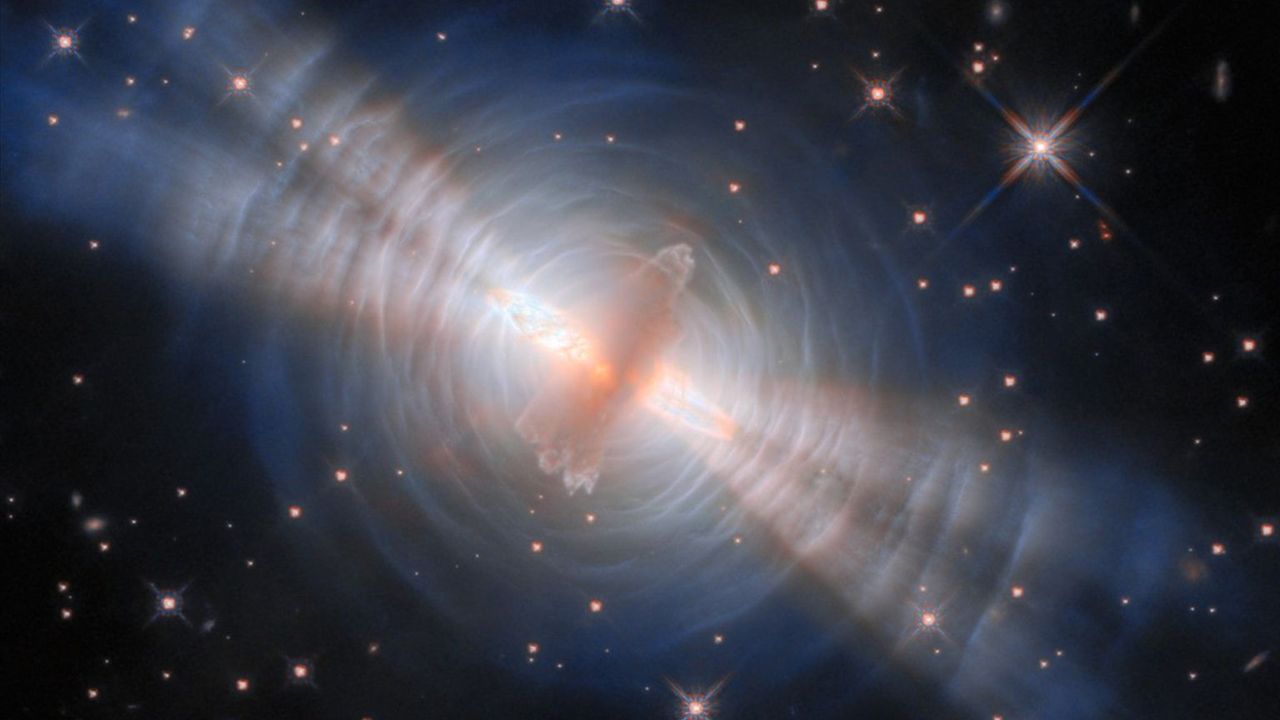
A photograph of the Egg Nebula, a pre-planetary nebula, captured by he Hubble Space Telescope.

The Hubble Space Telescope may be more than 30 years old, but the orbiting telescope continues to outdo its old self. Case in point: the Hubble Space Telescope just captured its sharpest view yet of the Egg Nebula, a dying star located about 1,000 light-years away.

NASA shared the photo this week, showing the star surrounded by a freshly ejected cloud of stardust that is both artistic and scientific.

The Egg Nebula gets its name from the central star – which resembles a yolk – and its cloud of surrounding dust that looks like egg white. The star is highlighted both by rings of dust and two beams of light, creating an X shape.

(Image credit: NASA, ESA, Bruce Balick (UWashington))

While that light and dust creates an artistic shape, the image is also giving researchers clues to what’s happening to the pre-planetary nebula. The shape of the dust, NASA explains, hints at gravity from a hidden companion star (or perhaps stars plural) that are buried in the dust.

The Egg Nebula is not just in the pre-planetary stage – a transitional stage of gas and dust formed from a dying star – but is also the first, closest, and youngest of its kind. While the Hubble Space Telescope has photographed the Egg Nebula before, the latest photo uses data from a 2012 image from Hubble’s Wide Field Camera to get an even clearer image.

“The symmetrical patterns captured by Hubble are too orderly to result from a violent explosion like a supernova,” NASA writes. “Instead, the arcs, lobes, and central dust cloud likely stem from a coordinated series of poorly understood sputtering events in the carbon-enriched core of the dying star.

“Aged stars like these forged and released the dust that eventually seeded future star systems, such as our own solar system, which coalesced into Earth and other rocky planets 4.5 billion years ago.”

The latest image, captured by Hubble’s Wide Field Camera 3, shows both science and art in its structure.

You may also like

Browse the best cameras for astrophotography or the best astrophotography lenses.

Sign up to read this article
Read news from 100’s of titles, curated specifically for you.
Already a member? Sign in here
Related Stories
Top stories on inkl right now
One subscription that gives you access to news from hundreds of sites
Already a member? Sign in here
Our Picks
Fourteen days free
Download the app
One app. One membership.
100+ trusted global sources.