
Get all your news in one place.
100’s of premium titles.
One app.
Start reading
Space
Space
Science
Kenna Hughes-Castleberry

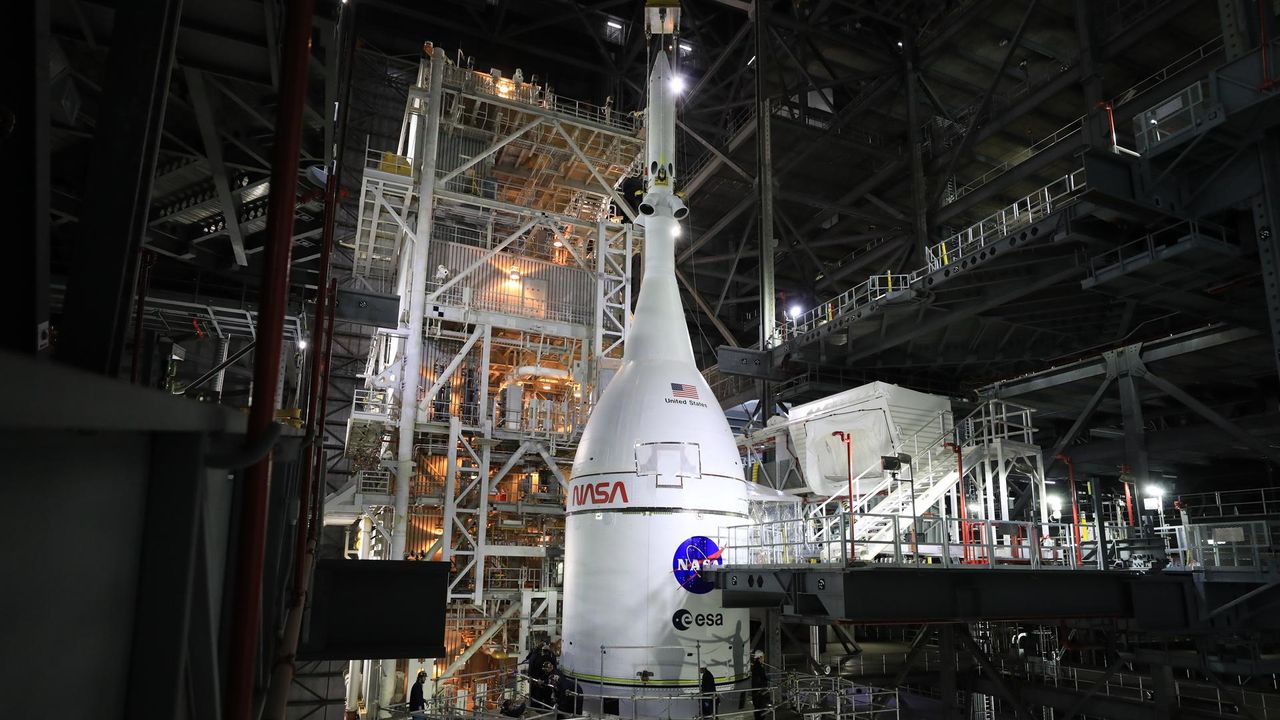
NASA’s Artemis 2 moon rocket comes together | Space photo of the day for Nov. 21, 2025

A white pointed rocket module sits on top of a white cylinder, both having the red worm NASA logo and the blue and red meatball NASA logo. The entire system sits in a large warehouse.

NASA has reached one of its key steps on the road to returning humans to the moon, as NASA's Exploration Ground Systems team successfully lifted and integrated the Orion spacecraft atop the Space Launch System (SLS) rocket. The operation marks a major step toward the Artemis 2 mission, which is set to send astronauts around the moon in early 2026.

What is it?

Artemis 2 represents the first time humans will travel to the moon since the Apollo 17 mission in 1972. While it will not involve a lunar landing, Artemis 2 is critical for validating the performance of the SLS rocket, Orion spacecraft, life-support systems, and deep-space operational procedures with astronauts onboard. The spacecraft will carry NASA astronauts Reid Wiseman, Victor Glover and Christina Koch, along with Canadian Space Agency astronaut Jeremy Hansen, on what will be the first crewed mission of the Artemis program.

The mission will follow a hybrid free-return trajectory, allowing Orion to loop around the moon and head back toward Earth using gravitational forces, an important safety feature for early crewed missions. Throughout the roughly 10-day journey, the crew will conduct evaluations of life-support performance, spacecraft maneuvering, communication systems and other mission-critical functions needed for future lunar landings.

Where is it?

This image was taken at High Bay 3 of the Vehicle Assembly Building (VAB) at NASA's Kennedy Space Center in Florida.

Artemis 2 will be the first crewed mission to the moon since Apollo 17 in 1972. (Image credit: NASA/Kim Shiflett)

Why is it amazing?

During Artemis 2, Orion will serve as both transport and habitat for the four-person crew. The spacecraft includes advanced guidance and navigation systems, radiation protection features, state-of-the-art avionics and life-support technologies capable of sustaining astronauts through deep-space conditions. Its heat shield—the largest ever built for a human spacecraft — will protect the crew during reentry at nearly 25,000 mph (40,000 kph).

Artemis 2 is a foundational step toward establishing a sustained human presence on and around the moon. Its success will support future construction of the Gateway lunar orbiting platform, development of lunar surface infrastructure and preparation for eventual crewed missions to Mars, according to NASA.

Want to learn more?

You can learn more about NASA's Artemis program and the Orion spacecraft.

Sign up to read this article
Read news from 100’s of titles, curated specifically for you.
Already a member? Sign in here
Related Stories
Top stories on inkl right now
One subscription that gives you access to news from hundreds of sites
Already a member? Sign in here
Our Picks
Fourteen days free
Download the app
One app. One membership.
100+ trusted global sources.






