Get all your news in one place.
100’s of premium titles.
One app.
Start reading
Space
Space
Science
Josh Dinner

NASA may be 1 month away from historic Artemis 2 astronaut launch around the moon

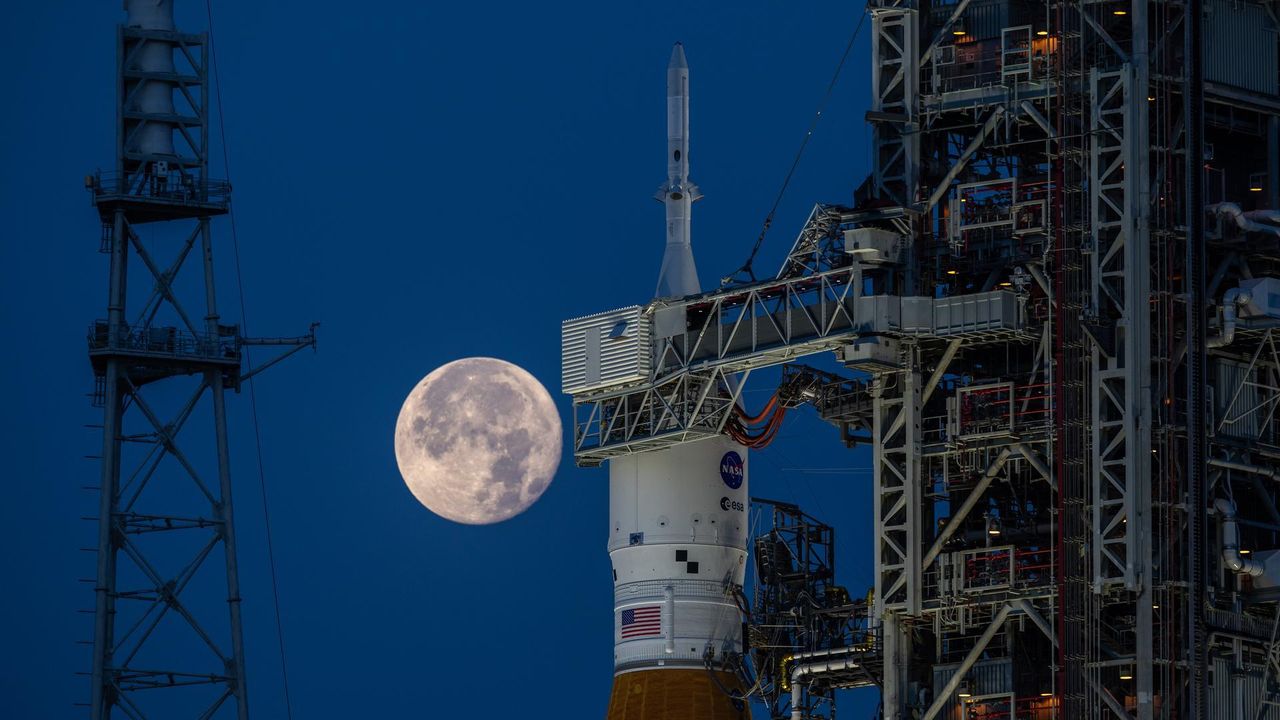
The full moon hangs in frame with the orion, inside its payload shell atop the SLS rocket.

We're at T-1 month to liftoff of NASA's next astronaut mission to the moon, if current schedules hold.

Artemis 2, the first crewed mission of NASA's Artemis program, could launch as soon as Feb. 6. The mission will fly NASA astronauts Reid Wiseman, Victor Glover and Christina Koch and Canadian Space Agency astronaut Jeremy Hansen on the first trip to lunar space in more than half a century, and will pave the way for what NASA intends to be an eventual permanent human presence on the moon.

The astro-quartet has spent the last few years training for their mission and completed several launch day dress rehearsals in recent months at NASA's Kennedy Space Center (KSC) in Florida. When the big day arrives, they will board the Orion spacecraft atop NASA's massive Space Launch System (SLS) rocket and lift off on a 10-day mission to fly around the moon and back.

If all goes according to plan, their launch will place Orion in Earth orbit, where the crew will complete a series of systems checkouts on their spacecraft before committing to burn for the moon.

A translunar injection (TLI) burn of SLS's upper stage will place Orion on a free-return trajectory — a figure-eight loop around the moon that slingshots the capsule back to Earth without the need for another burn of its engines.

The trajectory doesn't insert Orion into lunar orbit, but it ensures the spacecraft and crew's return to Earth regardless of any anomalies they might encounter after TLI.

Artemis 2 will be the first mission to send humans to the moon since the end of NASA's Apollo program and the departure of the Apollo 17 astronauts from the moon in 1972, and has been nearly two decades in the making. SLS, Orion and the space agency's plans to reboot its lunar program have had an evolving architecture at the cost of nearly $50 billion since 2006, with a roughly $4 billion-per-launch price tag at the moment.

Artemis 1 launched in November 2022, successfully sending an uncrewed Orion capsule to and from lunar orbit. Designed as a spacecraft systems shakedown, NASA had hoped Artemis 1 would put the program on a quick path to Artemis 2 and returning astronauts to the moon. Artemis 2's original 2023 launch target, however, was delayed by damage to Orion's heatshield caused during Artemis 1's reentry through Earth's atmosphere.

Having devised a fix to prevent that kind of damage from occurring again, NASA hopes the upcoming launch of Artemis 2 will put the program back on track. But complications with Artemis 3's infrastructure may throw another wrench into their timeline.

Just as Artemis 1 was designed as an uncrewed shakedown of Orion during an extended spaceflight, Artemis 2 is a test flight to confirm that the spacecraft can sustain a crew in deep space. Artemis 3 will put astronauts on the lunar surface. To do so, NASA has contracted SpaceX's Starship as the Artemis program's first Human Landing Services (HLS) vehicle.

Artist's illustration of SpaceX's Starship vehicle on the moon during an Artemis astronaut mission for NASA. (Image credit: SpaceX)

NASA is targeting 2027 for the launch of Artemis 3, but delays in Starship's development may push that mission to 2028. To avoid this, former NASA Acting Administrator Sean Duffy announced in October that he was considering reopening the HLS contract to alternative landers that could be made ready at an earlier date.

For now, however, NASA is focused on getting Artemis 2 out the door and into space in a safe and timely manner. The full stack of the SLS rocket and Orion was completed inside the Vehicle Assembly Building at KSC in October and is currently awaiting rollout to the pad at Launch Complex-39A, which is expected to happen in just a handful of days.

"Artemis 2 continues to make steady progress, with rollout now less than two weeks away," NASA Press Secretary Bethany Stevens said in a video posted on X on Jan. 2.

Once transported to LC-39A, SLS will undergo final systems checks and pad integration and complete a wet dress rehearsal to fuel and run the rocket through countdown procedures. The mission's launch window opens on Feb. 6, but NASA has yet to announce that as the official target date.

"I want more data to ensure we set proper expectations," said newly confirmed NASA Administrator Jared Isaacman in a Jan. 4 post on X. "We will be very transparent about technical readiness and timelines after rollout," he added in another post that same day.

Sign up to read this article
Read news from 100’s of titles, curated specifically for you.
Already a member? Sign in here
Related Stories
Top stories on inkl right now
One subscription that gives you access to news from hundreds of sites
Already a member? Sign in here
Our Picks
Fourteen days free
Download the app
One app. One membership.
100+ trusted global sources.