
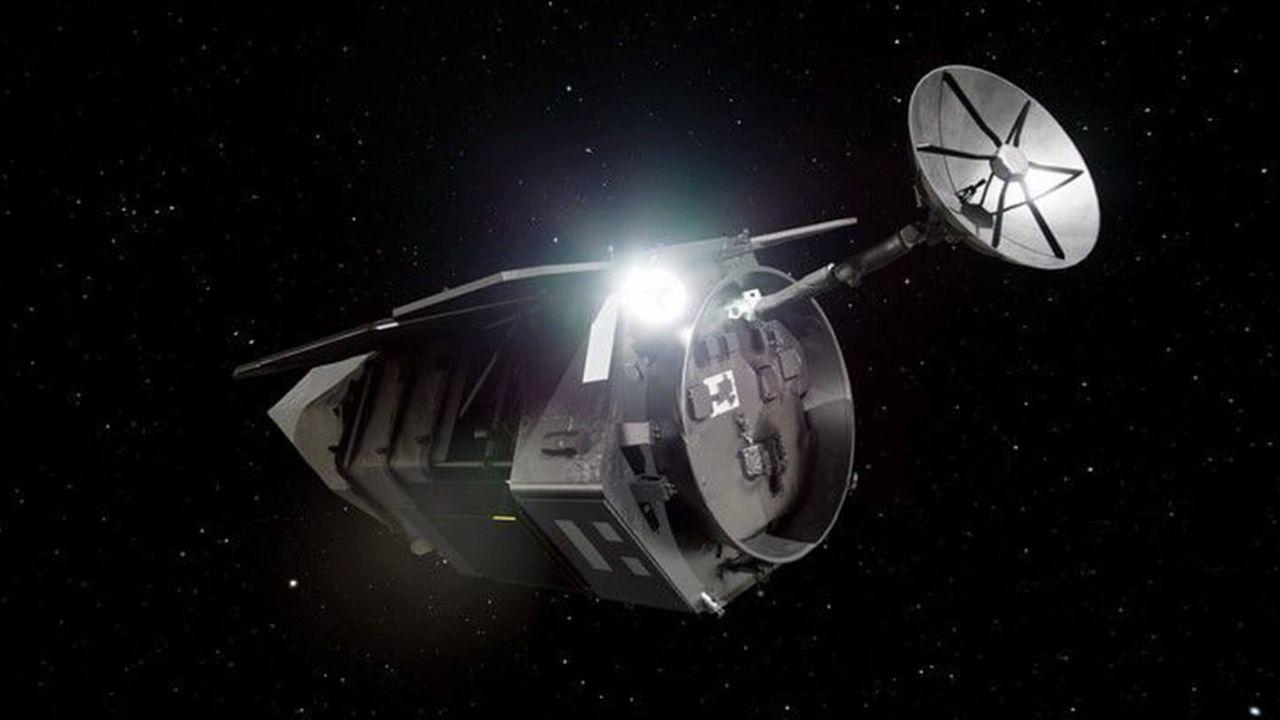
NASA has launched the Nancy Grace Roman Space Telescope (Roman), the latest of its galactic imaging devices, which will help astronomers unravel the mysteries of dark energy, exoplanets and infrared astrophysics.
The telescope blasted off today, nine months earlier than initially planned, from the Kennedy Space Center, Florida, propelled by a SpaceX Falcon Heavy rocket.

According to NASA, it will now journey to the second Sun-Earth Lagrange point (L2), a point in space roughly one million miles from Earth, where it’ll settle into orbit and begin sending back data.
Roman is essentially NASA’s equivalent of a wide-angle lens, which the space agency says will capture “deep, panoramic views of the cosmos.”
Unlike the Hubble and James Webb (Webb) space telescopes, which act like telephoto lenses observing precise regions of distant space in high resolution, Roman will photograph vast swaths of the night sky using its Wide Field Instrument (WFI).
Roman’s WFI features a 288MP near-infrared camera with 18 detectors, which will capture a 0.8-by-0.4-degree field of view – or an image that, to the human eye, is roughly the same size as the Moon appears. That’s a field of view 50 times greater than Webb’s and 100 times greater than Hubble’s.
However, the three telescopes are designed to work as a team. According to NASA, as Roman surveys huge sections of space, primarily in near-infrared, it’ll guide Hubble and Webb toward specific targets for a closer look in ultraviolet and visible light, and mid-infrared light, respectively.
Roman’s primary mission is set to last five years, but the telescope carries enough hydrazine fuel to extend this to ten. NASA says that fuel is the “life-limiting resource” and, once exhausted, the spacecraft can no longer maintain its precise orbit or point correctly – which will end the mission.
The space agency has also said that Roman is designed to be refuelable, but that it does not currently have a way of servicing observatories located as far away from Earth as L2.
Over its ten-year lifetime, Roman is expected to photograph and measure light from over one billion galaxies and map roughly twenty billion stars within the Milky Way. I can’t wait to see the galactic panoramas it’s set to produce!
You might also like…
Did you know that it would take Hubble a century to carry out some of the tasks Roman can? And here’s Jamie Carter, our expert astrophotographer’s, pick of the best cameras for astrophotography.






