Get all your news in one place.
100's of premium titles.
One app.
Start reading
Euronews
Euronews
Gavin Blackburn

NASA orders astronauts to take shelter after new leak aboard the International Space Station

Astronauts working on the International Space Station briefly sheltered in a docked capsule Friday as Russian colleagues assessed leak repairs, NASA said.

Five astronauts had briefly entered the docked Dragon spacecraft as a precautionary measure, the capsule functions as a lifeboat of sorts in the case an evacuation is needed.

NASA gave the all clear and the astronauts were able to return to their stations.

A NASA spokesperson told the AFP news agency that Roscosmos cosmonauts took measurements of the leaks and were now assessing data.

"With today's operations, they wanted to be extra safe, extra precautionary, and have the crew move into the safe haven posture," the spokesperson said.

NASA spokesperson Bethany Stevens then said on social media that "NASA has instructed the crew members inside the Dragon spacecraft to end the safe haven procedures and return to planned operations aboard the International Space Station."

In a statement cited by Russian state media, Russia's Roscosmos space agency said that while pressurising the transfer chamber, known as PrK, a leak was recorded.

"During an inspection of the PrK, the cosmonauts discovered two potential air leak sites. The first was promptly sealed by applying the first layer of the two-component sealant 'Germetall‑1.' The second site is located on the conical part of the PrK. Work is underway to prepare for its sealing," read the statement.

Stevens had previously said the transfer tunnel had suffered cracks and leaks for some time.

"NASA and Roscosmos have been working to determine the root cause of the cracks, and Roscosmos manages the issue through operational mitigation measures and periodic partial-repair efforts," she said.

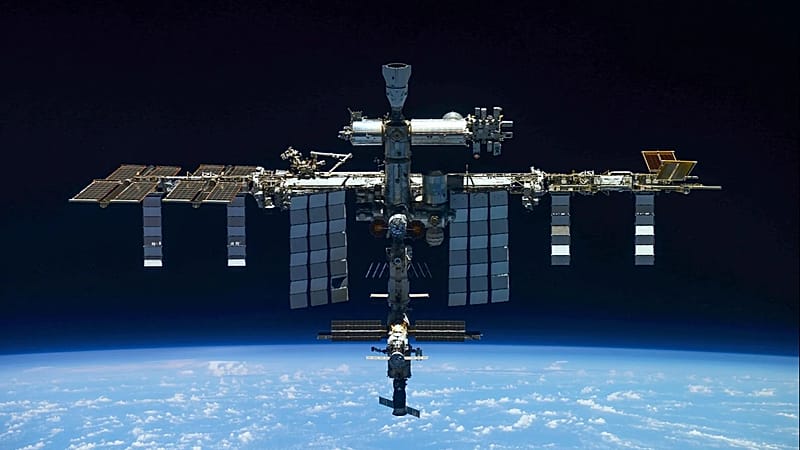
A SpaceX Dragon capsule approaches the International Space Station for docking, 14 February, 2026 (A SpaceX Dragon capsule approaches the International Space Station for docking, 14 February, 2026)

NASA and Russia's Roscosmos are two primary operators of the International Space Station.

Continuously inhabited for the last quarter-century, the aging ISS is scheduled to be pushed into Earth's orbit before crashing into an isolated spot in the Pacific Ocean in 2030.

The ISS, once a symbol of warming post-Cold War relations, has been a rare area of continued cooperation between the West and Russia since Moscow invaded Ukraine in 2022.

This text was translated with the help of artificial intelligence. Report a problem : [feedback-articles-en@euronews.com].

Sign up to read this article
Read news from 100's of titles, curated specifically for you.
Already a member? Sign in here
Related Stories
Top stories on inkl right now
One subscription that gives you access to news from hundreds of sites
Already a member? Sign in here
Our Picks
Fourteen days free
Download the app
One app. One membership.
100+ trusted global sources.